As tensions rise in Qatar, Saudi Arabia, Bahrain, Kuwait, the United Arab Emirates (UAE), and Oman, Nepal's tourism, remittances, trade, and foreign employment are seen to be directly impacted.
We use Google Cloud Translation Services. Google requires we provide the following disclaimer relating to use of this service:
This service may contain translations powered by Google. Google disclaims all warranties related to the translations, expressed or implied, including any warranties of accuracy, reliability, and any implied warranties of merchantability, fitness for a particular purpose, and noninfringement.
The ongoing war in West Asia is likely to affect Nepal's economy as the overall security situation there is disrupted. As tensions rise in Qatar, Saudi Arabia, Bahrain, Kuwait, the United Arab Emirates (UAE) and Oman, it is seen that Nepal's tourism, remittances, trade and foreign employment will be directly affected.
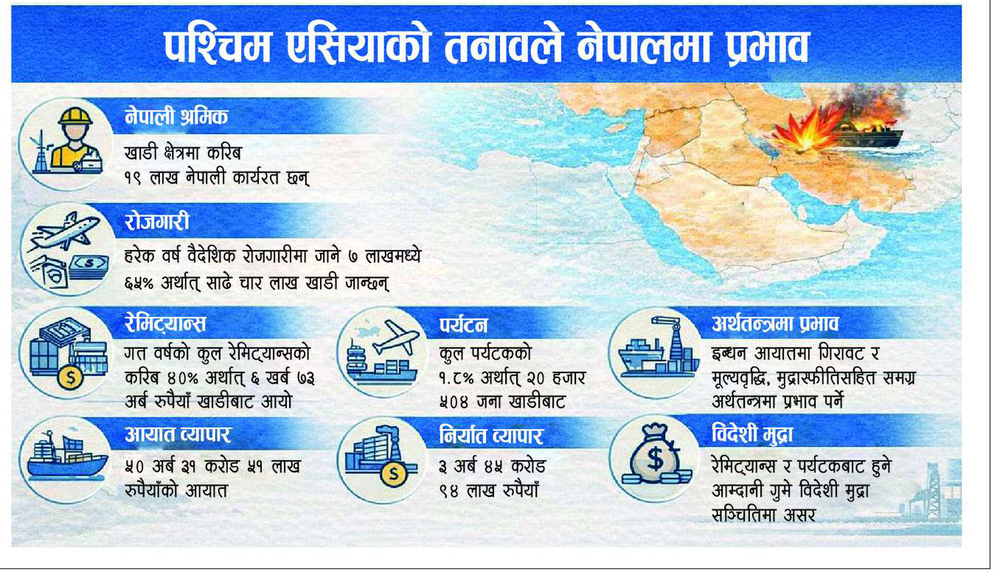
Air services via the Gulf countries have been affected. Currently, there are about 1.9 million Nepali workers in the Gulf region. Of the 700,000 Nepalis who go abroad for employment every year, about 65 percent, or 450,000, go to the Gulf countries alone. After the US and Israel attacked Iran, Iran has been retaliating by attacking American military camps in the Gulf countries. Which has created a tense atmosphere there.
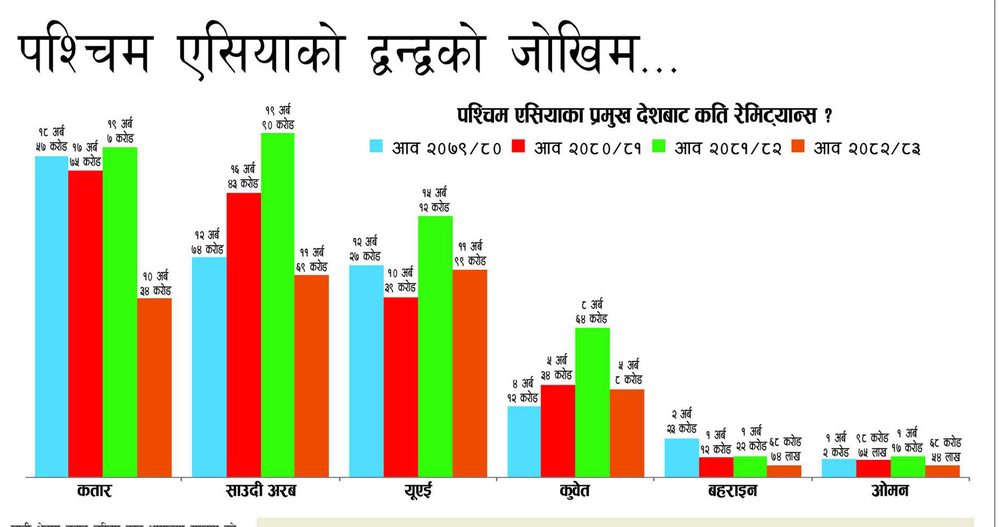
Experts estimate that the overall economy of Nepal will be affected, especially since fuel imports will decline and prices will increase. About 41 percent of the total remittances entering Nepal come from the Gulf region. In the first 6 months of the current fiscal year, remittances worth Rs 1030 billion have been received, of which remittances from the Gulf countries are Rs 422 billion. In the fiscal year 2081/82, 1.7 trillion 2 billion remittances were received. The contribution of the Gulf countries was 673 billion.
Tourists from the Gulf region have been coming to Nepal, albeit in small numbers. According to the Tourism Board, 20,504 tourists from the Gulf countries arrived in the last fiscal year. Compared to the previous year (16,648), more tourists came to Nepal from the Gulf countries last year. The number of tourists from the Gulf countries last fiscal year was 1.8 percent of Nepal's total tourists. Last fiscal year, 1,158,459 tourists entered Nepal.
If tensions persist in the West Asian region, Nepal's foreign exchange earnings will be affected. Imports of gold, silver and their jewelry, copper wire, plastic, packaging and pipe industries, which are considered essential for Nepalese consumers, will also be affected.
Experts estimate that Nepal's overall economy will be affected, especially as fuel imports will decline and prices will rise. After the attack on the main petroleum mines in the Gulf region, crude oil prices have increased in the world market since Sunday, and employment there has also been affected. In recent years, Nepal has had only modest economic growth and is more dependent on imports. Experts say that if tensions in the Gulf region continue, there will be problems in importing goods and imports will become more expensive, which will lead to an increase in inflation in the country.
'There is a risk that the country's foreign exchange reserves will be under pressure as transportation and insurance costs will increase when imports become more expensive,' says business expert Ravi Shankar Sainju. 'If tensions continue, on the one hand, workers will have to be rescued, and on the other hand, there is a possibility that workers going abroad will be stopped. This will affect remittances.'
Since the war has affected the trade activities of many countries in West Asia, it will have an impact on Nepal's remittances, trade and labor market, says Ram Sharan Kharel, head of the Economic Research Department of the Nepal Rastra Bank. ‘Out of the total remittances, about 40 percent of remittances come to Nepal from about 15 countries in West Asia. There is a possibility that the war will have a direct impact on it,’ he says, ‘There is a high risk of trade through the Gulf countries being affected.’
Kharel says that there will be no environment for more Nepalis to go abroad for employment after the economy of the Gulf countries has been disrupted. ‘The government has banned travel to those areas, so Nepal’s employment has started to be affected.’
Business expert Sanju says that the government should make a safety and rescue plan for labor destinations as Nepal's foreign employment is likely to be affected due to the ongoing tensions in West Asia. Chandra Tandon, former president of the Nepal Remitters Association, also says that Nepali workers have been affected due to the unrest in the Gulf and that it will definitely have a direct impact on remittances. ‘I spoke to our employees in four countries, Dubai, Qatar, Saudi Arabia and Kuwait, about the situation there today (Monday). They informed me that the situation is difficult,’ he said, ‘Many money changer companies in Qatar were closed on Sunday and Monday. Even if they opened sporadically, there was no work.’
Gulf countries are the main labor destinations for Nepalis. There are 900,000 Nepali workers in the United Arab Emirates (UAE), 384,000 in Saudi Arabia, 360,000 in Qatar, 175,000 in Kuwait, 30,000 in Bahrain, and 25,000 in Oman. In the past, about 80 percent of those who went for foreign employment went to Gulf countries. The number of Nepalis going to other countries has increased in recent years.
Now, the number of Nepalis going to Qatar in particular was going to increase further. Qatar is hosting the Asian Games in 2030. For that, major sports infrastructure is being built. Qatar had earlier hosted the 2022 World Cup. According to the Department of Foreign Employment, 100,000 (new and old) workers from Nepal went to Qatar annually until 2022 to build infrastructure including stadiums for the World Cup.
After 2022, the number of workers going to Qatar from Nepal decreased slightly for a year or two. But since then, more than 100,000 workers have been going to Qatar annually. According to the department's data, 140,000 Nepalis went to Qatar in the fiscal year 2081/82 and 134,000 in the fiscal year 2080/81. The number of Nepali workers in Qatar had reached 400,000. Even now, 357,000 Nepalis are working there. This shows stability in Qatar's employment.
Business expert Sainju says that the government should make a security and rescue plan for labor destinations as Nepal's foreign employment is likely to be affected due to the ongoing tensions in West Asia. 'The embassies of the relevant countries should be kept on high alert for the safety of about 2 million Nepalis in the Gulf. If necessary, they should be rescued immediately through chartered flights,' he says.
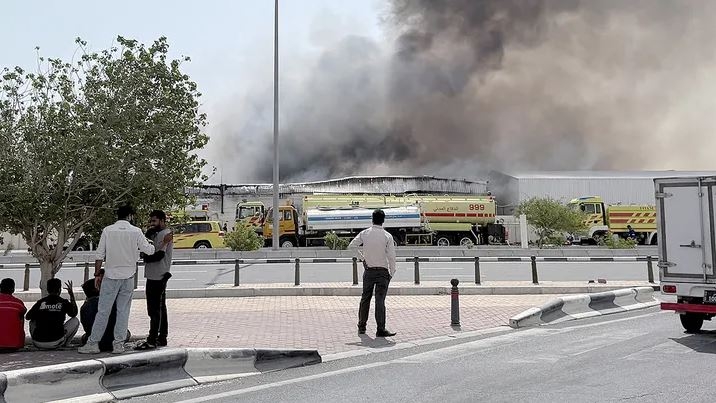
Employment expert Yubaraj Basnet says that it is too early to estimate the impact on the labor market in the Gulf region. 'The current war does not seem to be targeted at Gulf countries. It is focused on American military camps,' he says, 'how long the war drags on will determine the future of our main destination.'
International media outlet Reuters has reported that oil prices will reach $100 per barrel. On Monday, crude oil prices rose by 10 percent to $82 per barrel, the highest since 2025. On Tuesday, it is trading around $82 per barrel. As oil prices are expected to rise to $100 per barrel, fuel prices will have an impact on transportation costs and production costs in Nepal, says economist Keshav Acharya. He says that import prices, transportation costs, production costs and even inflation will increase in the coming days.
Currently, Nepal imports petroleum products only from India. Indian Oil Corporation (IOC) imports fuel from Gulf countries. Nepal has been signing agreements with IOC every five years for oil imports. India will provide Nepal with the fuel brought from the Gulf.
The Strait of Hormuz is a waterway between Iran and Oman. It connects the Gulf to the Arabian Sea. Tankers carrying 20 percent of the world's total oil consumption also use this route, along with cargo from producers including Saudi Arabia, Iraq, Iran, the UAE, Kuwait, and Qatar. "With the attacks on petroleum products in various countries including Iran, the price of crude oil has already increased in the world market on Monday. Since petroleum products are completely imported, Nepal may also be affected," said Ram Sharan Kharel, Head of the Economic Research Department of the Nepal Rastra Bank.
The US-Israeli war against Iran, a member of OPEC Plus (the Group of Oil Exporting Countries and its allies), and Tehran's retaliation have disrupted oil transportation in West Asia. The OPEC Plus meeting on Sunday discussed options to increase crude oil production from 137,000 barrels to 548,000 barrels per day. After the discussions, it was agreed to increase oil production by 26,000 barrels per day from next April. Production growth has been halted from January to March 2026 due to seasonal weakness.
India is looking for alternative routes for fuel transportation. Lines have been seen at petrol pumps in Nepal since Sunday, citing a shortage of petroleum products. However, Nepal Oil Corporation has been saying that there will be no immediate price hike and there will be no shortage.
The ongoing war is also directly affecting supplies to West Asia. In the seven months of the current fiscal year, Nepal has imported Rs 48.76 billion from the Gulf countries. Petroleum products are being imported regularly through pipelines and sufficient quantities of petroleum products will continue to be imported in the upcoming elections, said the corporation's Managing Director Chandika Bhatta. 'Considering the risk of fire accidents that may occur due to unnecessary storage of petroleum products, it has been prohibited to fill petroleum products in jerry cans and drums,' he said. 'We urge consumers to help by purchasing petroleum products only in the required quantity to minimize the risk of accidents. Recently, the prices of gold, silver, gas and other items have also increased in the international market. Gold is being traded at $5,230.50 per ounce. The price of gold in Nepal is determined by looking at the international market price.
The ongoing war is also directly affecting supplies to West Asia. In the seven months of the current fiscal year, Nepal has imported Rs 48.76 billion from the Gulf countries. During the same period, exports amounted to Rs 1.64 billion. 16 million. Last year, imports from the Gulf countries amounted to Rs 50.31 billion and exports amounted to Rs 3.45 billion. 94 million, according to the Customs Department.
Nepal is not only a country that sends workers to the Gulf countries, but also depends on those countries for raw materials (plastic/metal), agriculture (manure) and construction materials (gypsum). Experts say that the current tension is a direct challenge to Nepal's industrial production and food security. According to the Customs Department, the highest imports of gold, silver and their jewelry and copper wire came from the UAE. In the first seven months of the current fiscal year, gold, silver and copper wire worth Rs 37.6 billion have been imported from the UAE. Including other goods, Rs 41 billion have been imported from the UAE in the first seven months.
Although gold and silver were brought from the UAE by air, it is currently stopped. Since the remaining goods come through the ‘Strait of Hormuz’ waterway, Nepal’s gold and silver business and electrical manufacturing sector may be stopped, says former joint secretary to the government Ravi Shankar Sainju.
Raw materials essential for plastic, packaging and pipe industries are imported from Saudi Arabia. Mainly polymers (polythene and polypropylene) are imported, according to the department. Goods worth Rs 3.72 billion 29 million have been imported from Saudi Arabia in the first seven months.
Chemical fertilizers, gold ornaments, televisions, etc. are imported from Qatar. In the first seven months of the current fiscal year alone, Nepal has imported chemical fertilizers worth more than Rs 2.5 billion from Qatar. According to the department, goods worth Rs 3.34 billion have been imported from Qatar in the last 7 months.
The highest import from Oman is gypsum, which is required for the cement industry. There is a customs data of Rs 32.08 billion for gypsum alone. It is seen that heavy equipment (bulldozers, etc.) is traded in Oman.
Except for gold and silver coming from the Gulf region, all materials are interrelated with industrial production and economy. This is sure to have an impact on production here. According to Sainju, if the supply of plastic raw materials from Saudi Arabia and copper from the UAE is stopped, there may be a shortage of raw materials in Nepal's plastic pipe, bucket, packaging and electrical wire manufacturing industries. In addition, production costs may increase significantly.
मुख्य कुरा पश्चिम एसियामा द्वन्द्व कहिलेसम्म लम्बिन्छ र त्यसले त्यहाँको अर्थतन्त्र कति खलबलिन्छ, त्यसका आधारमा नेपालमा पर्ने असर अनुमान गर्न सकिने अग्रवाल बताउँछन् । If the supply of chemical fertilizers from Qatar is disrupted, there will be a shortage of fertilizers during the main farming season, adding to the challenge to Nepal's food security, says Sainju. ‘नेपाली उद्यमीका लागि खाडी मुलुक उदाउँदो बजार रहेकाले क्षेत्रीय युद्ध भए चिया बगान, गलैँचा कारखाना र चाउचाउ उद्योगमा आश्रित नेपालीको जीविकोपार्जनमा धक्का लाग्नेछ,’ उनी भन्छन् । उनका अनुसार साउदी अरबबाट ‘पोलिमर’ र कतारबाट ‘मल’ मा निर्भर रहेकाले तत्काल भारत, चीन वा दक्षिण–पूर्वी एसियाली देशबाट यी वस्तु आयात गर्ने वैकल्पिक बाटो खोज्नुपर्ने अवस्था आएको छ ।
पश्चिम एसियामा भएको युद्धको असरले नेपाली अर्थतन्त्र प्रत्यक्ष प्रभावित हुने नेपाल चेम्बर अफ कमर्सका अध्यक्ष कमलेशकुमार अग्रवाल बताउँछन् । ‘अहिले नेपाल पनि विश्व अर्थतन्त्रको सञ्जालबाट टाढिन सक्ने अवस्था छैन, यसकारण त्यहाँ भएको आर्थिक उचारचढावको प्रत्यक्ष प्रभाव हाम्रोमा पनि पर्छ,’ उनी भन्छन्, ‘अल्पकालका लागि रेमिट्यान्स घट्न सक्छ । तर, केही समयपछि यो अवस्थामा सुधार आउँछ किनकि त्यहाँ पुनर्निर्माण सुरु भएपछि कामदारको माग बढ्छ ।’
मुख्य कुरा पश्चिम एसियामा द्वन्द्व कहिलेसम्म लम्बिन्छ र त्यसले त्यहाँको अर्थतन्त्र कति खलबलिन्छ, त्यसका आधारमा नेपालमा पर्ने असर अनुमान गर्न सकिने अग्रवाल बताउँछन् । ‘तत्काल सुन–चाँदी, तेललगायतको मूल्य बढिसकेको छ । त्यसको असर हाम्रो बजारमा पनि देखिन थालेको छ,’ उनी भन्छन्, ‘नेपालको पर्यटनमा पनि प्रभाव पर्छ । सबैभन्दा ठूलो असर नेपालको आपूर्ति प्रणालीमा पर्छ ।’ अग्रवालका अनुसार खाडी मुलुकमा भएको तनावले भारतीय अर्थतन्त्र जति प्रभावित हुन्छ, त्यसको प्रत्यक्ष असर नेपालमा पर्छ । ‘किनकि भारुसँग नेपाली मुद्राको विनिमयदर स्थिर छ,’ उनी भन्छन्, ‘तर, नेपाली अर्थतन्त्रमा के कति प्रभाव पार्छ भन्ने आकलन अहिल्यै गर्न गाह्रो छ ।’
निर्यातको परिमाण सानो भए पनि केही नेपाली उत्पादनका लागि खाडी मुलुकहरू महत्त्वपूर्ण बजार रहेको जानकारहरू बताउँछन् । कतार, कुवेत र बहराइनमा ठूलो मात्रामा पास्ता, नुडल्स र स्न्याक्स (कुर्कुरे/लेज) निर्यात भइरहेको भन्सार विभागको तथ्यांक छ । नेपालले खाडी मुलुकमा सेफ्टी रेजर ब्लेड, एक्स्काभेटर, गलैंचा र चियालगायत वस्तु निर्यात गर्दै आएको छ ।
साउदीमा हेभी इक्विपमेन्ट (बुलडोजर, एक्स्काभेटर, लोडर आदि), गलैंचा, जर्दा/खैनीलगायत वस्तु निर्यात हुन्छ । यसबाट नगण्य मात्रामा भए पनि विदेशी मुद्रा आर्जनमा सहयोग पुगेको छ । युद्ध जारी रहे नेपालको बामे सर्दै गरेको निर्यात बजारमा समेत थप संकुचन आउने निश्चित छ ।

