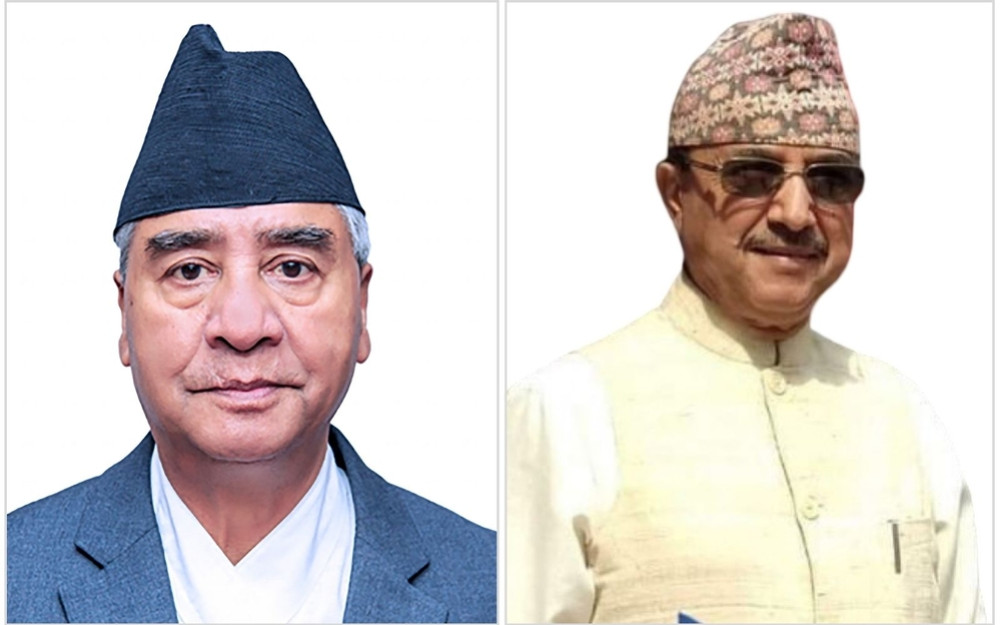
Deuba is active in continuing his previous collaboration with the UML. Similarly, he has also been participating in discussions on national politics.
We use Google Cloud Translation Services. Google requires we provide the following disclaimer relating to use of this service:
This service may contain translations powered by Google. Google disclaims all warranties related to the translations, expressed or implied, including any warranties of accuracy, reliability, and any implied warranties of merchantability, fitness for a particular purpose, and noninfringement.
Nepali Congress President Sher Bahadur Deuba, who garnered sympathy from cadres by appointing Deputy President Purna Bahadur Khadka as acting president, has once again become active at the center of national and party politics. While Deuba has been active, Khadka has been seen as limited to the role of chairing party meetings.
Despite not attending the Sanepa meeting, Deuba is running the party from his residence, which has angered General Secretary Gagan Thapa, who is dissatisfied with this, saying that he is exercising power himself by appointing a nominal acting president. “The president has not come to the meeting, but power is being exercised from his residence,” Thapa had told reporters after the Central Working Committee meeting ended last Wednesday.
In the first meeting of the Central Working Committee held on 28 Asho after the Gen-G movement, Deuba handed over the acting presidency to Vice President Khadka and gave the message that he had taken leave from active politics. After that, a debate began within the party regarding the new leadership. Before leaving for Singapore for treatment, Deuba had also indicated that he would not be a candidate in the upcoming elections.
After receiving that signal, central member Nainsingh Mahar, who is also the former president of the Nepali Congress, reached Dadeldhura with the message that he would contest the elections in Deuba’s place. This was considered to be the beginning of the process of leadership transfer in the Congress. But after returning from Singapore, Deuba has become active in exercising power again. From the party's daily decisions to strategic discussions, Deuba's activity has increased.
This is raising questions about the appropriateness of the caretaker post, while a power struggle has flared up within the party over the issue of leadership change. Deuba had increased his activity from Singapore after the issue of leadership change, which had been raised in the Congress Central Working Committee since October 28, was not resolved. While in Singapore, he had started a dialogue with UML Chairman KP Sharma Oli, and had increased coordination with disgruntled groups within the party and the initiative in the strategy for the upcoming elections. After returning from Singapore, he has been active in continuous meetings, meetings and strategic discussions.
Arun Kumar Subedi, an expert analyst on geopolitical affairs, says that the Congress, which made a big mistake by not leaving the government immediately after the incident of August 23, is trying to make another mistake by not carrying the message of change. "If the Congress does not change the leadership by holding a general convention on time and carry forward the message of reforming the economy and foreign policy that failed in the past, the Congress will face a big disaster," he said. "If the leadership that continues the failed foreign policy of the past created by communist obsession and collaboration remains, the Congress will exit the international democratic ranks and an alternative democratic force seems to take that place." He said that efforts are currently being made for that. He commented that the alternative force that is currently being built has the potential to be a clear alternative for Nepal's pro-democratic public opinion and anti-communist public opinion.
"Whether it is a regular or special general convention of the Congress, if the leadership is not changed immediately, this polarization seems to increase further. The possibility of losing with the communists and the leadership of the anti-communist pole going to someone else is increasing," he said. "If we can change the leadership and improve ourselves, there is still some room for hope. However, there is not much time for that now."
Former ambassador and Congress leader Deep Kumar Upadhyay says that the reason behind the Congress leadership's unwillingness to hold a general convention before the elections is the distribution of tickets for immediate interests. He says that Deuba's desire to remain at the center of power politics, even though he is not in the party leadership, is working.
'The leaders were worried about where the elections will be, who will win or not, what will be the size of the party in parliament tomorrow, and whether or not they will gain power. But this worry seems to be motivated by the aim of keeping the party in their hands,' Upadhyay said, 'No matter what KP Sharma Oli is like, he got himself approved by the general convention, but why don't Congress leaders check their legitimacy before going to the people? Neither acting President Purnaji could dare to do this, nor could the President show seriousness.'
Analyst Geja Sharma Wagle says that President Deuba is currently dominating the decision-making by prioritizing his own interests over the interests of the party. "On the one hand, the general convention will not be held at the scheduled time, and on the other hand, even though he was given the responsibility of the acting president, he has started dominating the party's decisions, which has created further controversy and crisis in the Congress," he said.
Deuba has been active in continuing the previous cooperation with the UML. On the other hand,
he has also participated in discussions on national politics. Deuba himself attended the meeting of the top leaders of the three parties called by President Ram Chandra Poudel on 9 Poush and Prime Minister Sushila Karki on 12 Poush, without sending the acting president. Deuba dominated the meeting called by Prime Minister Karki on Saturday. When Oli tried to speak on the agenda of the restoration of the House of Representatives, Deuba had stopped him several times. According to political experts, there is pressure within the party and even geopolitical pressure on Deuba not to bring up the agenda of the restoration of the House of Representatives. That is why Deuba's close leaders believe that he stopped Oli. Deuba, who always avoids the media, easily approached the media and made a message-oriented statement on Saturday. Deuba has not only tried to extend his term by postponing the general convention after the election, but has also made preparations to compete in parliamentary politics once more. He has already said that he will contest the election one last time with leaders close to him. After that, his name came up as a single recommendation from his home district, Dadeldhura.
After continuous dialogue with Oli, Deuba even had a writ filed in the House of Representatives. After the meeting between Deuba and Oli on 19 Mangs, eight members of the dissolved House of Representatives, including the then chief whip of the Nepali Congress parliamentary party, filed a writ petition in the Supreme Court demanding the restoration of the House of Representatives. After the meeting between the two leaders on 7 Poush, 57 more former Nepali Congress MPs submitted a supplementary petition with their signatures. This was done to create an atmosphere in favor of the restoration of the parliament by showing a majority in the court.
‘Continuing cooperation with the UML, giving instructions for the restoration of the House of Representatives and starting to make unilateral decisions in an underground manner, including an alliance with the UML in the upcoming National Assembly and House of Representatives elections, a serious question has arisen as to whether the central committee of the Congress will decide the policy or Deuba will decide,’ analyst Wagle says. ‘Deuba’s such tendency has seen the risk of completely destroying the remaining identity and reputation of the Congress.’
He said that Deuba is taking advantage of the fact that the acting president has not been able to play a decisive role. ‘The time has come for the general secretaries Gagan Thapa and Bishwaprakash Sharma to make a decisive and result-oriented struggle by proposing and taking the initiative to restructure, transform and purify the Congress. Otherwise, the crisis in the Congress is certain to deepen further,’ Wagle said. ‘This is the last chance for the two general secretaries.’
Central member Ramhari Khatiwada, who is close to acting president Khadka, says that the problem arose when some leaders within the party tried to use him for their own purposes to fail. "The acting president has been coordinating with both the general secretary and the president, starting with Shekhar Koirala, to reconcile the party. However, some leaders have been active in using him to disrupt reconciliation," Khatiwada said. "Problems within the party have increased as they try to make the acting president a failure."