A majority of the Central Working Committee could not call a special general convention. However, the chairman could not stop a gathering called by signatures. Deuba saw the risk of this leading to a split in the party.
We use Google Cloud Translation Services. Google requires we provide the following disclaimer relating to use of this service:
This service may contain translations powered by Google. Google disclaims all warranties related to the translations, expressed or implied, including any warranties of accuracy, reliability, and any implied warranties of merchantability, fitness for a particular purpose, and noninfringement.
Before the Gen-G movement, Congress President Sher Bahadur Deuba wanted to hold the general convention only around Mangsir 2083. His term was ending in Mangsir 2082. However, there is a provision in the constitution to extend it by one year. He wanted to extend it by one year using that facility.
The Congress, which is in power partnership with the UML, had an understanding to lead the government from Asad 083. The general secretaries did not oppose Deuba's desire to hold the general convention only after he became the Prime Minister. On the contrary, Congress leader Shekhar Koirala had been suggesting that the general convention should be held on a regular basis. General Secretary Gagan Thapa had admitted in the meeting that he had not played a decisive role in holding the general convention on a regular basis.
The mode that changed after the Gen-G movement
The discord within the Congress began after the Gen-G movement of Bhadra 23 and 24. The Gen-G movement not only broke the ruling alliance of the two parties, but also sent a message that the musical chair rule of UML Chairman KP Oli, Congress President Deuba and the then Maoist Chairman (now Nepali Communist Party) Pushpa Kamal Dahal should end. Congress General Secretaries Gagan Thapa and Bishwaprakash Sharma said that these three leaders should take a political break.
They started a campaign to change the leadership and policy by holding a general convention within the Congress before the elections announced on 21 Falgun. In the first phase, they suggested that Deuba be given an acting chairman. Deuba wanted to give an acting chairman immediately. Leaders close to him suggested that it would be better to go to the Central Working Committee and give it after his health condition improves. But they did not give an acting chairman immediately. There was suspicion about that. Then, the issue of a special general convention was raised and the signatures of the representatives began. The general secretaries themselves took the initiative in this.
The four-year term of the office bearers and members of the Central Working Committee, including Deuba, was ending in 082 Mangsir. The general secretaries took the stand that if the term could not be extended, a special general convention should be held. After the Gen-G movement, they demanded that a special or regular general convention should be held before the elections to change the party's policy and leadership. The signing of the special general convention was started to put pressure on the regular convention.
After the pressure from the general secretaries and the signing of the special general convention began, Deuba called a meeting of the central working committee on October 28. On the first day, Deuba reached the conclusion that he would personally attend and give an acting president but not resign. Giving an acting president without resigning meant that he could return at any time. However, he instructed to hold the general convention within the time specified in the statute, saying that he would not enter active politics while giving an acting president.
The four-year period specified in the statute was ending by mid-Mansir 2082. According to leaders close to Deuba, Deuba was in favor of bringing the Mansir agenda at that time. However, former office bearers of the establishment party, Krishna Prasad Sitaula, Prakash Man Singh, Shashank Koirala, Bimalendra Nidhi, Vijay Kumar Gachhadar and Prakasharan Mahat, did not want to hold a regular general convention in Mansir itself. Therefore, they did not allow the date to be brought. Even before the Gen-G movement, these seven office bearers had been increasing pressure on Deuba to choose a successor from among themselves at the 15th General Convention.
Deuba stopped chairing the meeting after Asoj 28 and the acting Purna Bahadur Khadka started. From the day he got the acting chairman, Khadka called a meeting of the establishment party's 'faction'. Deuba had stopped calling the meeting of the faction after becoming the president for the second time. That is why there was confusion within the establishment party about who would be Deuba's successor.
After getting the acting chairman, Khadka began to feel that Deuba's legacy was now mine. With that aim, he started repeating the meeting of the faction that had been stalled for four years. The views of the former office bearers dominated the meeting of that faction. They came to the conclusion that there would be no general convention before the elections. The establishment party agreed with the views of the seven former office bearers. The majority remained with the views they had taken.
A petition for a special general convention was registered at the party office on the second day of the meeting on Asoj 29, with the signatures of 54 percent of the delegates. There is a provision in the statute that a special general convention can be called with 40 percent signatures. If such a demand is made, the statute provides that a special general convention must be called within three months.
After the formal demand for a special general convention was made, a conflict of ideas began in the Central Working Committee meeting over whether to hold the general convention before the elections or after. A dispute flared up between the establishment and the general secretaries. Deuba, who had been silently observing the ongoing dispute in the Central Working Committee, flew to Singapore for a health check-up on Kartik 10, two weeks after the meeting began.
He returned on Kartik 28. However, the dispute within the Congress was still escalating. Leader Shekhar Koirala, who had advocated a regular general convention, said that he was not in favor of a special general convention. The establishment side has more than two-thirds of the number in the 165-member Central Working Committee meeting. Even then, since leader Shekhar did not support the General Secretary's agenda, there was no possibility of their agenda being passed in the Central Working Committee technically.
Deuba did not return from Singapore, and General Secretary Thapa wanted to present the agenda for the general convention by mid-Mansir in the meeting. However, the establishment party stopped him from formally moving forward with the proposal. After he could not take it to the Central Working Committee, he made it public. The meeting dragged on. Since it was not possible in Mansir, he tried again for the second time to bring another agenda for Poush 16-19. He did not get that either. One day, he boycotted the meeting. Finally, after not being able to bring a formal proposal, Thapa brought the regular general convention schedule for Poush 16-19 on Kartik 18. To thwart that, the former office bearers of the establishment party brought another counter proposal for Baisakh 27-29 through Joint General Secretary Mahendra Yadav. This further inflamed the dispute.
The middle-of-the-road proposal brought by Acting President Khadka and Central Member Ramesh Lekhak to resolve the dispute was not accepted by the seven former office bearers. However, initially 25 and later 29 members from the establishment side suggested to the leadership to bring the schedule saying that the general convention should be held before the election. The group led by former office bearers ignored the signature of the special general convention, the pressure of the general secretaries and the pressure of 29 central members from the establishment side. They did not waver from their stance.
And Deuba took a ‘U-turn’ to settle the dispute
According to the Congress leaders, the main interest behind the stance taken by the seven former office bearers was the distribution of tickets in the upcoming elections. They were worried that if the leadership of another party fell into the hands of Gagan Thapa, they might be ‘retired’ from politics. Although the reasons for affecting the election were shown externally, their internal interest was confirmed by the incident of registering the party with the Election Commission.
Last Sunday, the party was registered in the name of President Deuba so that tickets would be distributed with his signature. The law has made provision that any name among the central office bearers can be sent. After Deuba’s name and signature were removed, more controversy arose within the party. According to a leader from the establishment party, Deuba himself did not want to remain in active politics after the Genji incident. After returning from Singapore, the former seven office bearers were mainly trying to pull him into active politics.
However, Deuba came to the conclusion that the special general convention could not be postponed if it was not regularized before the election. After returning from Singapore, he met with almost all the leaders of his camp and other camps one-on-one and understood their feelings. The majority of the Central Working Committee could not have called a special general convention. However, the president could not stop the meeting called by signatures. Seeing the risk of this leading to a party split, Deuba made a 'U-turn'.
Leaders close to him say that Deuba was aware that the party should not split when he was the president, and on the other hand, the message that he had removed himself by holding a special general convention did not go around. To postpone the special general convention, he took the path of holding the general convention before the election. After about two weeks of understanding and analysis after returning from Singapore, he had instructed Acting President Khadka to bring the agenda by mid-December.
Sitaula and Nidhi were dissatisfied, saying that the leaders who played an important role in making the Prime Minister five times and the President of the Nepali Congress twice were being weakened. Deuba had also discussed with them on Monday morning. During that time, they also complained, saying, 'We helped make you the Prime Minister, but you are doing injustice to us.'
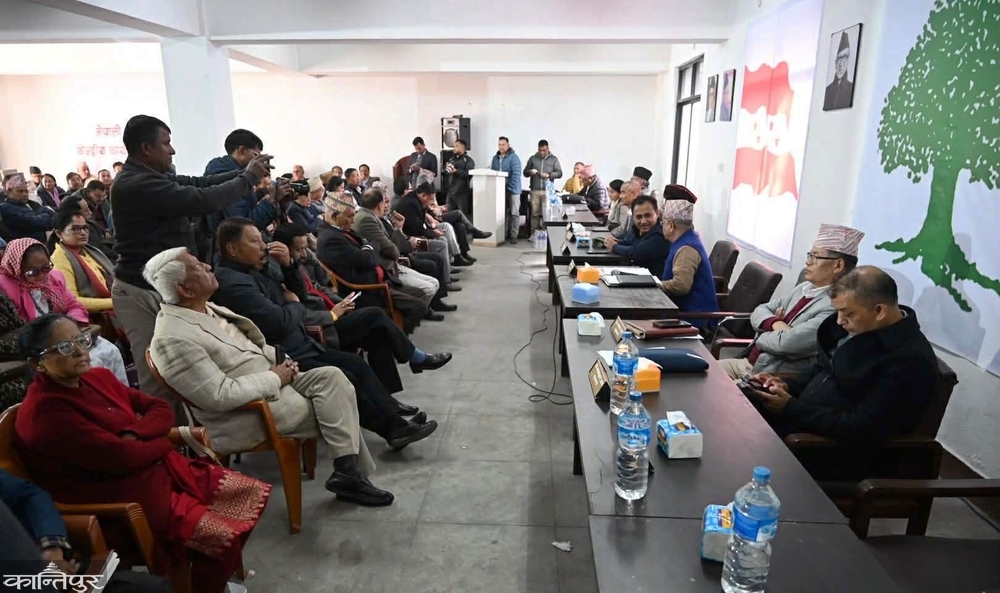
Finally, the proposed date and agenda of the general convention brought by Acting President Khadka in the central committee meeting on Monday have been unanimously passed. Khadka presented the schedule of active membership distribution, renewal and investigation, ward, municipality, House of Representatives constituency, provincial assembly constituency, district and provincial conventions. With the decision to hold the 15th General Convention in Kathmandu from December 26 to 28, the impasse in the Congress meeting that has been going on for one and a half months has found an immediate solution.


