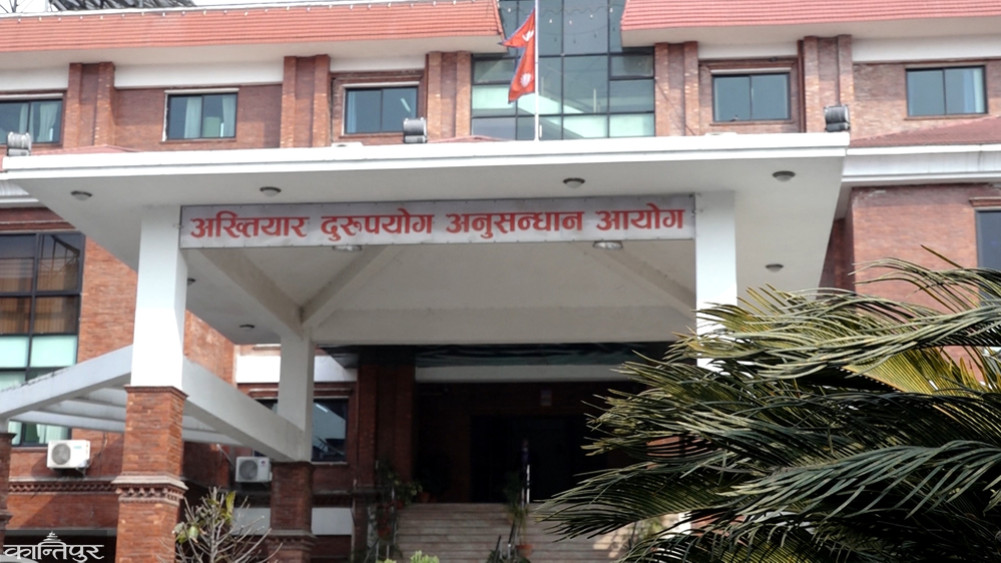
Constitutional amendment should be seen not only as a means of balancing political power but also as an opportunity to promote good governance and control corruption. For that, the Authority should be redefined as a modern, accountable, independent, and effective constitutional body.
We use Google Cloud Translation Services. Google requires we provide the following disclaimer relating to use of this service:
This service may contain translations powered by Google. Google disclaims all warranties related to the translations, expressed or implied, including any warranties of accuracy, reliability, and any implied warranties of merchantability, fitness for a particular purpose, and noninfringement.
A working group has been formed under the coordination of the Prime Minister's political advisor Asim Shah to prepare a discussion paper on the constitutional amendment. The working group is holding discussions with various political parties, constitutional experts, media and other stakeholders. Constitutional amendment is not only a process of changing the country's political system and legal structure, but also a means of ensuring systemic reform in promoting good governance and controlling corruption by making the governance process more transparent, accountable and participatory. For this, it is necessary to amend and add some provisions to the 'formation of the Commission for the Investigation of Abuse of Authority and its functions, duties and rights' in Articles 238 and 239 of the Constitution of Nepal.
The quality of democracy is measured by the commitment, accountability, transparency and effectiveness of the bodies established to control corruption of those in public office. The Constitution of Nepal has established a federal democratic republican system of governance. Similarly, inclusive democracy, rule of law, human rights, transparency, accountability and good governance have been accepted as the basic principles of state governance. Good governance and corruption control have been included as important issues in the preamble of the constitution and the directive principles of the state. For its practical realization, it is necessary to timely amend and restructure the qualifications of the officials of the Authority and its jurisdiction during the constitutional amendment process.
The ‘Constitution of the Kingdom of Nepal, 2047’, which was issued after the establishment of democracy in 2046 BS, and the ‘Interim Constitution of Nepal, 2063’, which was issued after the people’s movement of 2062/63 BS, had given the Commission for the Investigation of Abuse of Authority the constitutional authority to control corruption as well as investigate and take action on ‘improper acts’. The provisions in the said constitutions had constitutionally established the Authority as a body to control not only financial corruption but also biased decisions, abuse of power, arbitrariness and illegal administrative acts that may result from them.
However, Article 239 of the ‘Constitution of Nepal’ issued in 2072 BS has limited the authority of the Commission to controlling corrupt acts only. It has removed the provision related to improper acts from its jurisdiction. This has placed the authority outside the scope of action of the authority if the authorities in public office make arbitrary decisions against the law and against the public interest. This has created a situation where no matter how many illegal acts an official holding a public office commits, they do not fall within the jurisdiction of the authority unless they take the form of direct financial corruption.
Even a decade after the implementation of the Constitution of Nepal, no law has been enacted or institutional arrangements have been made to investigate and take action against improper acts. As a result, a large part of the public administration has fallen outside the effective supervision of the constitutional body. On the one hand, this has weakened the state of good governance, and on the other hand, it has also prepared the basis for corruption. Because the starting point of corruption begins from the last point of improper acts. Therefore, in the course of the upcoming constitutional amendment, both ‘corruption and improper acts’ should be re-included within the constitutional jurisdiction of the Authority by amending Article 239 (1).
Similarly, the provision on ‘policy decisions’ of the Council of Ministers is a major cause of corruption. The lack of constitutional clarity to prevent misuse of policy decisions is contributing to increasing corruption. In Nepal, to avoid the Authority’s investigation into corruption, the practice of having decisions that can be made through joint secretaries, secretaries and ministerial-level decisions of some ministries approved as policy decisions by the Council of Ministers is becoming more common. There has been an effort for a long time to avoid the Authority’s investigation and investigation by having decisions related to economic transactions and benefits such as public procurement, contracts, large economic transactions, exploitation of natural resources, decisions related to land, grants, tax exemptions, and distribution of licenses approved by the Council of Ministers. In some cases, even issues that could have been decided at the level of the joint secretary or secretary of the ministry are taken to the Council of Ministers for decision. An informal study conducted by former secretary Sharada Prasad Trital found that the Council of Ministers made less than 10 percent of policy decisions.
Considering all decisions of the Council of Ministers as policy decisions has seriously affected two issues. First, the state of good governance and administrative accountability in the country has become weak. Second, officials at high political levels are being exempted from investigation and scrutiny by the authority. Therefore, this problem needs to be resolved in the constitution. A clear provision should be made in Article 239 of the constitution, and a constitutional clarification should be added during the course of amending the constitution that public procurement, contracts, financial decisions, transfer of public property, commercial agreements, use of natural resources, and decisions that will bring economic benefit or loss to the state will not be considered policy decisions. There should be a clear constitutional provision that such decisions of the Council of Ministers should be within the scope of investigation and investigation of the Authority.
Similarly, in recent times, corruption is not limited to government offices and public bodies around the world. In the contemporary world, a large budget of the state is spent through the private sector, banks and financial institutions, public-private partnerships, NGOs, development partners and private service providers. However, Article 239 of the Constitution of Nepal has limited the jurisdiction of the Authority only to bodies and individuals holding public office. This seems to have created a huge legal vacuum. In the existing constitutional system, there is no constitutional basis for effective investigation if public funds are misused by private organizations.
Many countries in the world have given corruption control bodies broader and more extensive jurisdiction than Nepal. For example, Hong Kong's Independent Commission Against Corruption (ICAC) has been given the authority to investigate and investigate corruption and irregularities in the private sector, public contracts, banking transactions, private companies and public services, as well as government employees holding public office. Similarly, Singapore's Corrupt Practices Investigation Bureau (CPEB) has been given the authority to investigate from the Prime Minister to ordinary employees. The investigation and investigation of bribery related to the private sector, financial transactions against the public interest and misuse of government resources also fall within the jurisdiction of CPEB. These and some other examples show that in a democratic country, the authority of constitutional bodies to work in the field of corruption control should not be limited, but should be given broad authority.
Through the upcoming constitutional amendment, arrangements should be made to restore the investigation of ‘improper acts’ by expanding the jurisdiction of the Commission for the Investigation of Abuse of Authority, expand the scope of investigation to the private sector, and prevent misuse of policy decisions of the Council of Ministers. Nepal is a party to the United Nations Convention against Corruption. The Convention has directed member states to create an effective legal framework to control corruption in the public sector as well as the private sector, the banking system, non-governmental organizations and organizations that mobilize public resources. Nepal should also incorporate the provisions of the Convention into its legal system and nationalize the provisions of the Convention. Therefore, during the constitutional amendment, it is necessary to bring corruption in banks and financial institutions that mobilize public savings, non-governmental organizations that use government grants or public funds, and private organizations that provide public services under the scope of investigation and investigation of the Authority. Therefore, a sub-section should be added to Article 239 of the Constitution to include such bodies within the scope of investigation and investigation of the Authority.
Similarly, during the constitutional amendment, it is necessary to reconsider the existing constitutional limitations on the judiciary and the army. The exception provision in Article 239 of the Constitution regarding ‘officials separately provided for by the Constitution or other laws’ has in practice greatly narrowed the scope of corruption investigation and investigation.
Judicial independence is the foundation of democracy. Protecting and preserving it is the common and collective responsibility and duty of all democracy-loving citizens. However, judicial independence cannot mean that there will be no investigation into corruption or financial irregularities. Therefore, constitutional officials who are removed from office due to impeachment, judges of other courts other than the sitting judges of the Supreme Court and judges of special courts, and employees should be brought within the scope of the Authority’s investigation into corruption.
Similarly, the main military work of the Nepali Army should remain outside and independent of the Authority’s jurisdiction of investigation. However, if there is corruption in public procurement, development projects, infrastructure and economic transactions related to development work under the Nepali Army, those matters also need to come within the jurisdiction of the Authority’s investigation. The provision that the same work is within the jurisdiction of the authority when conducted by the Road Department or other government bodies, but outside the jurisdiction of the constitutional body when conducted by the Nepali Army is against the principle of justice. Therefore, during the constitutional amendment, the officials who are removed from office due to impeachment and other development-related work other than the army's core military work should be brought within the jurisdiction of the authority. Another important issue is that the qualifications of the officials of the Commission for the Investigation of Abuse of Authority should be updated. Article 238 (6) (a) of the Constitution states that a bachelor's degree is sufficient for the Chief Commissioner and Commissioner of the Commission. Considering today's complex economic, social, administrative, legal, political and financial governance system, the current minimum qualification should be amended to require a master's degree. In the next amendment, it is also necessary to make necessary amendments to Article 239 (2) of the Constitution of Nepal. Article 239 (2) provides that an investigation can be conducted after the person is removed from office through impeachment, a judge who is removed from office by the Judicial Council, and a person who is subject to action under the Military Act. In practice, many officials may need to be investigated and investigated not only after their removal from office but also after retirement. Therefore, it is necessary to amend the provision in the constitution and include the provision of 'removal from office or retirement' to resolve the constitutional ambiguity.
Similarly, a clause should be added to Article 239 of the constitution to provide the Authority with modern powers including corruption prevention, risk assessment, strengthening the integrity system of public bodies, conflict of interest, beneficial ownership, whistleblower protection, and investigation into digital corruption, thereby creating a constitutionally strong commission. In addition, in recent times, there has been a trend of hiding assets acquired through corrupt activities abroad. However, there is currently no constitutional provision for asset recovery. The upcoming constitutional amendment should give the authority the constitutional power to identify, freeze, confiscate and recover illegal assets through international cooperation. This will increase its effectiveness in controlling economic crimes and cross-border international corruption.
The biggest challenge to controlling corruption in Nepal is the limitation of constitutional powers regarding the Commission for the Investigation of Abuse of Authority. It is time to reconsider the narrowing of the authority's powers in the Constitution of Nepal. The constitutional amendment should be seen not only as a means of balancing political power but also as an opportunity to promote good governance and control corruption. For that, the authority should be redefined as a modern, accountable, independent and effective constitutional body.
Only by restoring improper actions, ending the misuse of policy decisions of the Council of Ministers, ensuring accountability in judicial and public institutions, extending jurisdiction to the private sector and expanding powers in line with international practices can corruption control work be effectively carried out in Nepal. The constitution not only determines the structure of the state but also creates the moral basis of governance. Therefore, a timely, visionary, and bold amendment to Part 21 of the Constitution to build a good-governance and corruption-free accountable governance system is an indispensable national need today.