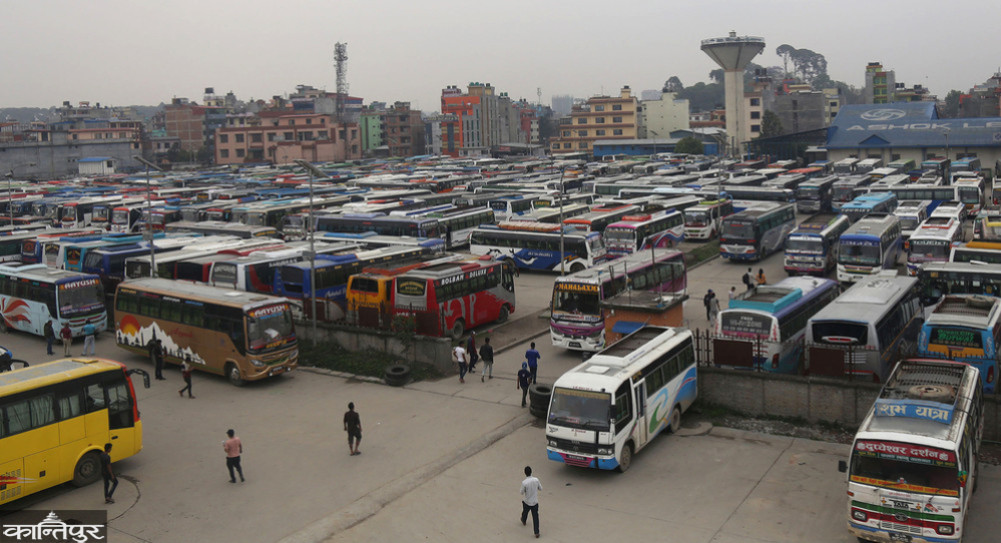
The main question today is not to drive more cars, but to get more people to their destinations safely, reliably, and efficiently. Now the need for organized public transportation, such as rapid transit systems, is becoming more apparent.
We use Google Cloud Translation Services. Google requires we provide the following disclaimer relating to use of this service:
This service may contain translations powered by Google. Google disclaims all warranties related to the translations, expressed or implied, including any warranties of accuracy, reliability, and any implied warranties of merchantability, fitness for a particular purpose, and noninfringement.
Anyone who has spent any time in the traffic of Kalanki, Koteshwor or Chabahil will readily realize that Kathmandu's transportation system is under increasing pressure day by day. The number of vehicles in the valley is constantly increasing, the roads are becoming congested. And, for many, daily travel has become a stressful, uncertain and sometimes unsafe experience.
In recent years, Kathmandu has tried to ease the traffic problem by widening roads, building flyovers or expanding physical infrastructure. While projects such as the Ring Road expansion have provided a temporary sense of improvement, many have experienced the same congestion situation within a few years. This situation is not only experienced in Kathmandu, but in many cities around the world. Various studies on transportation planning have shown that expanding roads further tends to increase the use of private vehicles in the long term, which is known as 'induced demand'. The famous study ‘The Fundamental Law of Road Congestion’ (2011) by American transport researchers Jill Duranto and Matthew Turner has concluded that as road capacity increases, traffic pressure also increases in approximately the same proportion. Therefore, the main question today is not just to drive more vehicles, but to transport more people to their destinations safely, reliably and efficiently. In this context, the need for organized public transport like the Bus Rapid Transit (BRT) system is becoming more and more clear.
BRT is not just a ‘bus lane’
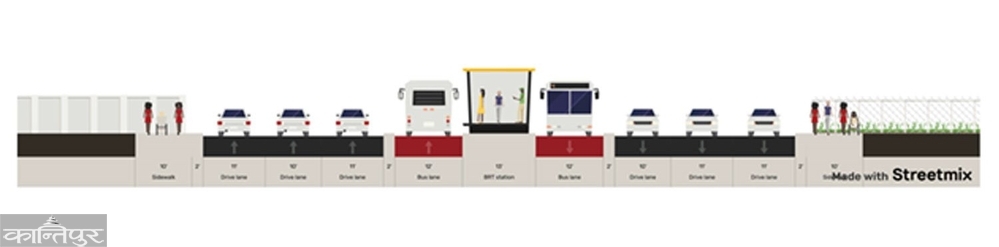
In Nepal, many people imagine only a lane reserved for buses when they hear the word BRT. However, in international practice, it is understood as a ‘metro-like’ public transport system operating on the surface, different from ordinary bus services. It includes separate bus lanes, organized stations, rapid boarding and alighting system, integrated ticketing system and smart traffic management within a single structure.
It prioritizes buses over traffic, significantly reducing the uncertainty and delays that passengers experience on current public transport. Instead of the current system that is based on random stops, overcrowding, or unorganized competition, BRT prioritizes schedules, safety, and passenger comfort.
Level boarding and alighting stations help provide easy access for senior citizens, people with disabilities, and families with children. Technologies like Transit Signal Priority (TSP) help buses stop at traffic signals for less time. Separate bus lanes make travel times more reliable. Perhaps most importantly, BRT puts the dignity of passengers using public transport at the center.
Why does Kathmandu need organized public transport?
Today, thousands of Kathmanduites rely on public transport every day. However, the current system is still largely fragmented and disorganized. Commuters are experiencing congestion, irregular schedules, unsafe boarding and alighting conditions, and long waits.
Despite these challenges, public transport remains the main mode of transport for students, workers, senior citizens, and low-income communities. The aim of BRT is not just to add new buses – it is to develop public transport into a systematic, reliable, and people-centered system. If the majority of the city’s citizens increasingly rely on private motorbikes and cars, a city with limited road infrastructure like Kathmandu may become increasingly difficult to operate in the long term. Without investment in systematic public transport, congestion, pollution, fuel consumption, and time loss are likely to increase.
An effective BRT system can help improve the overall quality of life in a city by providing a viable alternative to private vehicles. Modern BRT corridors often include safe sidewalks, bicycle lanes, street beautification, and accessibility-friendly infrastructure.
Opportunity to learn from South Asian cities
Kathmandu does not have to start from scratch. Many cities in South Asia have already tried to improve urban transport through BRT. India's 'Janmarg' system in Ahmedabad is discussed as an example of increasing public trust in public transport through separate bus corridors and systematic operation. Indore's 'iBus' has tried to transform a chaotic bus system into a more structured and efficient network. Similarly, in Pakistan, the Islamabad-Rawalpindi Metrobus is believed to have helped reduce travel time between the two busy cities, while various studies have noted that the Peshawar BRT has had a positive impact on urban transport, safety and environmental conditions. These examples show that BRT is not just a transport project but also a matter related to public life, economic activity and environmental sustainability.
The debate between monorail and metro rail often arises in the context of Kathmandu. While successful in some cities, various studies have argued that such systems may not be an immediate viable option for Kathmandu, given factors such as dense urban structure, construction costs, geography, and economic viability. Various urban transport studies by the World Bank and the Institute for Transport and Development Policy (ITDP) have noted that BRT can provide high passenger capacity at a relatively low cost compared to high-cost elevated rail or monorail systems. Studies such as the ITDP's BRT Standard and 'More Development for Your Transit Dollar' have described BRT as a 'low-cost, high-capacity public transport system', especially in developing cities.
BRT has been adopted by many cities as a relatively cheap, quickly implemented, and scalable alternative to underground metro or elevated rail systems.
A Practical Approach for Kathmandu
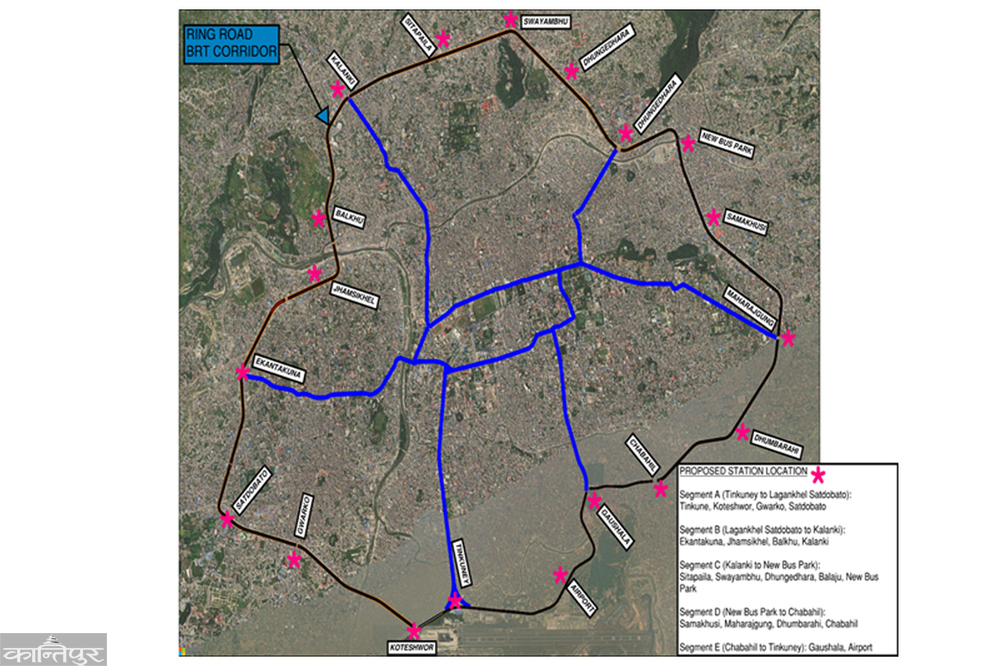
As part of our independent research, we have studied the feasibility of a BRT corridor based on the Kathmandu Ring Road, which can connect major residential, educational, commercial and employment centers.
The main objective of this concept is not only to manage chaotic traffic, but also to build a reliable public transport system that prioritizes passengers. Through separate bus lanes and modern stations on the Ring Road, Kathmandu can develop a public transport infrastructure that can serve millions of passengers daily.
In the future, there is a possibility that this system can be expanded to areas like Bhaktapur, Budhanilkantha, Thankot, Lalitpur and take the form of a regional network. This may require bridge improvements, traffic management and road sector restructuring. However, these improvements may be relatively less complex and less expensive than building an underground railway in a dense urban area like Kathmandu.
Public awareness is also equally necessary.
Infrastructure alone is not enough. Public trust and awareness are equally important. One of the biggest challenges in implementing a managed public transport system is changing the way people view public transport. Many still see buses as a last resort.
Our aim is not to criticize the current transport operators or the system. Rather, it is to start a positive dialogue on how Kathmandu can move towards safe, clean and managed transport.
People should have reliable, accessible, safe and comfortable transport. Students should not be forced to travel unsafely every day. Workers should not have to waste unnecessary hours in traffic. Families should be able to travel comfortably without private vehicles.
A managed BRT system can help rebuild trust in public transport.
This debate is not just ours.
As we know, the concept of managed public transport or BRT in Kathmandu is not new. Government agencies, planners, urban planners, and various organizations have been discussing this for a long time.
We are not trying to present ourselves as the first to bring the concept of BRT to Nepal. Rather, we are a group of Nepali transit professionals and enthusiasts working on various transportation and infrastructure projects in the United States who want to share the technical knowledge and experience they have gained with Nepal.
The main problem today is not a lack of ideas, but the challenge of implementation. Kathmandu has been discussing sustainable transportation for years, but commuters still suffer from chaotic and unreliable public transportation.
That is why public awareness is so important. When citizens start demanding organized, reliable, and respectful public transportation, change can happen. We believe that such discussions will help increase public understanding of why BRT is necessary, practical, and a viable option.
Kathmandu’s transportation problems cannot be solved by any one group alone. This requires collaboration between the government, transport professionals, planners, technicians and the general public. However, it can certainly start with open dialogue and knowledge sharing.
Towards a people-centered future
Many successful cities in the world have made a significant shift – they have started prioritizing people over cars. It is time for Kathmandu to think in the same direction.
If we continue to consider road expansion and private vehicle growth as the only solution, congestion and pollution may increase. However, if we can invest in organized, effective and sustainable public transport, Kathmandu can become a more livable, connected and clean city.
BRT is not the whole solution. However, it can certainly be one of the most practical, feasible and effective steps that Kathmandu can take in the current situation. Kathmandu's transport debate should no longer be limited to the debate about roads. It is also a debate about people, access, safety and quality of life. That is why the debate about BRT is important for Kathmandu.