In his tone of dismissing all critics as 'old-schoolers', Sapkota has forgotten that the established intellectual and legal circles he has mocked are actually the last line of defense against populist authoritarianism that protects democratic institutions and the rights of ordinary citizens.
We use Google Cloud Translation Services. Google requires we provide the following disclaimer relating to use of this service:
This service may contain translations powered by Google. Google disclaims all warranties related to the translations, expressed or implied, including any warranties of accuracy, reliability, and any implied warranties of merchantability, fitness for a particular purpose, and noninfringement.
The article by analyst-writer Bishnu Sapkota, published in Kantipur on 3 Jestha, caused a huge stir in the ‘traditional citizen circle that reads articles in Kathmandu’, in his own words. Since I do not originally live in Kathmandu, I consider myself a part of that circle, so the shock of that stir reached me too. The main reason why the article became famous was that those who had long considered Sapkota to be of their own class were now criticizing him for ‘not being able to accept change’. Many felt that they had been called ‘sloppy’ in intellectual terminology. Another reason why that article became famous was Sapkota’s article ‘New Nepali ‘Populism’: A Sympathy’, published in Kantipur exactly 84 days ago, i.e. on 12 Falgun 2082, in which he wrote –
Although political science interprets it from different angles, the basic character of ‘populism’ is that it says – you believe me, I will fix the rest. If someone asks, ‘How will you fix it?’ he says, ‘You first trust me and see, I will fix everything else.’ He does not have much ‘content’. He does not have both the ability and the interest to reason intellectually. But he can keep repeating sentences like ‘I will fix everything now’ without any hesitation, as if he believes in those sentences. There are problems in society, and people may be depressed personally. ‘Populism’ does not think much about what the answer to all of that is. He can simply say in a way that everyone can hear, ‘I am the answer to all of that.’ If someone asks, ‘How are you the answer?’ he says again, ‘Let me come first.’ In other words, weaving some simplified slogan amidst the despair prevalent in society, he comes and says – ‘You trust me, I will get you out of all your troubles.’ And, most people, being stubborn towards that, may follow him, saying, ‘Yes, everything I am looking for is here.’ And, what he wrote in the article 84 days later stood at a 180-degree angle with that and his previous articles.
And I imagined a scenario of sitting in a hypothetical situation and reading a hypothetical article: Suppose, in March 2025, I was in America and was reading the Washington Post. I saw an article in it – the headline was – Washington’s ‘departure’ and the traditionalist elite in fear. The article, which came less than two months after the Trump administration was formed, went like this:
‘The American people have voted for an even more powerful ‘departure’ by overwhelming the age-old corrupt elite in Washington. However, the established intellectual class and liberal analysts here are unable to digest this great departure.
Coincidentally, I was in Paris a few weeks after the new government was formed. There, people there excitedly said to me, ‘Congratulations! America has finally handed over power to a rebel, sidelining the old leaders who had ruined the country in the name of liberal-internationalist consensus. Now we come to America to learn.’ I felt proud of the American people when I saw our vote pulsating even in Europe. This was not just an election, with nearly 50 percent of the people clearly standing on one side, but an unprecedented popular uprising that the whole world was watching with interest.
But when I returned to Washington, I found the traditional intellectual circle here crying over very small technical issues. They are making a fuss about the president’s policy announcements via ‘X’ (social media platform), his red tie or the rapid decisions he makes through executive orders bypassing the Senate.
Critics are making a fuss about the bold steps taken for national security to deport illegal immigrants and the general inevitable clashes during law enforcement, calling them ‘inhumane’. They are entangled in meaningless issues like the president’s business interests and tax return hacking. But what they need to understand is that millions of Americans have chosen this new leadership out of disgust with these old processes and ‘traditional patterns’ of human sensitivity, and the government has done all these things in accordance with the people’s mandate. The procedural obstruction of the courts and the propaganda of the media are just the last straw of the elite class that is ‘afraid of change’. It is historical folly to view this unprecedented departure of the new government through the old lens.’
There are two purposes in reading you this fictional American article. First, these lines are taken from Sapkota’s own article, with only the country, the ruler, and some terminology changed. Second, it is to show how the attacks on democratic institutions and the rule of law are being covered up by the veneer of popular discourse. Such an argument ignores the separation of powers and the rule of law. Questioning ordinances passed by the parliament and stopping arbitrary decisions of the government in the courts is a fundamental characteristic of democracy. However, it devalues accountability and transparency by portraying these questions as ‘anti-change rhetoric’. The opaque wealth and conflict of interests of those holding public office are financial problems. The argument that ‘people have already voted for them, so questions should not be raised’ undermines not democracy but autocracy.
Sapkota’s article has silently supported many things. Remaining silent when bulldozers are used in squatter settlements or when force is used against the weaker sections is also a kind of support. Justifying such steps in the name of ‘development’ and ‘new era’ is against the welfare character of a democratic state.
Those who consider Bishnu Sapkota’s advocacy of ‘departure’ to be justified in the context of Nepal should also consider the above fictional American defense as justified. Because in both, there has been a similar attempt to hide the fundamental rights of citizens, legal boundaries, and serious questions of good governance under the emotional slogan of ‘fresh public opinion’.
Intellectual defense of populist politics
When established parties and institutions fail to meet citizen expectations, populist forces emerge from the womb of the system itself. Whether it is the rise of Donald Trump in the US in 2016 or the rise of the Rashtriya Swayamsevak Sangh (RSS) and Balendra Shah in Nepal, these are not just pure voter outcomes. These are manifestations of cultural and structural conflicts between the old elite and the angry new generation. Therefore, such upheavals are not problems in themselves, but in some cases can even be a necessary starting point for transformation.
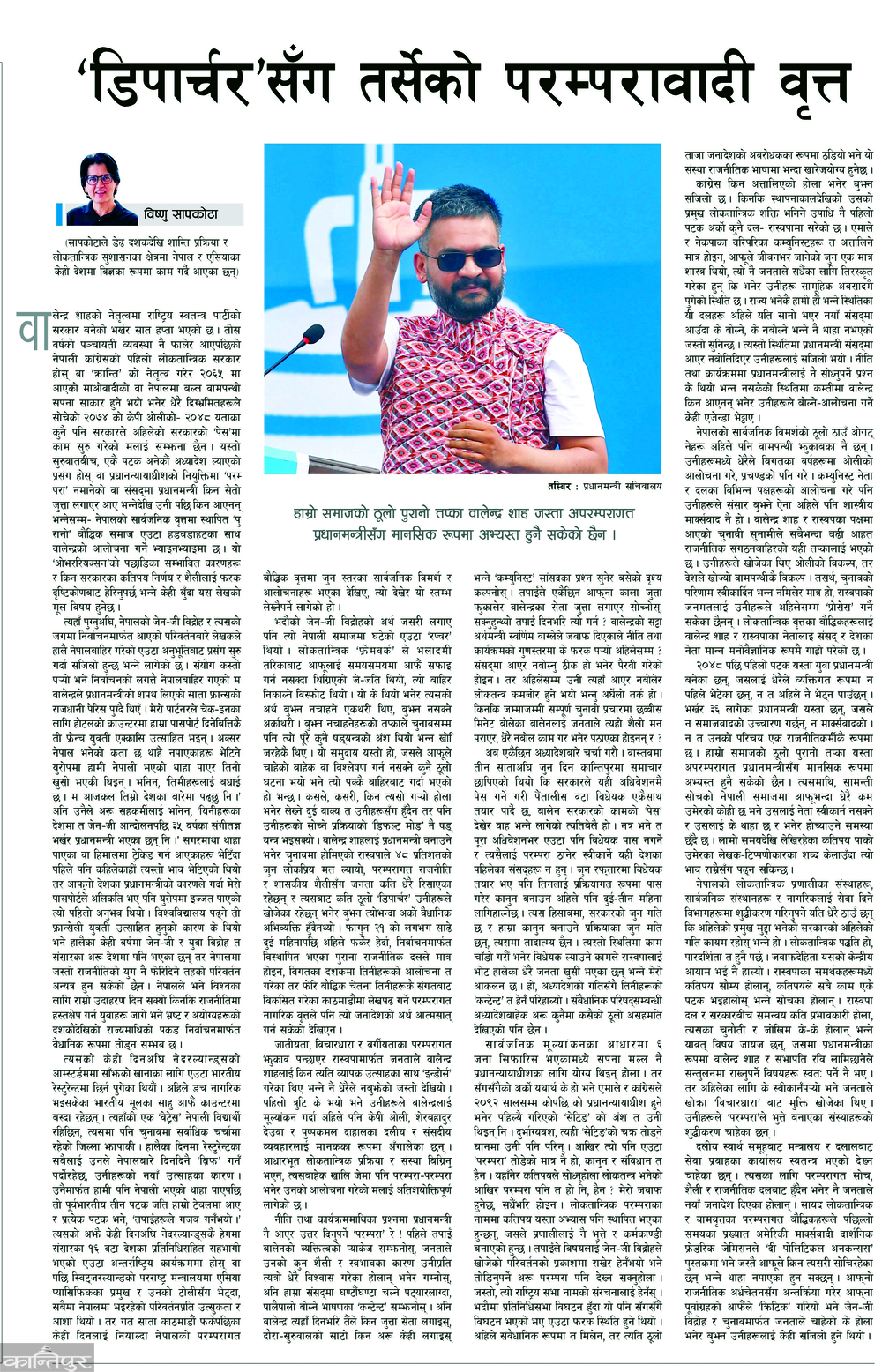 However, when an elected government tries to work at a ‘fast pace’ by violating legal dignity and democratic balance, a section of society becomes suspicious. Dismissing these suspicions as ‘fear of being robbed of what has been earned’ or ‘the cries of the oppressed class’ is a populist formula. It is precisely at this juncture that some intellectuals step forward and give the rulers’ liberal moves the intellectual cover of ‘historical necessity’ and ‘revolution’. Sapkota’s article could be the starting point for a similar intellectual exercise to defend the Balen government’s working style.
American intellectual wave: Commentary by Julius Crane and Michael Lind
Trump’s victory in 2016 shocked the American media and academia. While many saw Trump as a cheap sloganeer and liberal, Julius Crane initiated a different intellectual discourse through his established journal American Affairs.
According to Crane, Trump’s rise was not an accident but the result of the complete failure of America’s ‘managerial elite’. He interpreted Trump’s anti-institutional moves and legal confrontations as ‘a necessary push to wake up a dormant system’. Crane’s analysis caused a stir in American intellectual circles by portraying Trump’s rudeness and legal neglect as a ‘historical necessity’.
In exactly the same vein, political thinker Michael Lind added another debate through his book ‘The New Class War’. He defined Trumpism as a natural class struggle between ‘the working class’ and ‘the urban, highly educated, and establishment elite’. Lind’s main argument was that mainstream intellectuals and the media (which he calls the pundit class) are completely incapable of understanding the real anger and needs of the common people. What Crane and Lind’s writings prove is that in order to establish any populist movement intellectually, the established system and its critics must first be declared ‘a class that does not understand the feelings of the people’.
Nepal: Bishnu Sapkota's article and Crane-Lind's echo
Bishnu Sapkota's article 'Departure' published in Kantipur Daily and the inner circle of skeptics about it are exactly in line with Crane and Lind's own intellectual practice. He has presented the government's legal neglect and ordinance-oriented style as 'extraordinary speed' and 'courage to break tradition'. In addition, he has dismissed those who question this style of work as 'a group of old intellectuals' who 'do not understand public opinion and public sentiment' and are afraid of losing their privileges.
I also said above that the people who were most surprised after reading Sapkota's article are those who were admirers of his intellectual image and democratic ideas. Nowadays, it has become common in Nepal for disagreements to be expressed in the form of abuse on social media, of which he himself is now a victim. However, this article is not to criticize him, but rather an attempt to rise above the crowd of abuse and applause and examine his argument through logic.
Sapkota's main argument is the appeal to popularity. He has presented the 48 percent vote and public outrage received by the new government as a license for all its immature and unconstitutional steps. But in logic, political science, and jurisprudence, majority or popularity alone can never be proof that any step is legally or morally correct.
A large part of the article is spent on the enthusiastic memoirs of a receptionist in Paris and a restaurant owner in Amsterdam. The author considers the superficial happiness of foreigners thousands of miles away from Nepal's complex terrain and legal system as evidence of the government's effectiveness and international acceptance. In logic, such a weakness is called the 'anecdotal fallacy' (a fallacy in reasoning that draws conclusions based on a few small examples).
Sapkota has divided the intellectual discourse into just two extreme camps: on the one hand, the visionary ‘Gen-G rebellion’ and on the other, the old conservatives who are mired in ‘conspiracy theories’. His classification completely ignores a large conscious segment of the public that welcomes the rise of alternative politics and logically opposes the government’s authoritarian tendencies and legal autocracy.
Instead of logically answering serious questions such as the government’s violation of the dignity of parliament and the demolition of the houses of squatters without prior notice, Sapkota has attacked the background of the critics. He has diverted the subject by calling the critics ‘old writers of Kathmandu’ who grew up under the umbrella of the old parties. In the process, he calls Sapna Pradhan Malla ‘part of the setting before he became the Chief Justice’ but respectfully acquits Manoj Sharma’s court entry and history, revealing his double standards.
Political realities that have been ignored
Sapkota has deliberately ignored the brutal and frightening realities of Nepali politics by discussing the ‘speed’ and ‘aesthetics’ of the government (the prime minister’s white shoes, youth or musical background).
The ‘extraordinary speed’ and ‘ordinance culture’ that he praised were actually fatal to constitutional democracy. The Supreme Court immediately quashed the ‘high-profile’ arrests made on the basis of political vendetta without established legal process and sufficient evidence. As a result, the government was forced to back down from its weak steps. In a democracy, speed without process is a rehearsal for authoritarianism, which the court stopped through the principle of ‘checks and balances’. However, the author is completely silent on such harsh legal realities.
मानवीय संवेदनाको अभाव र 'डोजर राजनीति’
सहानुभूति र प्रगतिशील परिवर्तनको जगमा ‘जेन–जी विद्रोह’ भएको दाबी गर्ने यस लेखले काठमाडौंका सहरी गरिब र सुकुमवासी समुदायमाथि सरकारले चलाएको निर्मम डोजर आतंकलाई पूरै बेवास्ता गरेको छ । बिनाकुनै न्यायोचित पुनःस्थापनाको योजना, नागरिकको आवासको मौलिक हक हनन गर्दै बस्ती भत्काउने कार्यशैलीलाई मानवअधिकारवादी संस्थाहरूले ‘अमानवीय’ ठहर गरिसकेका छन् । आफ्नै राज्यका सीमान्तकृत नागरिकमाथि भएको यस्तो राज्य–नियन्त्रित हिंसालाई नजरअन्दाज गर्नु सापकोटा जस्ता लेखकका लागि शोभनीय होइन ।
सापकोटाले नयाँ शक्तिलाई ‘भ्रष्ट पुराना शक्ति’ को ध्रुवीयविपरीतका रूपमा चित्रण गरेका छन् । तर, नयाँ सरकारका मन्त्रीहरूको अस्वाभाविक सम्पत्ति, विवरण सार्वजनिक गर्न देखाएको अनिच्छा र अपारदर्शी चुनावी आर्थिक स्रोतबारे सञ्चारमाध्यमले उठाएका गम्भीर सवाललाई उनले पूरै बेवास्ता गरेका छन् । नयाँ शासकहरूमा पनि पुरानै प्रवृत्तिको संक्रमण देखिन थालेका बेला त्यसको आलोचना नगर्नुले लेखकको एकांगीपन सिद्ध गर्छ ।
लोकप्रियतावादी प्रतिरक्षाको जोखिम
पपुलिस्ट शासकहरूको बाह्य आकर्षण (विशिष्ट मौनता, सेतो जुत्ता, फेसन वा सस्तो अन्तर्राष्ट्रिय चर्चा) मा रमाएर उनीहरूको संस्थागत परिणाम र कानुनी धरातललाई बिर्सनु बौद्धिक चेतनाको पराजय हो । आलोचना गर्ने जति सबैलाई ‘पुरानो व्यवस्थाका मतियार’ भनेर खारेज गर्ने धुनमा लेखकले के बिर्सेका छन् भने, जुन स्थापित बौद्धिक र कानुनी वृत्तको उनले खिल्ली उडाएका छन्, पपुलिस्ट अधिनायकवादबाट लोकतान्त्रिक संस्था र आम नागरिकको अधिकार जोगाउने अन्तिम रक्षाकवच वास्तवमा त्यही हो ।
विष्णु सापकोटाको यो लेख वस्तुनिष्ठ राजनीतिक विश्लेषणभन्दा बढी लोकप्रियतावादी शासनको बचाउमा तयार पारिएको बौद्धिक घोषणापत्रजस्तो देखिन्छ । यसले स्वयं लेखकलाई नाफा–घाटा जे गराउला तर उनका पाठक र प्रशंसकहरूका लागि भने यो पक्कै घाटाको कुरा हो । आशा छ, ‘काठमाडौंमा लेखपढ गर्ने परम्परागत नागरिक वृत्त’ का यी झर्झराउँदा सदस्य नवलोकप्रियतावादी कित्तामा पूर्णतः अवतरित हुने छैनन् ।