In recent days, it seems that this commission-oriented middleman has also contributed well to the big and wide movement of those who run from the ward through the ministry to the Prime Minister's residence for allocation of the budget without any process.
We use Google Cloud Translation Services. Google requires we provide the following disclaimer relating to use of this service:
This service may contain translations powered by Google. Google disclaims all warranties related to the translations, expressed or implied, including any warranties of accuracy, reliability, and any implied warranties of merchantability, fitness for a particular purpose, and noninfringement.
The federal government has passed the estimate of income and expenditure for the next financial year, i.e. the budget, from the House of Representatives. State and local budgets are coming and being discussed. Except for Kathmandu, all the metropolitan cities have brought the budget.
Except for Dharan sub-metropolitan municipality and other 23 municipalities and 15 rural municipalities, all other municipalities have brought the same budget and proceeded with the discussion. The time schedule for which level of government will bring the budget is fixed.
Out of the set points for evaluating the performance of the local level, the issue of whether or not the budget for the next fiscal year has been published within 10 June has been made 5 points, because that point has been arranged to go up and down in the future grant money from the federal government to the local level, so the budget has started coming in at the local level.
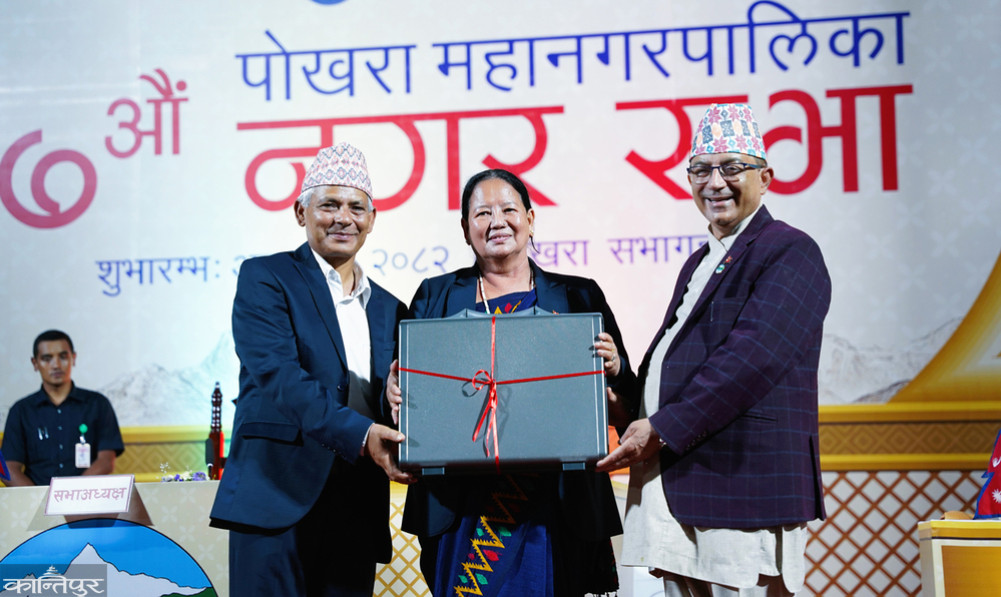
However, there is a reference to 24 municipalities (16 municipalities and 9 rural municipalities) of Madhesh province out of 42 municipalities that could not come up with a budget by June 10, and there is also the issue of Pokhara Metropolitan Municipality's budget, which has been at the center of debate as the budget was written in just two hours. Now, these issues did not happen overnight or suddenly, and how to look at them has become a complicated issue in itself. The practice of making the
budget based on the plans determined by local needs and choices through participatory discussion, but the practice of making a link in the chain management of 'political leaders' from the tol to the center is widespread.
This practice has created a situation where neither a budget can be made nor a political consensus can be reached. One of the reasons for the budget not coming within the time period is the conflict of interests, and after the sudden meeting of 'political leaders', trying to prepare an important document like the budget in a few hours is another reason for looking very flawed like Pokhara.
While discussing last year's budget, we said through Kantipur's article entitled '(Un)Economic Approach of Federal Budget', that in Nepal, when taking feedback about the budget, it is being made like a ritual of choosing-seeking business houses in the name of economists or private sector.
in such a way that it is as if the budget is not a matter of anyone else's interest or is just a matter of concern, as if other sectors of the society do not know about it or do not know about it. But the truth is that since the budget is a subject connected with the daily life of the society, it is not only a matter of expertise or interest in it, it is necessary for everyone to know and understand and be interested in it. Continuing this context, in this article, an attempt has been made to discuss the commentary and the ground reality about the budget as a whole.
In recent days, the wording of 'Kanika Chhare Jain' or 'Kanika Chhareko', which means that the budget has been poured or wasted, can be heard many times in the response to the budget. It may have other symbolic meanings, but the intention or message that the public is trying to understand by this is to understand and get used to the fact that the budget will not and will not come in small amount schemes.
If these words are used during this year's budget discussion, this wording will be repeated when someone has to give instructions about the budget. Especially the above-discussed 'politicians' can hear and read more and more saying that we should not let Kanika fall in the name of planning or budget. As a result, some local levels now say that they will not make plans below 5 lakh rupees and will not keep their budget.
Along with this, the question arises, can the development and construction work of the village houses not be done with less than 5 lakhs? Or 5 lakhs should not be spent on issues or needs of the government budget. In reality, the local level plans are often cost less than 1 lakh.
The budget demanded by many in the village is the repair of the canal leading from the nearby water source or river to the farm or the village house, the repair of the well being used for drinking water, the cleaning and maintenance of the moving goreto, the protection and enhancement of the local square where people spend their time heating and gossiping, a few thousand for the protection and development of the local square, the wages of some laborers for the protection of the ahal or pond near the square, the 2 coils of pipe needed to connect the source water to the house or village. In terms of
amount, even today even 5/10 thousand are spent on small jobs in the village. Plans above 1 lakh are very less for work that does not require external materials and tools, including dozers. In particular, these works have been carried out by public administration until a few years ago when the local government did not have the same assurance of financial resources as it does today.
In this way, the Nepalese custom of doing social work through public transport not only gave life to the village, but also reduced dependence on the state for development, reduced financial burden and helped and facilitated development. It can be said that the reason why citizens are asking for budget for these works today is because of the use of available resources and tools for these and similar works. When those who have access started using/misusing the government budget for such works, the concept developed that all public works are done and should be done by the government through the budget.
As a result, there was a massive change in the customs and culture of donating labor at the local level, which not only brought about a massive change in the sense and identity of the village, society and 'we', as well as the perception of 'our', but this practice also seems to have helped to develop common understanding and commentary as an easy source of state exploitation over time. Now why and how this is happening can itself be the subject of an intensive social study.
The question that should not be solved again is how to understand and address the conflicting trend of local needs requiring small budgets and small amounts of money, but those who are in charge of "budget experts" or "budgeting the village" to stop "sowing seeds" while rejecting such small and small amount plans and encouraging them to start only with medium and large plans.
experience says that small plans based on real needs are still the needs of the villages, while medium and large plan focused advocacy is not just the 'voice of development' today, especially the product of the bureaucratic needs of the government.
In other words, when working under the current legal, technical and procedural arrangements in terms of plan formulation, implementation, monitoring and approval, the local government should be given more time to carry forward all small projects, but it means that the officials will not have enough time and will not have enough time for this work and there will be widespread frustration. Based on the legal framework, administrative psychology and the limits and time of the people's representatives, some have
For advocating for medium and large plans with its simplicity, making it a strong comment and making development out of the reach of the community as a 'game changer' plan, it can be clearly seen that another class of people are born, raised and established in the same society. In recent days, it seems that this commission-oriented intermediary Tapka has also contributed well to the large and wide movement of those who run from the ward through the ministry to the Prime Minister's residence for allocation of the budget without any process.
Ward president who doesn't trust the ward members, the municipal leadership who doubts even the ward president, the bureaucracy that considers all the elected as incompetent and incompetent, and the provincial and federal structure that does not see the local level as competent but instead considers them dependent or dependent is the ironic reality of today. Amidst such mistrust, confusion and disharmony, plans are being formulated and budgets are being implemented today.
Ward members did not even come to Ganouta when some ward presidents did not have a role in monitoring. It seems that small schemes are discouraged in the name of their 'busyness', as most of the technical work is carried out by the employees in the field.
result, goreto, which is very short distance and takes less time than the road, the intersection made to facilitate the journey of goreto and the public well or stream next to it, the fragmentation or newness of the strong social relations, on the one hand, on the one hand, the small ahal or pond made to use the same water source, which is always flowing with the facility of recharge (recharge), environmental crisis caused by the plight of water sources, animal husbandry and grazing problems, losses in agricultural production and conflicts over access and use of water resources etc.
But the reality is that the needs of the villagers are often small and only the Hazare Yojana. And, if all the governments do not move forward by encouraging it, the villages will not remain sustainable or habitable. Can local needs be trampled and ignored for structural reasons? While saying this, it can be said that the local level is also doing such small works. Yes, it can be seen that some wards are addressing the needs of 5, 7 thousand people.
It is heard from some ward presidents and people's representatives that a few thousand small projects across the ward have been linked together and passed as a plan worth 5.7 lakhs. But its weakness is that tens of such small projects become a single consumer group and there the planning, implementation, monitoring and concessions are weakened and some people's irregularity increases.
How to connect the state's investment with the local people and increase the ownership of that state with the voice of "We are not in the committee, we don't know how it is happening"? By discouraging the small plans of the real needs of the local people, those plans lose the ownership of the local people because even if they are done through paper and legal committees without the participation of anyone else or real consumers, it seems to become like the work of someone who has access to them.
8, 10 There is no doubt that the transparency of the work of such legal committees will be weak and the fear of irregularity will remain more than in the plan driven by the locals. Therefore, the alternative to both ignoring small plans and running such plans is to monitor the plan and amend the legal framework of the permit.
The main person of the municipality should be involved in the monitoring of all the plans, the current system of hastily doing it due to lack of time or submitting paper procedures should be comprehensively revised and the 'social audit' can be made agile by giving the consumers the responsibility to answer questions about the plan for at least 10 years. It can be changed into a positive comment that they do it with their children.
Although this suggestion seems like an 'ideal' to some people today, the list of such works done by the locals themselves is an experienced basis and motivation to move towards such positivity. A key part of this context of
budgeting and planning relates to the size of our local level. The current blueprint of the local level is that some of the previous village development committees have been established as one ward, while some of the current ones are in two wards of the municipal structure. Meaning, the ward structure is several square kilometers in size and one has to travel dozens of kilometers to reach all the villages. In order to improve it, the existing big houses have to be broken.
By doing so, there is a possibility that some municipalities will also increase. But the opinion of Kathmandu-centered experts who refer to the amendment of the constitution seems to be in the opposite direction than what we have raised. Some people have already started saying that, "There is not much work at the local level." If there is too much, it should be reduced.' In reality, this statement is not pro-people, the bigger the structures are built, the more locality (whether in planning or leadership) is in danger of disappearing. To do so is to promote grandiose and anti-localism schemes, alienating local citizens from government.
People's representatives who understand and understand locality in large structures cannot be won, but for some other reason, a celebrity who is known by many or has worked in a certain area gets votes and opportunities based on populism. There is no doubt that in today's situation where most of the celebrities are not immersed in the local soil, their consciousness and thinking will be weaker than now in terms of local needs. Without localism, development and special development is not possible.