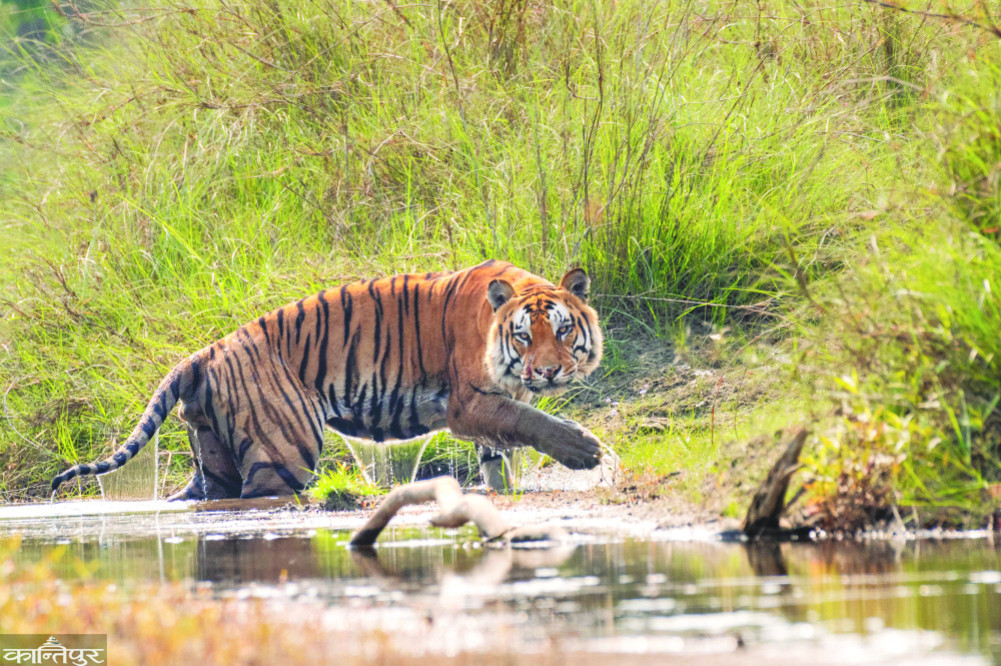
Studies have shown that only 5 percent of the tigers in the park come into conflict with humans. If we can regularly monitor and identify such tigers, human-tiger conflict can be reduced. On the other hand, it is important for everyone to think that if there are tigers, tourists will come, economic activities will increase when tourists come, and the livelihood of the community will be easier when economic activities increase.
We use Google Cloud Translation Services. Google requires we provide the following disclaimer relating to use of this service:
This service may contain translations powered by Google. Google disclaims all warranties related to the translations, expressed or implied, including any warranties of accuracy, reliability, and any implied warranties of merchantability, fitness for a particular purpose, and noninfringement.
From 2010 to 2022, Nepal fulfilled the international commitment to double the number by doing significant work for tiger conservation. According to the 2022 tiger census, the number of tigers in Nepal has reached 355. The role of government, community, partner organizations and conservationists is immeasurable in increasing this number. This is possible due to their efforts. Around 2010, there were around 121 tigers in Nepal.
In 2010, the government declared an area of 550 square kilometers east of Bardia National Park as Banke National Park for tiger conservation. Now there are 25 tigers in Banke. By adding 128 square kilometers to the erstwhile Parsa Wildlife Reserve and expanding 637 square kilometers as a park, the government undertook core area and habitat improvements. There were 4 tigers in Parsa in 2010 and 41 in 2022 count. It reflects the government's efforts to protect wildlife and biodiversity including tigers.
The government also focused on habitat improvement, grassland management, construction of ponds and ponds within forests, and management of food species. Along with this, the institutional reform program also seems to have contributed to the increase in the number of tigers. For example, the formation of the National Tiger Conservation Committee in 2067 under the chairmanship of the Prime Minister, the establishment of the Central Wildlife Crime Control Unit for wildlife crime control and the expansion of such unit to the district level have also helped in crime control. Apart from these activities, poaching control task force formed at the community level, regular patrols of security agencies are also helping in protection. In this way, it can be seen that the government has taken tiger conservation as a priority at the national level.
Community level programs for tiger conservation also helped. As such, tiger-based tourism has benefited local residents. Community homestays have also inspired the community towards income generation. It is believed that the government has achieved significant achievements in tiger conservation with the significant support of national and international cooperation, conservation partner organizations such as the National Nature Conservation Fund.
The tiger is a threatened species on Schedule 1 of the Convention on the Control of International Trade in Endangered Species of Wild Fauna and Flora (CITES) and on the IUCN list of endangered species. However, the number of tigers in Nepal has increased, now what? Questions have started coming. With the increase in the number of tigers, human-tiger conflict also seems to increase. This is reality. Currently, there are two types of comments especially regarding the number of tigers. One, the number of tigers in Nepal has increased, the park can no longer handle it. Also, the number of tigers has not stabilized, it may still increase. For this, we first need to take into account the range of the tiger, its food species and habitat. In the 2009/10 tiger survey, there were 91 tigers in Chitwan, by the 2022 census, there were 128. If we talk about Bardia, it has increased from 18 to 125. From 8 to 36 tigers have reached Shuklaphanta.
If we look at the presence of tigers in the parks and forest areas of Nepal, there are more than 7 tigers in Bardiya, more than 4 in Chitwan and more than one in Parsa for every hundred square kilometers. If we look at the density towards India, it is more than that of Nepal. As per 100 square kilometers, there are 14 tigers in Jim Corbett National Park, 13 in Kaziranga, 9 in Rajaji and 8 in Manas National Park. Considering this, the density of tigers in the parks of Nepal has not increased and the carrying capacity has not been exceeded. Looking at these data, there is a lot of ground to grow more tigers in Nepal's parks. For that, the current conservation work should be made more effective. A study conducted in Nepal has shown that the Chitwan Parsa area can support at least 175 tigers. It seems that at least 390 tigers can be bred in Nepal based on the achievements of the current food species by making 165 tigers in Banke Bardia area and 50 tigers around Shuklaphanta and Nikunj.
34 of the 93 conservation activities mentioned in the Tiger Conservation Action Plan 2016-2020 made by Nepal have not been started. Similarly, 51 activities were completed only partially. Only 10 of the mentioned activities were fully implemented. Despite this, Nepal managed to increase the number of tigers to 355. If half of them were completed, there would be some change in the number of tigers.
According to studies conducted in Nepal, only 5 percent of the tigers in the park come into conflict with humans. Based on the context of Chitwan, only 5 percent of the tigers in their natural habitat may come into conflict. Tigers that can come into conflict are old and injured. If we can regularly monitor and identify such tigers, conflicts can be reduced. Therefore, if a possible management system (proactive management system) can be implemented to manage tigers that may come into conflict, such conflicts can be minimized.
In this way, it seems that the number of tigers in Nepal will continue to increase and for that, a lot of work needs to be done to increase the food species of tigers. For this, attention should be paid to habitat improvement and management. In order to make the work done by the government for habitat management more effective, it seems that partner organizations should also provide financial and technical support in the plan. It is important to teach the community to take tiger conservation as an opportunity. If there are tigers, tourists will come, economic activities will increase when tourists come, and livelihood of the community will be easier when economic activities increase. Therefore, tiger conservation will be worthwhile if the community can be led towards skill-based programs, building green economy, tiger-friendly tourism and business that have direct economic benefits.
Much of the recent interest in conservation is in biological pathways. Such management is necessary in wildlife corridors. Wildlife movement corridors should be protected and managed as corridors. For that, protection of the corridor area, discouraging external influence should be done. More than 25,000 tourists come to Bardia every year because of the presence of tigers. More than 3 lakh tourists come to Chitwan every year to see tigers and rhinos. According to the data of the financial year 078/79, the annual revenue of Chitwan Park is 280 million and in Bardia more than 450 million. Hotels and restaurants have flourished due to the arrival of tourists in Chitwan, Bardia just to see tigers. More than 1500 people have got employment in them. Therefore, a positive impact on conservation can be seen if tiger-based tourism is given more attention.
Analyzing the human-tiger conflict, however many deaths there are, most of them have occurred inside the forest. This means, we did not take precautions when going to the forest. When going to the forest, do not go alone, if possible, go in a group with permission, there is a possibility of fewer incidents. For this, the community should be educated on how to reduce tiger-human conflict. There are programs like this, it is necessary to make them more effective. When human-tiger co-existence is maintained, then it is clear that Nepal's efforts to protect animals including tigers will become a standard for the world as an incomparable example. Nepal has earned international fame for tiger conservation and the way forward is coexistence, conflict reduction and livelihood improvement.
– Subedi is the member secretary of the National Nature Conservation Fund, while Pokharel is working as a conservation officer at the Fund.