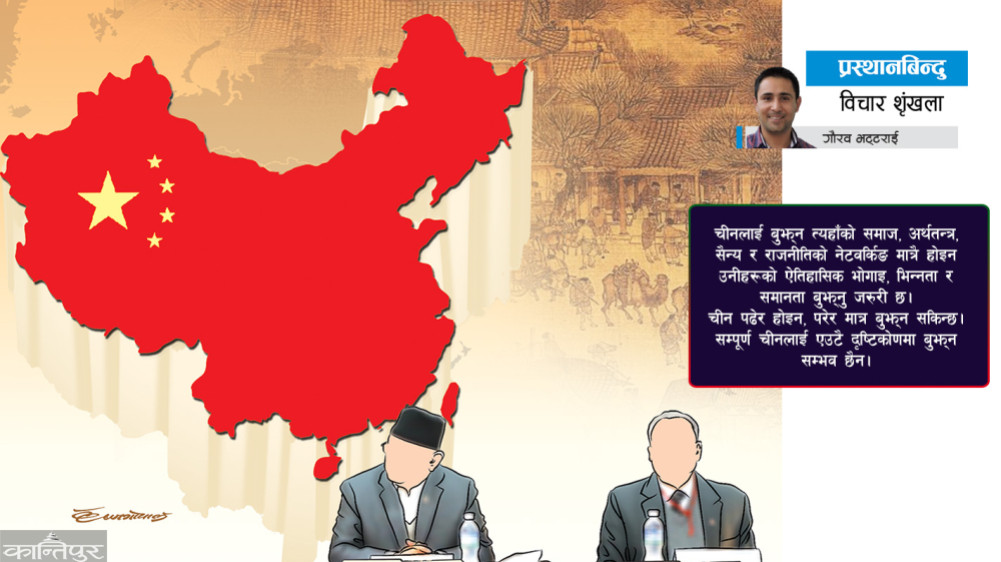
To understand China, it is important to understand not only the networking of society, economy, military and politics, but also their historical experiences, differences and similarities. China cannot be read, it can only be understood by reading. It is not possible to understand all of China from one point of view.
We use Google Cloud Translation Services. Google requires we provide the following disclaimer relating to use of this service:
This service may contain translations powered by Google. Google disclaims all warranties related to the translations, expressed or implied, including any warranties of accuracy, reliability, and any implied warranties of merchantability, fitness for a particular purpose, and noninfringement.
Nepal's foreign policy practices seem to rely less on knowledge and more on ad hoc. They focus less on practice planning and more on ritual. In relation to the two neighborhoods, ad-hocism seems to have flourished through knowledge and practice. The provision regarding neighborhood preference is found mentioned in two words in the Integrated Foreign Policy of 2020. However, the analysis of Nepal's foreign policy analysts starts from the neighborhood and ends in the neighborhood.
It is clear that the vocabulary used without thinking, discussing and interacting on the basis, reality and challenges of neighborhood and neighborhood relations leads to ad hoc and rhetoric. In this article, the question of what it means to know China is discussed, highlighting the limitations and challenges brought about by the production of knowledge about China in Nepal. While searching for an answer to the question of who introduces China to Nepal, this article acknowledges that the main challenges seen in Nepal's relationship with China cannot be solved only through the available means of knowledge production.
Knowledge production in Nepal-China relations
Until the 18th and 19th centuries, the Nepalese state used to take the help of the Chinese representative in Tibet, 'Amban', to understand China. At that time, to understand China was to understand the power of the emperor of China. It was also customary for the 'lawyers' and 'nayohs' working in Lhasa to inform the Nepalese state about Sino-Tibet relations. The Rana ruler used to understand what the British and the British Residency in Kathmandu explained about China.
After the political changes of 1950, only the then ruling class was informed about the China seen by KI Singh. About the China seen by Tank Prasad Acharya, Raja Mahendra, Manmohan Adhikari, BP Koirala, Narayanman Bijukche, Raja Birendra, Yadunath Khanal and others, the Nepalese people were also told and explained. Nepalis also got a chance to understand something about China during the visit of China's former Prime Minister Chouen Lai, Marshal Chen Yi and former Chinese President Jiang Zemin to Nepal. The development and rise of China started to be discussed gradually in the information technology and social network market that emerged with globalization. At the same time, the literate Nepali people also started consuming the knowledge produced by the western world about China. Therefore, the means of understanding China are not only high-level visits or leaders' speeches and their writings.
Chinese President Xi Jinping's visit to Nepal in 2019 has become more meaningful - for the Western world and Nepal's southern neighbors. But from Chouen Lai's visit to Nepal to Chin Fing's visit, it is said that a constant obstacle in Nepal's process of understanding China is the inability to increase the number of groups that have a grasp of the Chinese language. Although Confucius centers are operating in some cities of Nepal, the drop-out ratio of students learning Chinese is increasing. But the problem of 'drop-out' is very less among Nepalis who learn Chinese while staying in China. However, language is the means, not the end. Language is not enough to understand thought. Language is insufficient to understand the
strategy. For that, one must be able to interact with Chinese society, culture, people's life, economy, civilization, struggle. China can only be understood by reading, not by reading. In the age of Google and Artificial Intelligence (AI), the work of language can be done by smartphone, but to understand China, it is necessary to understand the networking of Chinese society, economy, military and politics. It is important to understand their historical experiences, differences and similarities. It is not possible to understand all of China from one point of view. Even when traveling from the East Coast to the West Coast of America, one can easily understand the American society, lifestyle, food, clothing, and local history by using the English language. But understanding China is not only the Chinese language. For example, 'One China Policy' and 'One China Principle' can be taken.
In September 2023, during Prime Minister Pushpa Kamal Dahal's visit to China, a joint statement was issued between China and Nepal, in one point of which Nepal's adopted 'One China Policy' was changed to 'One China Principle'. Knowing the Chinese language alone is not enough to understand why this was done. Although the meaning of principle (yuan cha) and policy (chang ch) in Chinese language are different, understanding the linguistic change requires political, geopolitical and historical knowledge. Yuan Ch (principle) refers to the broad philosophical or ideological foundation that guides the overall approach of the Chinese government. Such as the principles of socialism with Chinese characteristics. Chang ch (policy) means specific guidelines adopted by the Chinese government to achieve certain objectives. Thus policies are specific actions while principles are underlying beliefs that shape those actions.
However, Nepal's accepted 'one China policy' should be understood in the context of Taiwan or Tibet is a part of China. Be it the Nepali context or the West, principles are long-lived and policies are temporary. From that perspective, it can be understood that China is looking for a permanent commitment from Nepal. But if we look at China with Nepali or Western glasses, is that not enough to be guilty? The Chinese perspective on this context is political. The most important question is whether linguistic change will reduce Nepal's commitment to 'One China'? To understand that the change from 'policy' to 'principle' has caused China's trust to decrease, increase or create a situation where Nepal has to accept China's political claims is to look at China through western lenses.
main problem
When discussing the importance of knowledge production in the dimension of diplomatic practices, the main problem in the history of Nepal-China diplomatic communication and relations is institutional memory. Remembering the institutional relationship with China, evaluating the bilateral relationship by focusing only on big events and achievements, the big role played by small things tends to be overshadowed. For example, foreign policy experts and experts who seek the difference between 'One China Theory' and 'One China Policy' seem to be unaware of the history of Nepal's commitment to 'One China'. The employees of the Ministry of Foreign Affairs of Nepal, the former ambassador of Nepal to China, the Minister of Foreign Affairs, security experts also seem to be divided or unknown on this question. Only after understanding the history of Nepal's commitment to 'One China', it is appropriate to proceed with the discussion on whether 'theory' and 'policy' are really different. Understanding it only in the contemporary perspective that the knowledge produced in the politics and competition of power nations or the lack of necessary diplomatic communication in the China-Nepal relationship and ad hocism becomes dominant.
The reason why China does not hesitate to praise Nepal and Nepali leaders always give confidence to the Chinese Communist Party leader is Nepal's commitment to 'One China'. Regarding the political history of such an important topic, knowledge production on it and the first use of the term 'One China Policy', discussions, interviews and news on Nepal-China relations seem to be silent. As a result, it is natural for the institutional memory to weaken. In the future, it cannot be said that the time will not come to search for the history of the 'One China Principle' mentioned in the joint statement issued during the visit of Prime Minister Pushpa Kamal Dahal to China in September 2023. The two former foreign ministers who do not have original copies of the Sugauli Treaty of 1816 with the British and the Nepal-India Treaty of 1950 have already spoken publicly. This means ignoring the invaluable role of archives and institutional memory in diplomatic relations and communication.
Analyzing the 'One China' theory as Nepal's acceptance of China's political claims during the rivalry between the superpowers, it is not only seen that the history of Nepal's commitment to one China is not understood, it is clear that the western perspective of China is heavy in the production of knowledge about it. Although Tank Prasad, Raja Mahendra and BP are credited with laying the foundations of Nepal's 'One China' commitment, it is easy to understand that commitment only by considering the international and regional political environment of that time, and not by discussing linguistic changes in contemporary perspective. Although Nepal expressed its commitment to 'One China' in the 1950s, it is not so easy to find the answer when the language of 'One China Policy' was used in joint statements and diplomatic letters. Admirers of monarchy want to give credit to panchayats while left-wing historians want to give credit to communist leaders and prime ministers. Some say that it started with the treaty on Tibet, citing Tank Prasad's name, while others say that Nepal adopted America's 'one China policy'.
Therefore, it is clear that archival preservation and institutional memory are weak in Nepal's diplomatic history. Whether King Birendra's Khampa dissolution is taken as a starting point or Manmohan Adhikari's visit to China in 1995. At that time, using the terminology of 'One China Policy', if the official's communist personality and the Chinese Communist Party's relationship with the Nepali monarchy are considered as the basis, it becomes a guilty spectacle once again. The Khampa dissolution itself was only successful because of the restoration of harmony in Sino-US relations. Similarly, understanding the literal change from 'Policy' to 'Principle' cannot be based only on the communist personality of Pushpa Kamal Dahal. Nepal's commitment to 'One China' seems to have existed long before it was literally used, whether it was based on the 1956 Treaty or the 1971 UN General Assembly Resolution 2758.
There is a kind of cordiality, ideological brotherhood and international unity between the leaders of the Chinese Communist Party and the Communist Party of other countries, but if Nepal's 'One China' commitment is interpreted only by the Communist ideology, it will not take long to come under its ownership. Aren't the voices raised on the difference between 'policy' and 'principle' leading to the same path?
Globally, the "one China policy" originated as a "bargaining chip" for Chinese strategic interests and American security interests rather than a combination of communist and democratic ideologies. During the Cold War, when the Soviet Union's relationship with China was deteriorating, the US used the 'One China Policy' as a bulwark. Soon after, many democratic and communist countries adopted the 'One China Policy'. But the present time is different. Even if the 'one China policy/principle' is not free from the side effects of Sino-US rivalry, if we evaluate it only from the perspective of linguistic and political belief, will it be late to understand how China thinks?
How to know China?
The first thing, to know China is to know who? Communist Party behavior or ideas? To the Chinese people or their understanding and actions? The China of Lhasa or the China of Sichuan or the China of Beijing? To the Chinese businessman or his business? To the Chinese soldiers or to its military power? In the same way, who knows or knows China in Nepal? The China known by the Prime Minister (the China of being welcomed in Chinese cities and airports, the China of correcting agreements)? The China known by the foreign minister (visiting China, sitting in negotiations)? The China known by the Foreign Secretary (reporting and updates received from the Embassy and overall diplomatic communications)? China seen by the ambassador (during his tenure)? China seen by Nepali traders bringing goods from cities near Chinese ports? Nepalese students studying in China know China? Considering the more important geographic vastness, which China should be recognized? To Beijing? To Shanghai? Sichuan? Tibet? Kunmin? Guangzhou, Hong Kong or Taiwan?
To understand the change from 'policy' to 'principle', it is not customary to search for answers to so many questions. It is customary to understand only the foreign policy of the Chinese Communist Party and the characters associated with it. That too from western glasses. At present, the pillars of China's foreign policy are perhaps interpreted as the BRI and the 'One China Policy/Principle'. Whenever China feels that these two pillars are under pressure, it seeks commitment to 'One China' from a country like Nepal in various ways. At the same time, an example of linguistically persuasive style is the joint statement issued by Nepal and China. But understanding this only as the sensitivity of diplomatic language will dilute Nepal's understanding of China. A sense of perspective is limited. Knowledge production seems ambiguous.
Knowing China for the Prime Minister's Office is limited to understanding 'political networking' and 'special dignitaries'. China for the Ministry of Foreign Affairs is only centered on employee recruitment in the preparation and embassy in high level visit and embassy. However, for the employees of the Foreign staff, the west country to speak English is priority. Similarly, Confucius Center seeks to attract students at university in university. Nor is it about China in the university, nor about its political philosophy and diplomatic history. China, who is outside the university divided and polented. Translation and BRI project translated into Chinfing Speech of A Speech Cognition Speech and BRI project are incense, while China publishing the report against the other person. Confirmed by the assistance against China against the oneon's financial assistance from China, including publication and interacting. How can China's study of study of China's studies be scientific, reliable, and legitimate? When the change from the policy is put into the field, we are more than China's unlike China's unlike China. Why don't we have the Magarmourg, we have to see China? While the Buddhorms have shown in the discussion of Nepal-China relations) even if Buddhism (holds the center of the midmosture in the center). & Nbsp; Stormy - Breaks, Sinjan Sno, refune to various historic period of Nepal-China relations, said China, Martin Jacks 'China, the Chinese Ruler's World'. Purl S's looks deeply impressed by China mentioned in 'Good meaning'. Even today, the Communist leader and writer's China's China's Chinese understanding of Mao's story, Shamohan Officer Nepal and Mind Mind Committee and Narayan Articles are also directed from China's visit.
, it seems necessary to understand the politics of infrastructure and energy to understand today's China. China's BRI and Nepal are unlikely to import treatment of China, leader, leader and his Asci, is expelled to understand the strategy of the financial centers and markets of its South Asia. The delay in BRI implementation is a vivid example. But it is also wrong to understand that the process of 'theory' from 'theory' 'from the' principle 'of the syssage' in this perspective. & Nbsp; From
's relationship, Nepal-China relations are more than by the emotion, from the development of the benefits, from the epidemic, from the epidemic. Nepal is seen even when they do not understand each other's language, Nepal-China relations. For example, diplomatic relations have been established with Patan's 'Rama' family during Patan Rajwan. All parties also all exchanged by diplomatic missions from 1384 to 1427 1327. To hear, it may seem strange that the Chinese uttered 'Lama'. Because of the difficulties of pronounces sound because of the difficulties that the word followed sound, the gems were not associating with the "Rama 'family's Hindus. It exposes two facts: First, how the language and pronunciation, there is a vandamod of the fact.
is the one who is in the connection and move forward but also in a relationship to move forward or understand each other. Nepal-China relations. Therefore, there are a complexity on the journey of 'theory' from 'theory' to 'from' theory 'to', and how and why do they become charges before the elderly of Nepal-China relations? The answer should either seek in the power of power either in the security interest. The language is only means, it is not possible. & Nbsp;
- Bhattarai teach international relations and diplomacy at Tribhuvan University.