During the Janajati Movement, the inscription was also destroyed by fire when the Department of Roads caught fire.
We use Google Cloud Translation Services. Google requires we provide the following disclaimer relating to use of this service:
This service may contain translations powered by Google. Google disclaims all warranties related to the translations, expressed or implied, including any warranties of accuracy, reliability, and any implied warranties of merchantability, fitness for a particular purpose, and noninfringement.
UML General Secretary Shankar Pokharel wrote on social media: 'A name may be erased from an inscription, but history cannot be erased!'
The inscription he referred to is that of the Nagdhunga–Sisnekhola Tunnel.
The foundation stone of the tunnel was laid by then Prime Minister KP Sharma Oli. Posts on social media claim that the current government has removed the inscription bearing his name. Without understanding the reality, General Secretary Pokharel further wrote, 'The removal of KP Oli's name from the foundation stone inscription of the tunnel is a vile prejudice and politics of revenge by the government. In fact, the actions being taken by the government led by Balen, forgetting history and democratic values, will only push them toward an unfortunate downfall!'
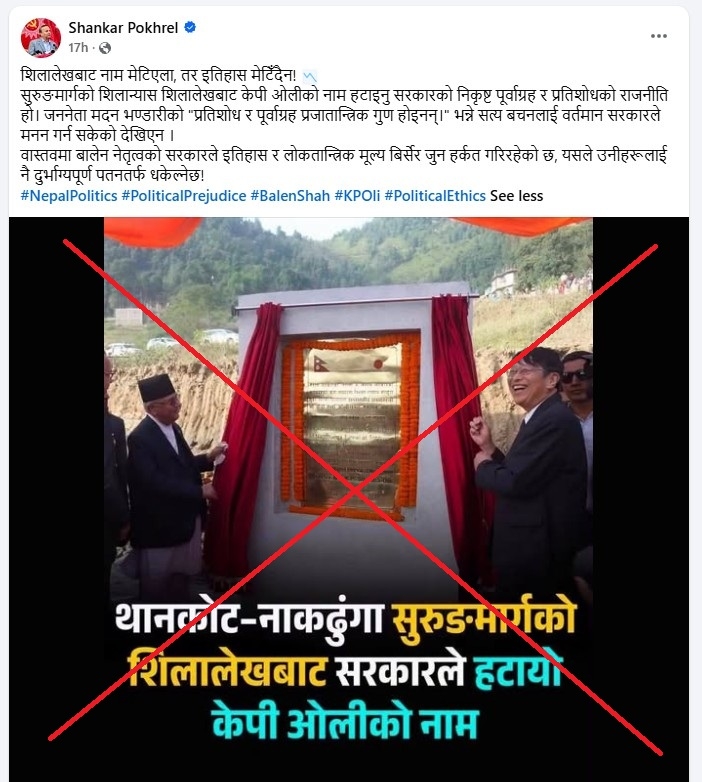
What is the reality?
According to the Department of Roads, the inscription placed at the site of the foundation stone on the Kathmandu side was removed a year ago because a building for CCTV cameras needed to be constructed there as per the tunnel's design.
Director General of the Department, Bijay Jaisi, said that the inscription was taken and kept at the Department's office in Barmahal at that time. 'It was brought and kept at the Department before this government came to office,' he said. 'During the Jen–Ji movement in Bhadra, a fire caused damage to the Department, and at that time, the inscription was also burned and destroyed.'
He said that the current claims on social media about the removal of the inscription are not true. 'I don't know why this is being exaggerated,' he said.
The tunnel will come into operation tomorrow, Monday. However, Jaisi said that no decision has been made regarding whether to reinstall the foundation stone inscription. According to a Department source, such items are rarely kept in tunnels.
The foundation stone of the tunnel was laid by then Prime Minister KP Sharma Oli on Kartik 4, 2076 BS at Tutipakha, Chandragiri Municipality–2, Kathmandu.
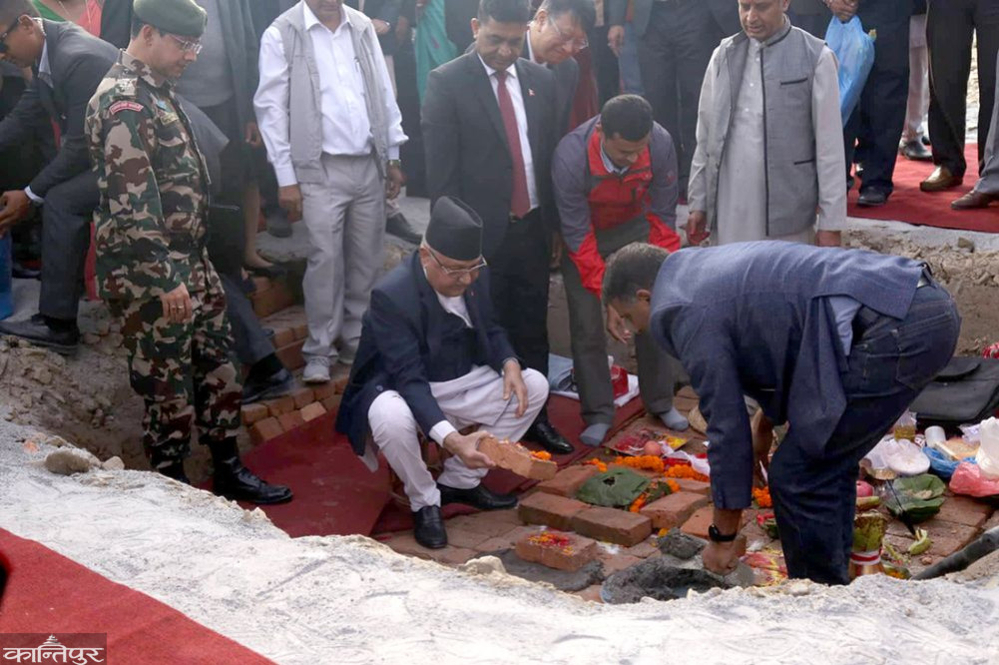
Although it was initially said to be completed in 42 months, the tunnel is coming into operation on Monday after 80 months of construction. The tunnel will be open 24 hours a day.
In the first phase, the tunnel will be opened for emergency vehicles. According to Saujanya Nepal, Director of the Nagdhunga Tunnel Construction Project, on the first day, Monday, only ambulances, fire-fighting vehicles, and security vehicles will be allowed.
Tolls have already been set for vehicles using the tunnel. Pedestrians, two-wheelers, three-wheelers, and non-motorized vehicles will not be allowed to enter the tunnel. Vehicles carrying highly flammable substances such as diesel, petrol, gas, and explosives are also prohibited from entering the tunnel.
An N-Tag system based on RFID (Radio Frequency Identification) technology has been arranged for paying the tunnel toll. For now, N-Tags can be purchased with cash amounts of one, two, and five thousand rupees.
Entry is prohibited for pedestrians, motorcycles, three-wheelers, and non-motorized vehicles. Vehicles carrying highly flammable and explosive substances such as petrol, diesel, and gas will also not be allowed to enter the tunnel.
Yusin–ART JV will operate and manage the tunnel for five years, while Japanese company Hazma Ando Corporation has a contract for maintenance for one year.
The tunnel was built with approximately Rs 21.5 billion in concessional loans from Japan and Rs 6 billion investment from the Government of Nepal.


