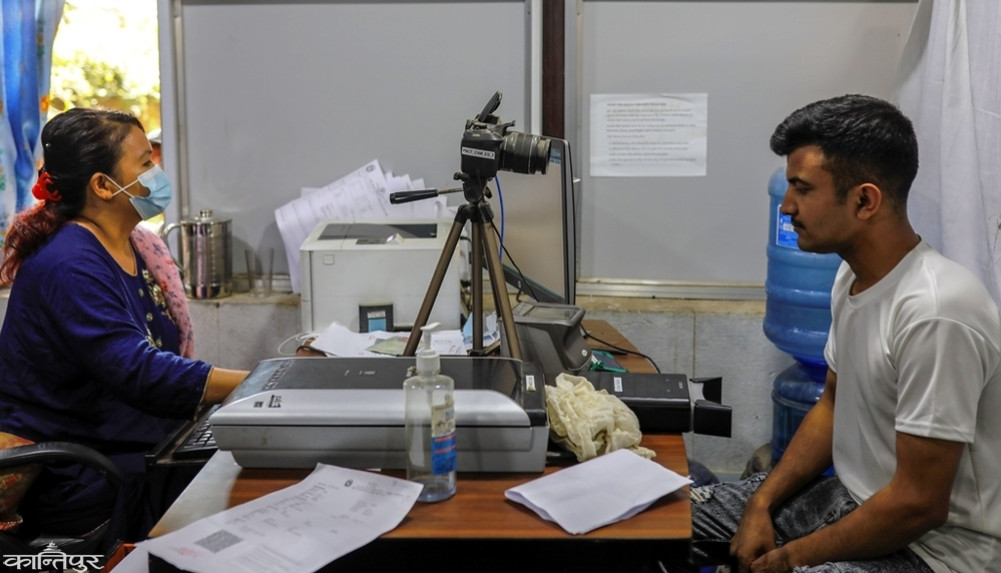
Based on the proposal of the Department of National ID and Civil Registration under the Ministry of Home Affairs, the Council of Ministers led by Balendra Shah decided on June 12 to procure the ABIS system through a government-to-government (G2G) agreement with the French company 'IN Group'.
We use Google Cloud Translation Services. Google requires we provide the following disclaimer relating to use of this service:
This service may contain translations powered by Google. Google disclaims all warranties related to the translations, expressed or implied, including any warranties of accuracy, reliability, and any implied warranties of merchantability, fitness for a particular purpose, and noninfringement.
The government is set to purchase 10 million Automated Biometric Identification System (ABIS) units for the national identity card from a French company without competition. The government has decided to procure them from ‘IN Group’, the parent company of ‘IDEMIA’.
Based on a proposal from the Department of National ID and Civil Registration under the Ministry of Home Affairs, the Council of Ministers led by Balendra Shah decided on June 12 to purchase the ABIS system from the French company ‘IN Group’ through a government-to-government (G2G) agreement. Previously, the department itself had canceled an agreement with IN Group. However, it has now decided once again to purchase from the same company. Earlier, the department had purchased the ABIS license from the French private company ‘Safran Identity’.
The procurement issue has come to light as the license period for the ABIS system is about to expire and the Department of National ID has only a few thousand biometric identification systems left in stock. After the licenses purchased from IDEMIA expired, the department began preparations to purchase from IN Group. Since 2010, IDEMIA has been providing passports to Nepal.
IN Group has also acquired ownership of Safran, which previously supplied the ABIS system to the department. “After the Cabinet decision, the Ministry of Home Affairs has formed a negotiation team for an agreement with IN,” said Department Director General Krishna Paudel to Kantipur. He stated that the price of ABIS will be as proposed by the department. According to the Cabinet decision, out of the 10 million units, 1.5 million will be purchased directly from the company, while the remaining 8.5 million will be procured under the G2G agreement.
“Once the negotiation team concludes discussions and reaches an agreement, the price of the ABIS system will be determined,” Paudel said. “We have already informed the company of our decision.” This procurement process will be conducted directly from ‘IN Group’ through a G2G agreement.
According to the proposal, as per the Cabinet’s decision of March 25, 2019, the government had decided to purchase an additional 10 million ABIS licenses in March 2019 to expand the system’s capacity. The goal was to extend this capacity to register up to 30 million citizens.
According to the department, the proposed cost for the ABIS system is €0.0995 per unit, as proposed by the supplier in 2011. The government has proceeded with the procurement at the same rate. “Since the ABIS license period has expired, the Department of National ID and Civil Registration has been facing difficulties in service delivery,” said another official. “After service recipients repeatedly faced problems, the government decided to procure the system through a G2G agreement.” According to one official, a month ago, a meeting of outgoing Chief Secretary Suman Aryal and other senior government officials decided to immediately procure the ABIS system. The meeting made this decision based on the provision in Section 3 and Subsection 41 of the Public Procurement Act, which allows direct procurement under special circumstances.
The government first launched the national identity card (NID) program in 2009 as a pilot project for employees in Panchthar district and Singha Durbar. Under this, a budget of Rs 190 million was allocated with the goal of distributing national identity cards to 250,000 citizens.
In the second phase, the government decided to expand the service to all Nepali citizens by distributing national identity cards with biometric details and a unique identification number. For this, the government decided to purchase ABIS licenses for 20 million records. The agreement worth Rs 6.7 billion was signed on June 10, 2019.
The company supplying the system, ‘IDEMIA’, is the same company that printed Nepal’s passports for nearly 16 years. Of IDEMIA’s three branches, ‘Smart Identity’ was sold to ‘IN Group’ a year ago. According to the department, since the branch responsible for Nepal’s ABIS license has been transferred to the French company (IN Group), the department is preparing to purchase additional ABIS licenses from IN Group. As the agreement period with IDEMIA has now expired, the government has decided to directly purchase additional ABIS licenses from IN Group.
However, government officials have not been able to clearly justify the direct procurement of the ABIS system without open competition. Section 41 of the Public Procurement Act allows for direct procurement without competition if only one supplier with the required technical capacity is available, if there are exclusive rights to provide the goods and services with no suitable alternatives, or if additional goods and services must be compatible with the existing system.