In videos that have gone viral on social media, individuals claiming to be journalists have increasingly been entering government offices without permission and interrogating and intimidating employees under the pretext of checking their dress and ID cards.
We use Google Cloud Translation Services. Google requires we provide the following disclaimer relating to use of this service:
This service may contain translations powered by Google. Google disclaims all warranties related to the translations, expressed or implied, including any warranties of accuracy, reliability, and any implied warranties of merchantability, fitness for a particular purpose, and noninfringement.
On Asar 7 (mid-June), a video became widely discussed on social media. In the 9-minute, 10-second-long video, a heated argument and physical altercation between two people can be seen. One of the individuals in the footage is a ward chairperson, while the other is a woman who claims to be a journalist.
This incident involves Rabindra Devkota, the ward chairperson of Bhimdatta Municipality-18 in Kanchanpur, and journalist Aishwarya Kunwar. The video, posted from Kunwar’s own account at 5:53 pm on Sunday, clearly shows the two exchanging words for some time before the situation escalates to physical contact. In the video, journalist Kunwar is also seen pushing and shoving ward chairperson Devkota.
After assaulting the ward chairperson, she was taken into police custody, and the Kanchanpur branch of the Federation of Nepali Journalists also suspended her. However, this is neither the first nor the only incident where someone, under the guise of being a journalist with a mic (boom) and camera, threatens or bullies others.
The main responsibility of journalism, considered the fourth estate of the state, is to inform society, point out irregularities, and promote good governance. In a democratic system, the freedom granted to the press means investigating the truth and advocating for citizens’ rights. But recently, with technological development and the growing reach of social media, serious questions have arisen about the fundamental values, principles, and code of conduct of journalism.
There is a growing trend where, as soon as someone picks up a mic and camera, they see themselves as the state’s ‘supervisor’, ‘judge’, or even ‘police’, and go to public offices to berate employees and elected representatives. Several recent incidents that have come to light confirm this trend.
The incident in Kanchanpur, where a ward chairperson was assaulted, was extreme. However, entering government offices and schools to harass employees has become a daily occurrence. In videos found on social media, some individuals enter government offices’ workspaces without permission, boom mic in hand, and start unnecessarily interrogating employees about their ‘dress and ID cards’.
Similar scenes are frequently found on the Facebook page and YouTube channel called ‘Sunchhahari Khabar’. In one video uploaded from that page, a man holding a black boom mic questions a female employee of Dangisharan Rural Municipality in Dang district.
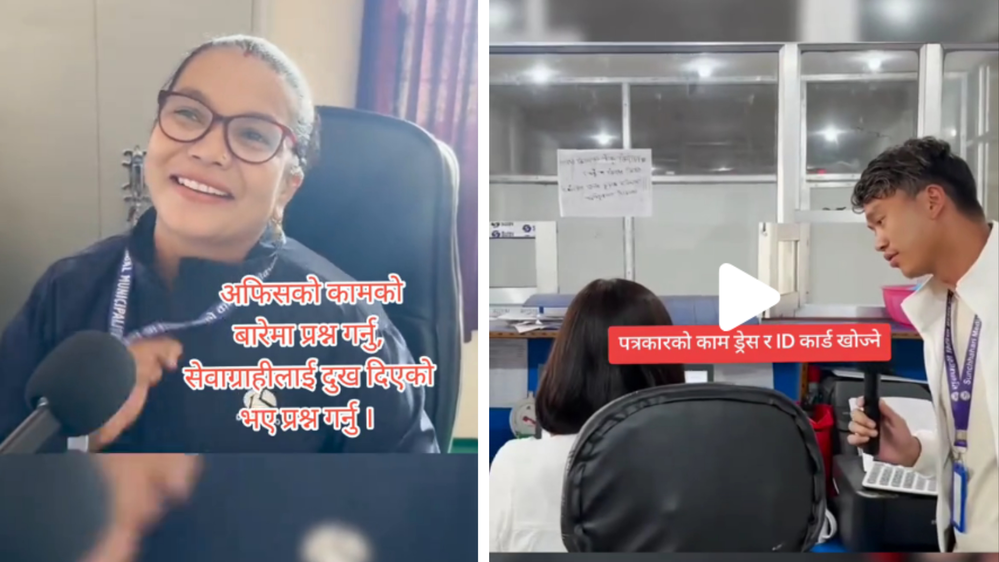
Boom mic holder: “Are you feeling cold?”
Employee (unzipping her jacket): “I’m not cold, sir.”
Boom mic holder: “Then what’s the matter?”
Employee: “Nothing’s the matter.”
Boom mic holder: “Is this your uniform, then?”
Employee (nervously): “More than the uniform, yes, this is the uniform, sir.”
Boom mic holder: “Please stand up. Is this the uniform?”
Employee (looking at her outfit): “This is the uniform: white shirt, blue pants.”
Boom mic holder: “Are you sure about the shirt? Swear on your faith.”
Employee: “It’s a T-shirt, sir.”
Boom mic holder: “It’s a market-bought T-shirt. Are you going straight to the market from here after work?”
Employee (shaking her head quickly): “No, no. Sometimes it gets dirty. Since it’s white, it’s considered the uniform.”
Boom mic holder: “You must be clever, we’re feeling hot. Because people can see from outside, you wear a jacket…”
Employee (nervously): “No, no, sir. If you see me anywhere, let me know. I always wear a jacket.”
Watching this scene, it seems he is ordering the employee around, with no awareness of the nature of his questions. The same person, in another video, enters the office of Ghorahi Sub-Metropolitan City while an employee is on the phone and again interrogates about the uniform. He forces the employee to take out their ID card from their bag and show it on camera. In the video, the employee is clearly scared and reluctant to speak, but the boom mic holder keeps firing question after question.
This same person also pressures another female employee to stand up and show her outfit, claiming that the government does not recognize tailored clothes as uniform. Watching other videos posted from this account reveals the same ‘pattern’. He does not consider the employees’ privacy, nor does he ask for their consent to speak. His main goal seems to be to barge into offices and create panic by demanding, “Where is your uniform and ID card?”
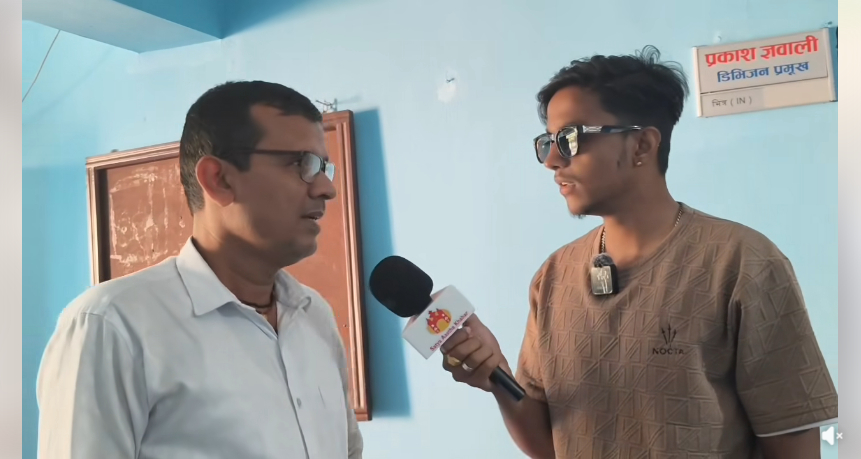
The same style is seen in a video posted from the ‘Satya Astha Khabar’ Facebook page. A man wearing black sunglasses enters the Division Office of Groundwater Resources and Irrigation Development in Birgunj, Parsa, with a boom mic. He not only questions employees about their attire and ID cards but also carries the attendance register, interrogating at the gate about when each employee arrived and left. Watching the video, it seems as if he is the head of some official monitoring body for government offices.
Such stunts, carried out in the name of ‘surprise inspection’ in offices, are also frequently found on platforms like ‘Sanchar Hub Online TV HD’ and ‘Falano News’ (Gandaki Chadke). Carrying a boom mic labeled ‘Pyuthan Chadke’, a person arrives at a rural municipality early in the morning and interrogates employees about attendance and timing as if they were criminals. In all these videos, the attitude of those claiming to be ‘journalists’ and ‘media workers’ is the same.
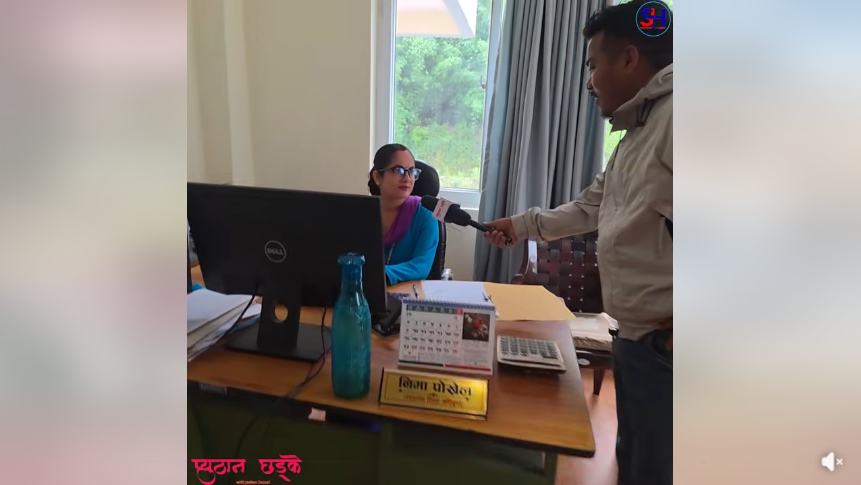
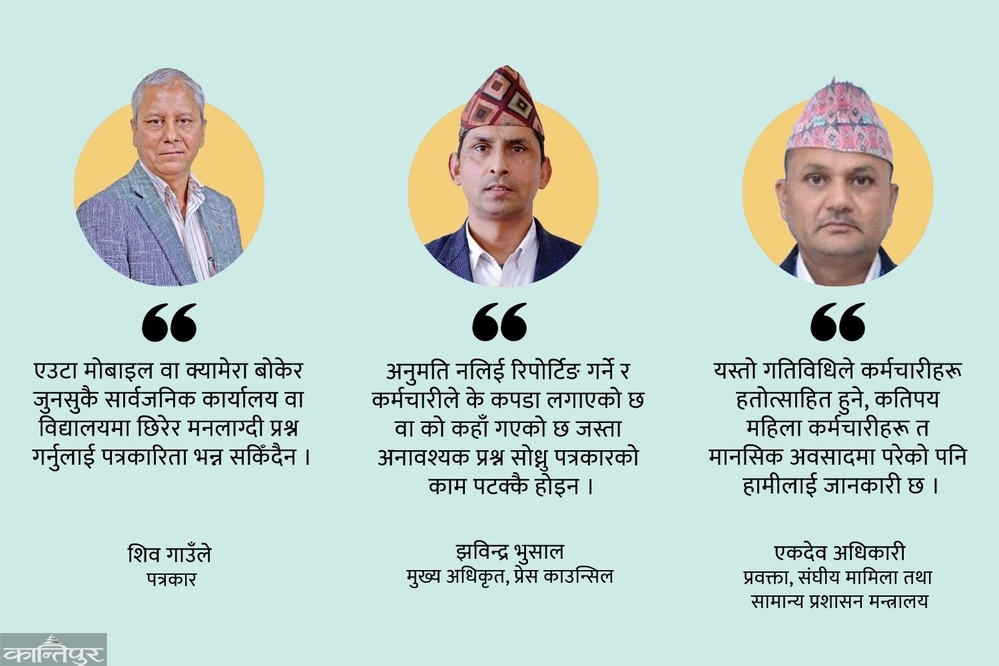
According to Ekdev Adhikari, spokesperson for the Ministry of Federal Affairs and General Administration, such activities carried out in the name of monitoring have caused government employees to suffer mentally. “In some places, employees have been mistreated, and even when they are working properly, they face unnatural pressure and are made to feel as if they are acting out of self-interest,” says spokesperson Adhikari. “If this is left unchecked, it disrupts office work and demoralizes employees. We have even learned that some female employees have fallen into mental depression.”
Is what they are doing—this ‘surprise inspection’ or ‘monitoring’—really journalism? Chief Administrative Officer of Press Council Nepal, Jhabindra Bhusal, rejects this notion. According to him, terrorizing government offices with a media boom mic is against the journalistic code of conduct. “Entering offices indiscriminately, reporting without permission, and asking unnecessary questions like what employees are wearing or where they have gone is not the work of a journalist at all,” he says.
Vice President of the Federation of Nepali Journalists, Neetu Pandit, also argues that their actions do not fall within the definition of journalism. “For something to be journalism, values, principles, and the code of conduct must be followed,” says Pandit. “That is not reflected in their actions. Such activities go against the basic principles and code of conduct of journalism, so they cannot be called journalism.”
Former President of the Federation of Nepali Journalists, Shiva Gaunle, also says such antics have nothing to do with journalism. “The style of walking around with a boom mic that is currently in use has no connection to journalism,” Gaunle told Kantipur. “Carrying a mobile phone or camera and entering any public office or school to ask whatever questions you like cannot be called journalism.”
According to Gaunle, journalism has an accepted method. Journalists must determine in advance and collect information according to a process. “First, the information must be of public importance. Second, there must be at least minimal research and pre-determined questions for information gathering,” he said. “It is proper procedure to seek permission from the office’s information officer or chief and only meet at the time they provide.”
Similarly, Kundan Aryal, head of the Department of Mass Communication and Journalism at Tribhuvan University, says that poor standards are becoming the norm in journalism and that practitioners themselves are encouraging this. “What does an ordinary child understand by ‘journalist’? They think a journalist is someone who ‘berates and scolds’,” he says. “The standards set by Nepali media are themselves ‘rough and ready’. The practitioners themselves are rough, and they have no values or principles.”
Despite criticism and controversy, those making such videos claim they only go to offices to ‘investigate’ after receiving complaints from the public. “The journalism we do is mainly based on complaints and information received from the public. We don’t know directly what is happening in which office, but when service seekers complain that employees are not arriving on time or are delaying work, we go there,” says Gaurav Barma, managing director of Satya Astha Khabar.
Similarly, Jeevan Hamal of ‘Sanchar Hub Online TV HD’ argues that their work is focused on addressing public complaints and issues where service seekers have not received services. “We mainly go to offices based on public complaints, because when employees are not present on time, service seekers do not get services,” he said. “The main role of the media is to act as a ‘bridge’ between the people and the government.”
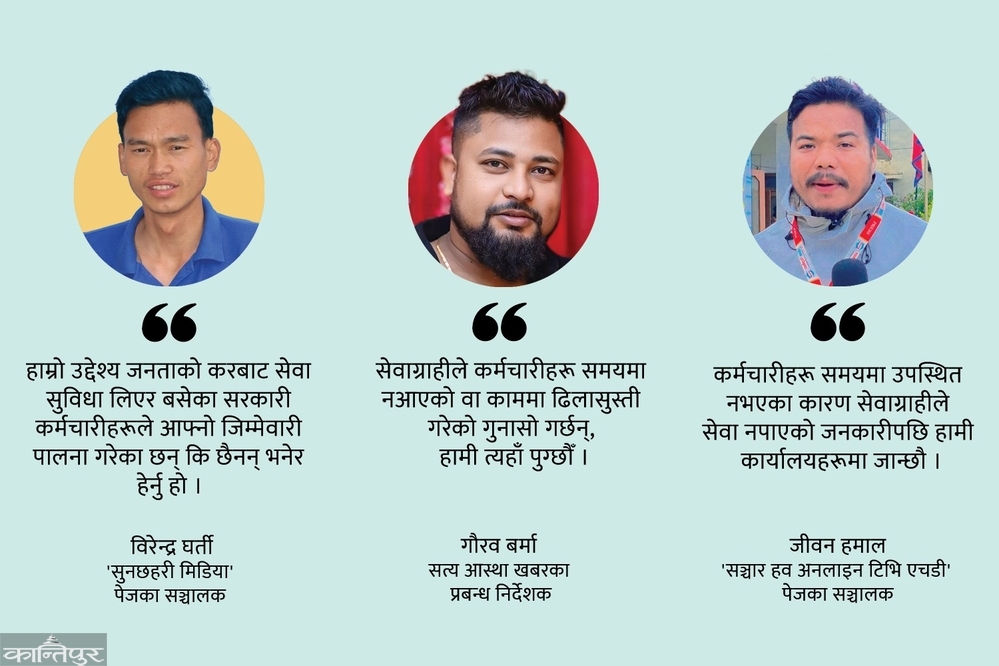
Birendra Gharti of ‘Sunchhahari Media’ claims they have to do their own reconnaissance to see whether employees are fulfilling their responsibilities. “Our main objective is to see whether government employees, who receive services and facilities from the people’s taxes, are fulfilling their responsibilities,” Gharti told Kantipur. “I believe that office hours and discipline among employees are the first priority for good governance.”
Interestingly, they themselves admit that they do not fully implement the journalistic code of conduct. “Sometimes the code of conduct may not be followed, but it doesn’t apply to everything. During ‘sting operations’, not everything is considered,” Gharti said.
When Kantipur asked, “Isn’t there such a thing as employee privacy?” Gharti replied, “It depends on what kind of privacy, sir. We haven’t filmed anything confidential.” Similarly, Hamal of ‘Pyuthan Chadke’ claims he only enters after getting permission. “You can see in my videos. I enter after asking to come in,” Hamal says. “But now I have started focusing on specific issues.”
How can such activities carried out in the name of media inside government offices be stopped? According to spokesperson Adhikari of the Ministry of Federal Affairs and General Administration, it is the government’s job to regulate if employees do not follow proper conduct. On such matters, journalists can inform the regulatory officer or supervisor, and only then can the system be managed. “Rather than asking about an employee’s personal conduct, such questions should be directed to the office chief or regulatory body,” he said.
Adhikari said that discussions are ongoing at the ministry to address such activities carried out under the guise of journalism. “If we try to regulate this in a restrictive way, it could shrink the overall big picture of our good governance,” he says. “A method needs to be developed that holds both employees and social media users or media accountable. That method should be a middle path, one that does not restrict openness and transparency.”
Meanwhile, Press Council Nepal has also stated that it is monitoring those who engage in such activities. “We are monitoring such activities. Some have been cautioned through letters, notices, and phone calls,” said Chief Administrative Officer Bhusal. “The process of taking action against those acting indiscriminately has been initiated.”
However, Vice President Pandit of the Federation of Nepali Journalists emphasizes that press and freedom of expression should not be restricted in the name of regulation. “It is wrong to file criminal charges solely on the basis of expressing opinions or content unless it is highly harmful,” Pandit said. “The state must be responsible in regulation, but it should not be in a threatening or imprisoning manner.”
To address existing distortions, Aryal, head of the TU Department of Journalism, points out that the entire journalism sector needs to engage in self-reflection and reconsider the standards that have been set. “In any profession, one must be accountable to society. We need to have discussions about our practices that are connected to society,” he says. “It seems we still need to invest in ‘grooming’. Just as a father becomes responsible after his children grow up, we need to pay attention to what we are teaching the new generation.”
Journalist Shiva Gaunle suggests that those engaging in such activities need to be taught the basic grammar of journalism. “Relevant professional organizations and legal bodies like the Press Council should run media literacy classes,” he said. “To stop the mental stress and panic caused to government employees in the name of journalism, these people need to be made literate.”

