After cocaine worth Rs 467.1 million was seized in just one year, investigators say Nepal is increasingly becoming a transit point for international cocaine traffickers.
We use Google Cloud Translation Services. Google requires we provide the following disclaimer relating to use of this service:
This service may contain translations powered by Google. Google disclaims all warranties related to the translations, expressed or implied, including any warranties of accuracy, reliability, and any implied warranties of merchantability, fitness for a particular purpose, and noninfringement.
After exiting Tribhuvan International Airport, the 62-year-old Colombian woman kept glancing repeatedly at her suitcase. Sometimes she pretended to make phone calls, sometimes she looked around. Officers from the Narcotics Control Bureau (NCB) were monitoring her activities from a distance.
When she reached a hotel in Thamel, she met with an Indian woman there.
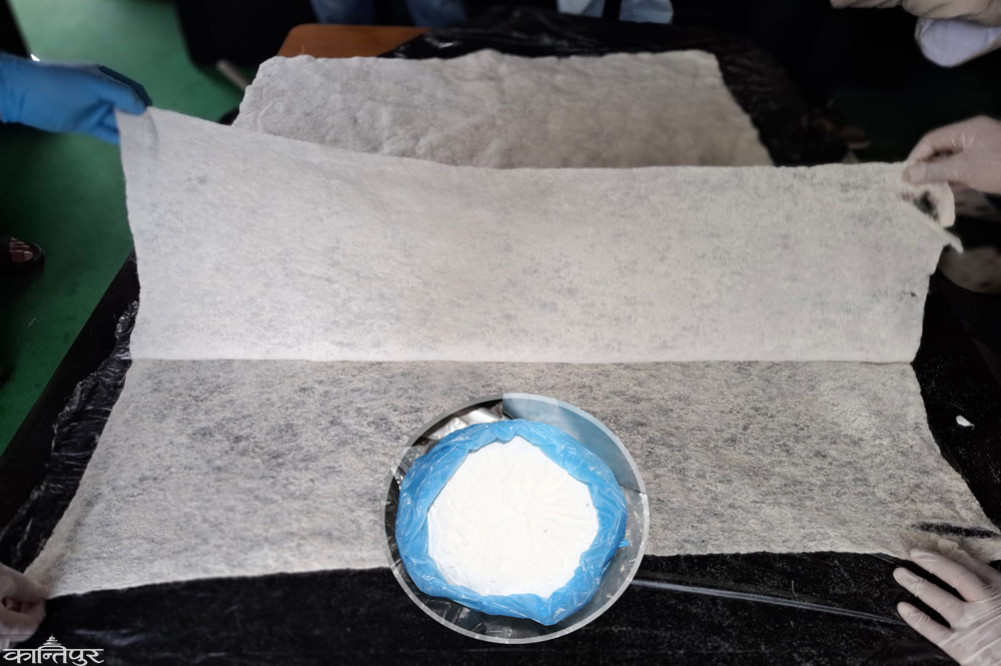
“Her behavior matched exactly with that of a drug trafficker,” said one of the bureau’s investigating officers. “After searching her, cocaine was found hidden inside a false bottom in the suitcase, concealed within a blanket, mat, jacket, apron, and neck pillow.”
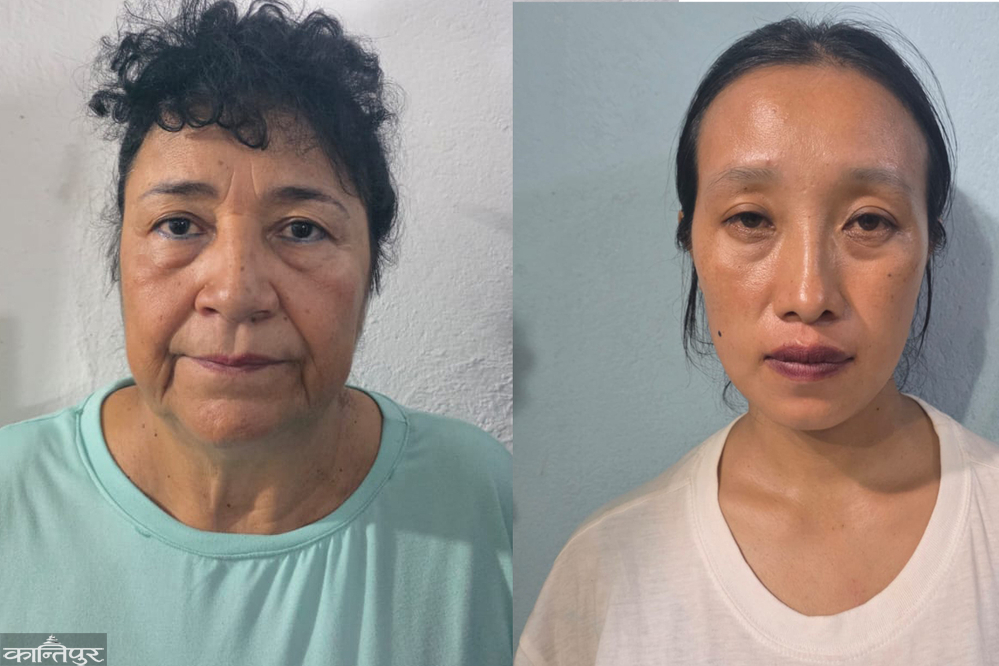
After opening the false bottom of the suitcase, 4 kilograms of cocaine, mixed with silicon and shaped like thin fabric, was found. Colombian woman Yoneth Garzon Caicedo and 37-year-old Revika Pule from Manipur, India, were arrested.
According to the officer, Colombian national Yoneth had brought the cocaine to Kathmandu on July 15, hidden inside her suitcase via Qatar Airways. Even the airport’s X-ray could not detect it. However, as the bureau’s officers were profiling foreign nationals arriving by air and investigating those with suspicious travel details, they became suspicious of Yoneth. “In the past, women arriving from Colombia have been found to be carrying cocaine, so we pay close attention,” said another investigating officer from the bureau. “We were also suspicious because it was her first time coming here.”
According to Bureau DSP Jeevan Niraula, the seized cocaine had been mixed with silicon and made to look like fabric. “This is possibly the first time cocaine has been smuggled using this method,” he told Kantipur.
In their initial statements to police while in the bureau’s custody, both women claimed they did not know there was cocaine inside the suitcase. According to Yoneth, she had been working as a kitchen assistant at a restaurant in Buga, Colombia, for the past five years. “While visiting Cabal Park in my free time, I became acquainted with friends named Kio and Jyasom,” said a police officer, quoting her statement. “A month ago, when I was stressed because my salary hadn’t come, I was crying in the park, and at that time, they promised to find me a job.”
During that time, a person named Kendy contacted her and told her she needed to deliver some food somewhere, according to her statement. “They said they would provide a plane ticket, hotel booking, and 800 US dollars. They also said I would get good money upon returning,” the officer quoted her as saying.
According to her, without thinking much, she went from Buga Airport to Bogota, where a man brought her the suitcase by taxi. After arriving in Nepal, she was responsible for handing over the goods to someone who would come to collect them. Accordingly, she traveled from Panama to Brazil, then to Sao Paulo, Garulhos, and from Doha to Kathmandu. After arriving in Kathmandu, Indian national Revika came to meet her. However, both were arrested together.
The statement of arrested Yoneth is similar. Unemployed, she had gone to a relative’s beauty parlor one day. There, she met Nigerian woman Lily Nesi, who was married to an Indian national. “After learning that I had no work, she said she would give me a job for 30,000 to 40,000 Indian rupees, and the job was to go to Kathmandu and bring some goods,” she told police. “Accordingly, after she gave me 15,000 rupees in advance, I went to collect the goods.” She also claimed she did not know there was cocaine in the suitcase.
According to Bureau DSP Niraula, the cocaine seized in Kathmandu was not intended for consumption in Nepal. Most of the cocaine arriving via Tribhuvan International Airport is destined for the Indian market. “Sometimes, small amounts are found coming back into Nepal from border areas, but our country is not the main market,” he said.
However, the incidence of cocaine seizures in Kathmandu is increasing. Previously, on April 24, a team from the Narcotics Control Bureau arrested a Senegalese national who had arrived in Kathmandu from Ethiopia via Doha with cocaine. According to DSP Niraula, police became suspicious after noticing the unusual behavior of 43-year-old Amadou Saar. During the investigation, suspecting he might have hidden drugs in his stomach, police administered medication to induce defecation. “It was later found that he had swallowed 76 plastic-coated capsules, intended to be taken to India,” he said. “The total weight of the cocaine inside those capsules was 1 kilogram and 500 grams.”
Police also arrested 36-year-old Ruby and 31-year-old Soni, who had come from New Delhi, India, to collect the cocaine. Before that, on July 26, 2025, Indian national 35-year-old Rubina Abdullah Sheikh was arrested by police from a hotel in Kathmandu with 1 kilogram and 574 grams of cocaine. Indian national 33-year-old Arun Pratap, who had come to collect the cocaine from her, was also arrested.
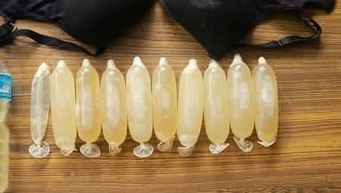 On August 5, 2025, police seized 1 kilogram and 950 grams of cocaine from Brazilian national 21-year-old Imi Mikei, who was about to travel from Kathmandu to Bhutan with the help of Santosh. According to investigating officers, while cocaine is usually trafficked from Nepal to India, this case was somewhat different. Police officers say that after arriving in Kathmandu from Brazil via Doha, she was found to have concealed cocaine inside condoms. She was arrested while trying to smuggle it hidden in her undergarments.
According to Bureau SSP Subas Bohora, in 2025/26 alone, the bureau seized 13 kilograms and 327 grams of cocaine. “Cocaine sells for 35,000 rupees per gram in the market, so the value of the cocaine seized by the bureau comes to 467,145,000 rupees,” he told Kantipur. Bureau statistics show that 18 kilograms and 919 grams were seized in 2024/25, and 12 kilograms and 939 grams in 2023/24.
Retired Deputy Inspector General of Police (DIG) Hemant Malla Thakuri, who is also a former chief of the Narcotics Control Bureau, says traffickers are trying to use Nepal as a transit point for cocaine smuggling. “Some people take it lightly, thinking it’s just a transit point, but this could create a big problem in the future,” he told Kantipur. “First, as soon as we become a transit point, there is a possibility that Nepali citizens will also become connected to organized crime networks, because someone here will have to facilitate it.” He also points out that even if large quantities are destined for other countries, there is a possibility that some could be used in Nepal as well.
Recalling that Punjab used to be the transit point for heroin smuggled from Pakistan to India in the past, he said, “At that time, people used to say it was just a transit point, but now heroin has become the biggest headache for Punjab. That’s why such matters should be taken seriously.”