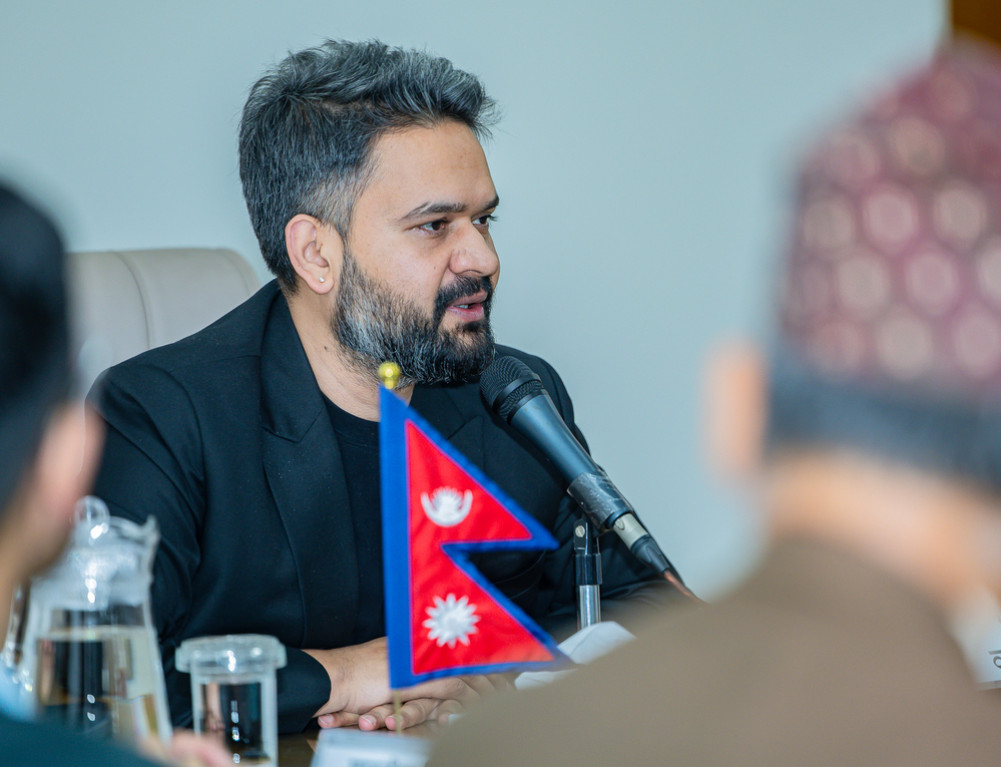
In the meetings and discussions the Prime Minister holds with various sectors, his advisors, chief personal secretary, and personal secretary are usually present, but in some cases, the relevant minister is not included. This has led to analysis that the distance between the Prime Minister and some ministers is increasing, and that advisors are becoming more influential in the governance process.
We use Google Cloud Translation Services. Google requires we provide the following disclaimer relating to use of this service:
This service may contain translations powered by Google. Google disclaims all warranties related to the translations, expressed or implied, including any warranties of accuracy, reliability, and any implied warranties of merchantability, fitness for a particular purpose, and noninfringement.
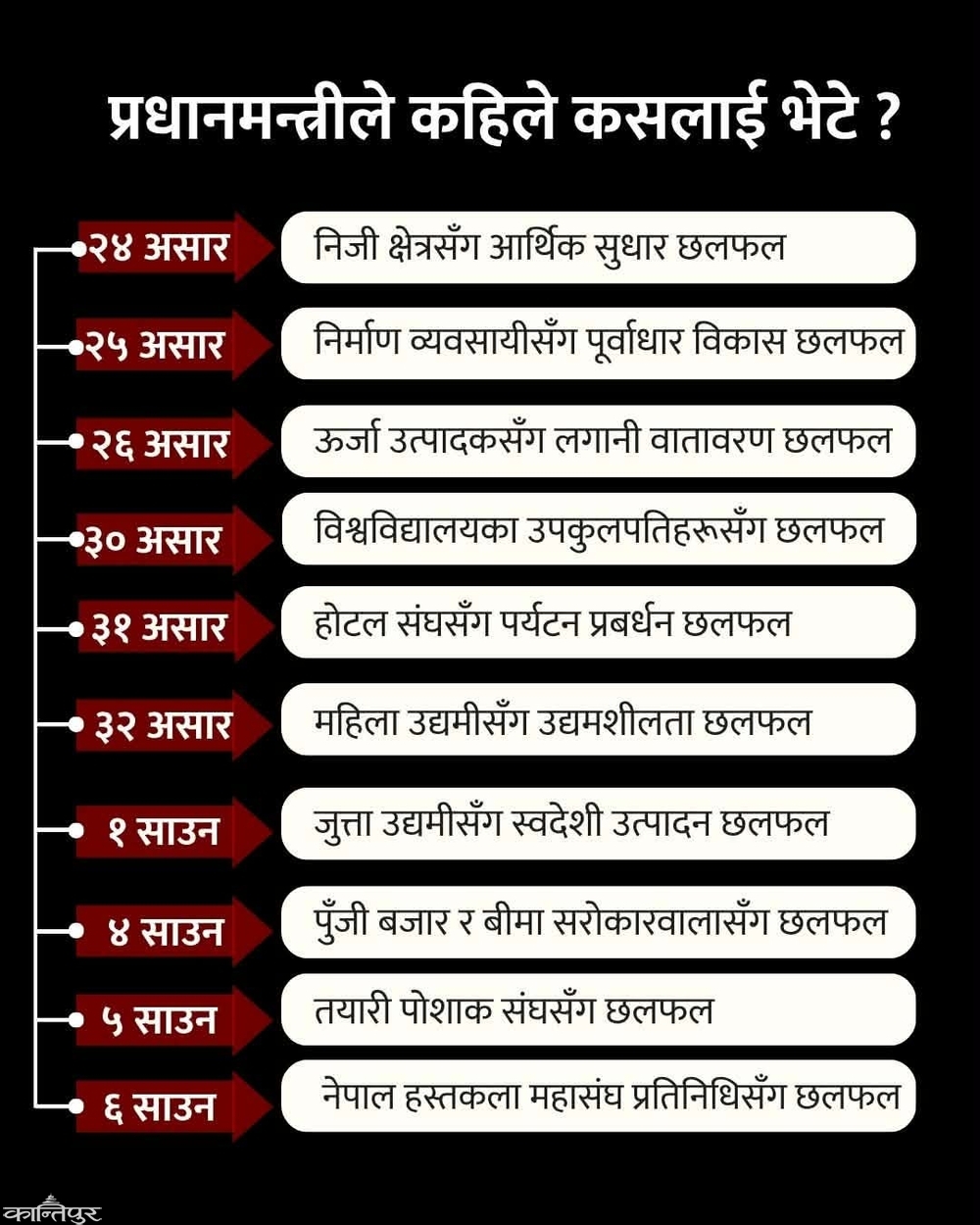
Prime Minister Walendra Shah has held discussions with representatives from 11 sectors since Asar 24. In such discussions, attended by the Prime Minister’s advisors, Chief Personal Secretary, and Personal Secretary, the relevant ministers, however, have not always participated.
In the meeting with vice-chancellors, Education Minister Sasmita Pokharel was present, and in the meeting of the National Medical Education Commission, Health and Food Safety Minister Nisha Mehta and Education Minister Pokharel participated as co-chairs. In the program of the Hotel Association Nepal, Culture, Tourism and Civil Aviation Minister Khadkaraj Paudel was included. In discussions on economic matters, Finance Minister Swarnim Wagle and Industry Minister Gauri Kumari were not included.
In the meeting with energy producers, Energy, Water Resources and Irrigation Minister Virajbhakta Shrestha was absent, and in the discussion with construction entrepreneurs, Infrastructure Development Minister Sunil Lamsal was also not present. Even for the implementation of decisions made in these discussions, the Prime Minister must assign responsibility to the relevant ministers and ministries. However, the Prime Minister has been holding discussions excluding the ministers.
Usually, the Prime Minister’s Chief Advisor Kumar Byanjankar, Political Advisor Asim Shah, Policy, Administration and Good Governance Advisor Sudip Dhakal, Information and Communication Technology Advisor Vivek Mishra, Chief Personal Secretary Subash Sharma, and Personal Secretary Navin Bhandari participate in these discussions. This has led to analysis that the distance between the Prime Minister and some ministers is increasing and that advisors are becoming more influential in the governance process.
After the completion of one hundred days since the formation of the new government, Prime Minister Shah has been meeting people from various sectors almost daily. The government was formed under the leadership of senior Rastriya Swatantra Party leader Shah on Chaitra 13, 2082. The government completed its first hundred days on Asar 20.
Although the government claimed to have initiated significant work and launched a campaign to lay the foundation for good governance within the first hundred days, the lack of supporting data and declining morale in the private sector prompted Prime Minister Shah to take the initiative in holding discussions himself. In discussions with the private sector, the main concerned ministry is Finance. However, participants in the discussions have expressed concern that Finance Minister Wagle himself was not present.
Culture, Tourism and Civil Aviation Minister Khadkaraj Paudel (Ganesh), who participated in the discussion with representatives of the Hotel Association Nepal (HAN) on Asar 31, said that if a minister’s immediate response is required, the Prime Minister calls them. “This applies to all ministries,” he told Kantipur. “If ministers are busy or out of Kathmandu, the Prime Minister does not call them.”
Former Secretary and former Chairman of the Public Service Commission Umesh Mainali said that when the Prime Minister holds discussions with the private sector and various stakeholders in the country, he should include individuals recognized by the constitution and law. He argued that involving individuals who are not legally accountable and not recognized by law in discussions would demoralize those who have to work in the future. “Those who are legally accountable are the positions defined and recognized by law. The positions recognized by law are secretary, chief secretary, minister, and prime minister. Individuals not recognized by law should not dominate the governance process; the prime minister and ministers should,” he said.
Those who are legally accountable are the positions defined and recognized by law; the positions recognized by law are secretary, chief secretary, minister, and prime minister. Individuals not recognized by law should not dominate the governance process: Umesh Mainali, Former Chairman, Public Service CommissionMainali also said that all secretaries should respect the prime minister as the elected guardian and provide proper advice. “Ministers should be allowed to work, and secretaries should be encouraged. The advisors to ministers are the secretaries. The advisor to the prime minister’s cabinet is the chief secretary,” he said. “They should be taken into confidence. I feel this has been somewhat lacking. I believe the prime minister will consider and correct this.” He did, however, praise the prime minister for consulting with the private sector.
Mainali said the prime minister should understand that the relevant minister is responsible for the work of the ministry. He emphasized that when giving instructions and implementing them based on discussions, the responsibilities defined by the constitution and law must be understood. “When it comes to departmental work, departmental ministers must be made fully responsible. The constitution states that ministers are individually responsible for their ministry’s work and collectively responsible for cabinet decisions, so the departmental minister must take responsibility for everything good or bad in that ministry,” he said.
The prime minister includes advisors and secretariat members in discussions held in his own office. According to the Prime Minister’s Office, in almost all meetings, Chief Advisor Byanjankar, Political Advisor Shah, Policy, Administration and Good Governance Advisor Dhakal, Information and Communication Technology Advisor Mishra, Chief Personal Secretary Sharma, and Personal Secretary Bhandari participate alongside the prime minister.
Prime Minister Shah begins meetings by encouraging informal dialogue. He then asks participants to share their thoughts on the strengths and weaknesses related to the work areas of the ministries and ministers. The prime minister also requests that no photos be taken during the discussions. He maintains that the discussions should remain informal and focus on in-depth subject matter.
Former Minister Kulman Ghising said that if the prime minister had included ministers in the discussions, the implementation of the issues would likely have been more effective. “After completing one hundred days, the way the prime minister has started listening to everyone is good and seems to be done with good intentions,” he said. “Even though it started late, this is a good step. But including ministers in the discussions would make it more effective and send the right message.”
Ghising said that since the responsibility to move forward by instilling confidence from industrialists to the public lies with the prime minister, including ministers in the process would yield quicker and more expected results. “How to run the government is the prime minister’s prerogative. It is his cabinet,” he said. “But if ministers are kept in confidence and work is done through the chain of command, it sends a good message.”
A private sector leader said that the absence of the relevant minister is often felt in discussions with the prime minister. He said that when Prime Minister Shah met separately with everyone from the president of the Federation of Nepalese Chambers of Commerce and Industry to bank CEOs, the absence of ministers was seen not only as a break from tradition but also as significant.
A businessperson who participated in the discussion with the prime minister said that although the absence of ministers was felt, the assurances received from the prime minister were encouraging. “Whatever commitments the prime minister makes, it is the relevant ministries, including finance, that implement them. But the absence of ministers in the meetings was felt,” he said. “However, after receiving assurances from the prime minister himself that our problems would be solved, we were more encouraged than disappointed by the absence of ministers.”
Since the government is formed under the leadership of the prime minister, the absence of the relevant minister in discussions does not have much significance. If the prime minister listens to the problems and seeks solutions, that is good: Bimal Koirala, Former Chief SecretaryFormer Chief Secretary Bimal Koirala commented that since the government is formed under the leadership of the prime minister, the absence of ministers in such discussions does not have much significance. “Whether the knife falls on the apple or the apple falls on the knife, it is the apple that gets cut,” he said. “The main thing is to solve the problem. If the prime minister listens to the problems and seeks solutions, that is even better. After all, the ministers are appointed by him.”
Prime Minister Shah’s Press and Research Expert Deepa Dahal said that ministers and secretaries are called to discussions according to the nature of the discussion. She informed that representatives from the Ministry of Finance were included in discussions with stakeholders from the capital market, securities business, and insurance sector. “Representatives from the Ministry of Finance participated in Monday’s discussion, and a representative from the Ministry of Industry attended on Tuesday,” Dahal said. “The prime minister calls the relevant minister as needed. The finance minister was called to the meeting with industrialists from the private sector, but could not attend due to a busy schedule.”
Dahal said that the prime minister himself has been holding discussions to deeply understand and resolve the issues and concerns of stakeholders. “He listens to stakeholders for hours. Ministers are also busy with their own ministry’s work. Therefore, ministers are called only as needed,” she said. Dahal also said that if stakeholders complain that the instructions given by the prime minister have not been implemented, the relevant secretariat member facilitates the solution.
After crossing one hundred days in office, Prime Minister Shah began discussions with the private sector on Asar 24. On that day, he met with the private sector to discuss industry and business, investment climate, and economic reforms. As the government’s crackdown on industrialists disrupted the investment environment and discouraged new business and industry, the prime minister held discussions with Federation of Nepalese Chambers of Commerce and Industry President Anjan Shrestha, former President of the Confederation of Nepalese Industries Rajesh Kumar Agrawal, Nepal Chamber of Commerce President Kamlesh Kumar Agrawal, among others. “The finance minister and industry minister should have been present in the discussion, but they were not,” said an industrialist who participated in the discussion.
In that meeting, Prime Minister Shah said that policy and procedural obstacles would be removed to make the country’s economy dynamic and create an investment-friendly environment. He said he would listen to the private sector to boost morale, create jobs, and increase production, and work to solve problems.
On Asar 25, the prime minister chaired a meeting of the National Medical Education Commission. Health and Food Safety Minister Nisha Mehta and Education Minister Sasmita Pokharel participated as co-chairs. On the same day, Prime Minister Shah held discussions with construction entrepreneurs. On that occasion, Prime Minister Shah said that to make the construction sector dignified, transparent, responsible, and result-oriented, and to complete development works on time, active and effective cooperation from all sides is essential. The discussion was attended by Federation of Contractors’ Associations of Nepal President Nikolas Pandey and others. The issues raised there were directly related to the Ministry of Infrastructure Development. However, Infrastructure Minister Sunil Lamsal was not present in the discussion.
On Asar 30, Prime Minister Shah, accompanied by Education Minister Sasmita Pokharel, held discussions with newly appointed vice-chancellors of various universities. According to the prime minister’s secretariat, the vice-chancellors pledged not to allow political activities, including student unions, that would disrupt the academic environment of universities. The prime minister instructed them to focus on academic reform, financial discipline, educational environment, and establishing good governance.
On the same day, Shah also held discussions with representatives of the Hotel Association Nepal (HAN). In the discussion, witnessed by Minister Paudel, the prime minister told HAN representatives that work to promote Nepal’s tourism had already begun at a rapid pace. Acting President Dinesh Tuladhar and others participated on behalf of HAN.
On Asar 32, Prime Minister Shah held discussions with office bearers of the Federation of Women Entrepreneurs Associations of Nepal. President Darshana Shrestha and others participated on behalf of the federation, where the prime minister accepted the request to help establish the “Ma Udyami” trademark brand in the market and assured that the brand would be launched immediately.
On Shrawan 1, the prime minister held discussions with office bearers and members of the Footwear Manufacturers Association of Nepal (FMAN). Shah expressed the government’s commitment to provide necessary policy and institutional facilitation for the promotion of domestic footwear industry, import substitution, job creation, and export promotion. The discussion, facilitated by Rastriya Swatantra Party MP and industrialist Vidushi Rana, was attended by association president Suraj Banjade and others.
On Shrawan 4, aiming to address the continuously declining capital market, the prime minister held discussions with stakeholders and agencies from the capital market. He said that developing entrepreneurship and creating jobs through the capital market is a main priority of the government. The discussion was attended by Stock Brokers Association of Nepal President Sagar Dhakal, Capital Market Committee Chairperson Priyaraj Regmi, and others. From the regulatory side, Nepal Securities Board Chairperson Gopal Bhatt was also present.
On Shrawan 5, the prime minister held discussions with office bearers of the Nepal Readymade Garment Association. Association President Pashupatidev Pandey and others participated in the discussion. After an industrialist informed that the file for forming the “Textile and Clothing Development Council” was stuck in the ministry, the prime minister called Commerce and Supplies Minister Gauri Kumari. He also instructed Minister Gauri to move the work forward.
On Wednesday, Prime Minister Shah held discussions with representatives of the Federation of Handicraft Associations of Nepal. Shah held discussions with President Rabindra Shakya and other representatives with the aim of expanding and promoting Nepal’s handicrafts.