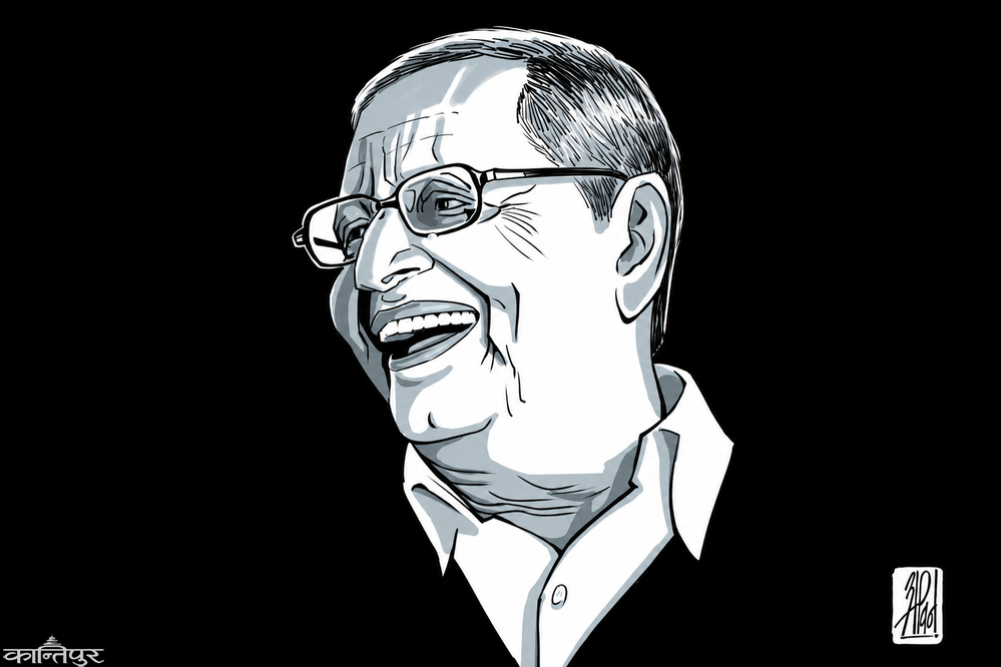
Pandey's active participation in the cause of civil rights and a citizen-friendly system dates back to 2036 BS. His image as a civic leader was established since the people's movement of 2046 BS.
We use Google Cloud Translation Services. Google requires we provide the following disclaimer relating to use of this service:
This service may contain translations powered by Google. Google disclaims all warranties related to the translations, expressed or implied, including any warranties of accuracy, reliability, and any implied warranties of merchantability, fitness for a particular purpose, and noninfringement.
Devendra Raj Pandey's residence in Bishalnagar, Kathmandu, was an active place for advocating for civil rights and democracy. Many people committed to a democratic republic used to visit that residence and seek advice from Pandey. Pandey would unburden his memory and guide him.
Pandey, a public intellectual warrior who had been active in favor of a citizen-friendly system for more than 45 years, passed away on Friday. He passed away at his private residence. According to Dr. Anup Subedi, who is closely aware of his health condition, he was battling pancreatic cancer.
Narayan Wagle Pandey, who was active on the path of a journalist and citizen activist, is remembered as a staunch citizen activist who ignited the fire of civic consciousness in the political transition of the last four decades. He said, "He will always be remembered as someone who was always active in establishing democracy, civil freedom, civil rights and equality."
Pandey's active participation in the cause of civil rights and a citizen-friendly system has been going on since 2036 BS. Initially an employee of the Panchayat regime, he resigned as Finance Secretary in 2036 BS. He resigned after Surya Bahadur Thapa, who was made Prime Minister to make the referendum announced by the then King Birendra Shah a success, intensified the misuse of state power to win the Panchayat party. His resignation gave great energy to the multi-party party and angered the Panchayat party. He played a role in bringing the weaknesses of the Panchayat system to the public through articles and interviews.
After the 2048 election, he became dissatisfied with the working style of Prime Minister Girija Prasad Koirala and after receiving indications that the entire politics was going against the spirit of the 2046 people's movement, he entered politics himself. Since the people's movement of 2046 BS, his image as a civic leader has been firmly established. While the people's movement was ongoing, he was arrested on 7 Chaitra 2046 BS for being the main organizer of the 'Role of Nepali Intellectuals and Professionals in Today's Context' meeting organized at Tribhuvan University. While he was in Bhadragol Jail, the government changed on 24 Chaitra. The new Prime Minister Lokendra Bahadur Chand summoned Pandey to Singha Durbar and used him as a contact point for discussions with Ganeshman Singh.
After the people's movement was successful, he became the Finance Minister in the interim government led by Krishna Prasad Bhattarai. In a dialogue program on the concept of self-reliance and Dr. Devendra Raj Pandey's contribution organized by the Rural Self-Reliance Development Center on 29 Poush 2080, writer Chaitanya Mishra mentioned the reason for Pandey being made a minister - 'He and his colleagues were leading a massive political movement of non-party citizens that had been organized at that time and gained popular legitimacy. On the other hand, political parties had to gain the legitimacy of that massive citizens' movement and make the new government successful.'
According to current Finance Minister Swarnim Wagle, as the then Finance Minister, Pandey played a good role in managing the transition between the Panchayat period and the multi-party period. ‘He did not make many major reforms as the interim finance minister. He brought the concept of taxing property at that time,’ said Minister Wagle.
Having been finance secretary and finance minister, he also has an image as an economist. ‘He was of the opinion that foreign aid should be phased out gradually,’ says writer and analyst Yug Pathak. ‘He was of the clear opinion that foreign aid would never allow Nepal to become self-reliant and its economy to become strong.’ Pandey was always active in his ideals and beliefs. During that time, he appeared in various roles.
After leaving the Panchayat administration, he became actively involved in studying and researching various aspects of Nepal’s development and human rights issues by formally and informally associating with various domestic and foreign non-governmental organizations.
After the 2048 election, he became dissatisfied with the working style of Prime Minister Girija Prasad Koirala and got indications that the entire politics was going against the spirit of the 2046 people’s movement. He entered politics himself. He formed the 'Democratic Lok Dal' under his own leadership, mainly with the support of the ML and Marxist youth who had left when the UML was formed. However, the party disintegrated after a poor performance in the 2050 by-elections and the 2051 mid-term elections.
Pandey was also active in ending the Maoist armed struggle that began in 2052. Even when the armed struggle was at its peak, he engaged the underground Maoist leaders Pushpa Kamal Dahal and Baburam Bhattarai in dialogue. Meeting and providing guidance to the leadership of parties including the Congress-UML was common. He has written about some of the incidents in his autobiography 'Ek Jaan Dui Juni'. Pandey has written - I spoke to Prachanda on a satellite phone from the roof of a house where a Maoist leader lived in Delhi and reprimanded him in a way that even Baburam could hear, 'We are taking many risks and are going to create an environment for political harmony and cooperation between you and the parliamentary parties (seven parties). It is not right that former Panchayat employees like me continue to fight with the king, while you fight among yourselves. You do not even let us know whether this fight is about a principled issue, this is not working, stop the fight immediately, come together.'
Before the talks between the government and the Maoists in 2063, representatives of the Congress, UML and Maoists used to hold discussions at Pandey's residence. Pandey's residence was an unofficial venue for the peace talks. Pandey's role was further established during the people's movement of 2062/63.
The dissolution of the House of Representatives by the then Prime Minister Sher Bahadur Deuba on 8 Jestha 2059 and the struggle against the dictatorship imposed by the then King Gyanendra twice (18 Asosh 2059 and 19 Magh 2061) gave rise to the civil movement (civil society). Gyanendra's authoritarian rule reached its peak in the time when the Maoists were engaged in armed struggle and the parliamentary parties had lost the trust of the citizens. At that time, the link connecting the people and the party was the civil movement.
The meeting of the dissolved parliament was scheduled to be held at the Pragya Pratisthan on 4th Shrawan 2062. But it could not be held. The leaders did not even make the usual effort to open the lock there and enter. Pandey had said in his speech titled 'Civil Movement: Experience and Needs' at Martin Chautari on 23rd Asad 2075 - 'Now we will not wait for the parties to open the doors of the Pragya Pratisthan, hold a movement, support them and change will come to Nepal under their leadership. We agreed that it was time for us to take the initiative. We decided to call all the citizens and hold a conference. In our meeting held on the same day, ‘Citizens’ Movement for Democracy and Peace’ was written on the white board.’
This same citizen movement did everything from taking control of Ratna Park to holding leaders in the audience to organizing programs. The leaders apologized and made them promise to improve. The common people trusted the leaders of the citizen movement and participated in the democratic movement. Ultimately, the people’s movement was successful, and a constitution with pillars such as democracy, republic, federalism, and secularism was promulgated in the country.
After the people’s movement, the leadership of the citizen movement was divided. But only a limited number of people, including Pandey, remained steadfast in their previous ideals. They continued to warn the government by staying away from political positions. They continued to stand as a legacy of the current system. However, he was deeply dissatisfied with the fact that the parties had forgotten the promises they had made before the people’s movement of 2062/63.
Pandey had a deep affection for the pillars mentioned in the constitution. His 'litmus paper' for testing any movement that arose on the streets was those issues. Due to his lack of clear attachment to those issues or suspicions, he did not participate in or openly express support for even the most famous movements of the past. In recent years, he was physically weak. However, he was more interested in current events. He would keep reacting to them. For that, his choice was - X (Twitter). On this platform, he mainly wrote about cricket, politics and himself. He would be sarcastic, and he would even make fun of himself.
writer Chandrakishore met Pandey for the last time on 1 Asad at his residence. According to him, Pandey was very unwell physically and he also had a sense of death. However, more than his health, he was deeply concerned about the health of Nepal's democracy. 'He was concerned about the increasing challenges to democracy and the situation where citizens were afraid to speak openly.' "He emphasized that the person leading the government should be transparent and able to communicate continuously with the citizens," Chandrakishore said.
UML leader Usha Kiran Timsena presents Pandey as an example of how capable citizens can contribute to society, how they can rebel when necessary, and how they must rise above personal interests while remaining committed to democratic values. "If we want to remember what it means to be a democrat, we must remember Pandey," she said.