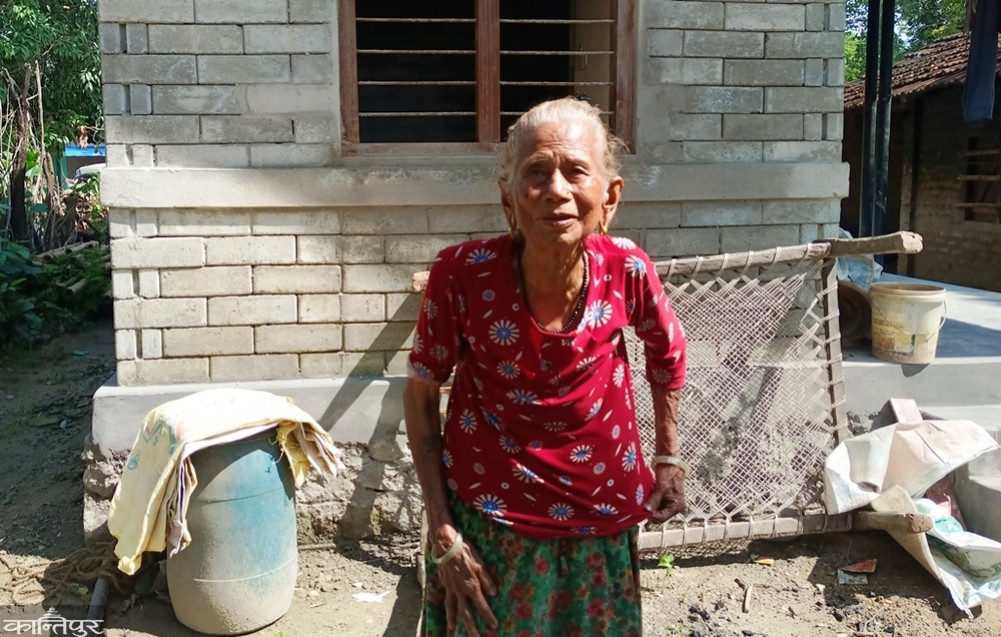
Although 26 years after the declaration of Kamaiya emancipation, some families have found safe homes, most are still forced to live in unsafe tents.
We use Google Cloud Translation Services. Google requires we provide the following disclaimer relating to use of this service:
This service may contain translations powered by Google. Google disclaims all warranties related to the translations, expressed or implied, including any warranties of accuracy, reliability, and any implied warranties of merchantability, fitness for a particular purpose, and noninfringement.
Most of her life, almost nine decades, was spent selling her labor in other people's fields and houses. She had no home of her own, and no certainty about her future. After the government announced the liberation of Kamaiyas on 2nd July 2057, the hope of a free life arose. She was also given a little land to live in. But a safe home remained a dream for 26 years.
Udasi Chaudhary, who is about 90 years old and lives in the courtyard of her new concrete house. Having spent her entire life as a Kamaiya in her master's house with her husband, she had to live in a hut for two and a half decades after the liberation was announced.
The worry that her house would collapse due to floods and inundation after the onset of the rainy season, the fear that wild animals would enter the settlement at night, and the fear of the roof being blown off in a storm were common things for her. Even as she grew older, her desire to live in a safe home could not be fulfilled.
This year, a new chapter in her life has begun. After the handover of the pucca house built in a government-non-government partnership, she experienced safe housing for the first time. According to her, the house has not only removed years of insecurity, but has also provided a basis for living with dignity in old age.
The story of sadness is not unique. Rita Chaudhary's family of Ramghat Muktakamanaiya Camp, Belauri Municipality-9, also suffered the same pain for generations. Her in-laws worked in the houses of moneylenders and laborers throughout their lives to support the family. After the announcement of Kamaiya emancipation, the bond was broken, but the cycle of poverty was not broken.
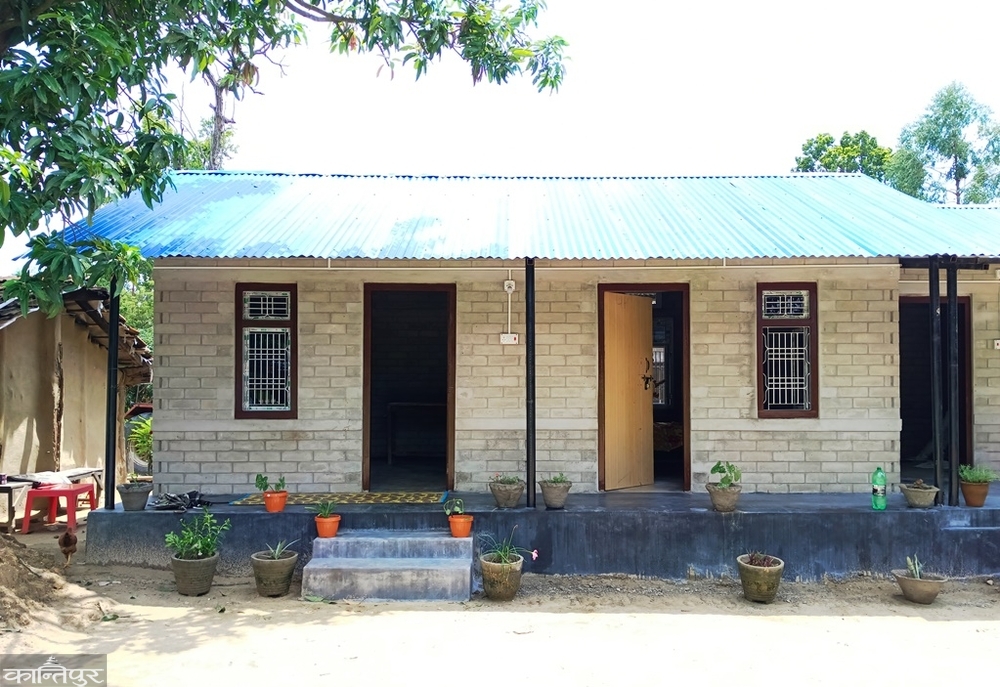
The children grew up in a mud house. A hut near the forest, constant fear of wild animals, a leaky roof during the rainy season, the risk of floods and unsafe housing became their daily reality. Now, after the construction of a new pucca house, the family has started seeing new hope for the future. Rita says, "Now, I have the confidence to raise my children in a safe home, not fear."
Even after 26 years since the declaration of Kamaiya liberation, many freed Kamaiya families in Kanchanpur are still forced to live in mud huts. Some have not been able to get even the minimum housing facilities. However, after a few years, a campaign to build safe houses started in collaboration with the local level, provincial government and development partner organizations, positive changes have started to be seen in the lives of some families.
In the fiscal year 2082/83, 35 safe houses were constructed and handed over to freed Kamaiya families, including 18 in Belauri Municipality-5 and 17 in Ward No. 9. The municipality has stated that a total of Rs. 7,171,395 was spent on the construction of these houses.
The Ministry of Land Management, Agriculture and Cooperatives of the Sudurpaschim Province Government has provided Rs. 3,150,000, Belauri Municipality has provided Rs. 1,350,000, and Habitat for Humanity Nepal has provided Rs. 1,080,000. The value of the beneficiary family's labor donation is equivalent to Rs. 1.5 million 91 thousand 395.
According to Belauri Municipality Deputy Chief Jogram Chaudhary, houses were constructed by selecting the most deprived and insecure families among the freed Kamaiya families. He said that the goal is to improve their living standards along with providing safe housing.
This campaign did not start just this year. In the fiscal year 2080/81, 10 houses were constructed in Belauri Municipality-9 and 5 houses in Belauri Municipality-10. In the fiscal year 2081/82, 14 houses were constructed in Belauri Municipality-5, 5 houses in ward number 6, 5 houses in ward number 7 and 5 houses in ward number 8, informed Habitat for Humanity Nepal's program coordinator Saraswati Puri Bam. According to him, such houses were constructed and handed over to freed Kamaiya and extremely poor families. She also said that there is a plan to identify poor families from Ward No. 1 to 4 in the current fiscal year 2083/84 and build safe houses.
On 27 August 2057, the then government led by Sher Bahadur Deuba in Nepal declared the Kamaiya system free and declared thousands of Kamaiyas free. Since then, despite various programs for land distribution, rehabilitation and livelihood for them, many freed Kamaiya families have not yet been completely freed from the problems of poverty, unemployment and unsafe housing. Leaders of this community say that despite the declaration of liberation, safe housing, a dignified life and opportunities have not yet been ensured.