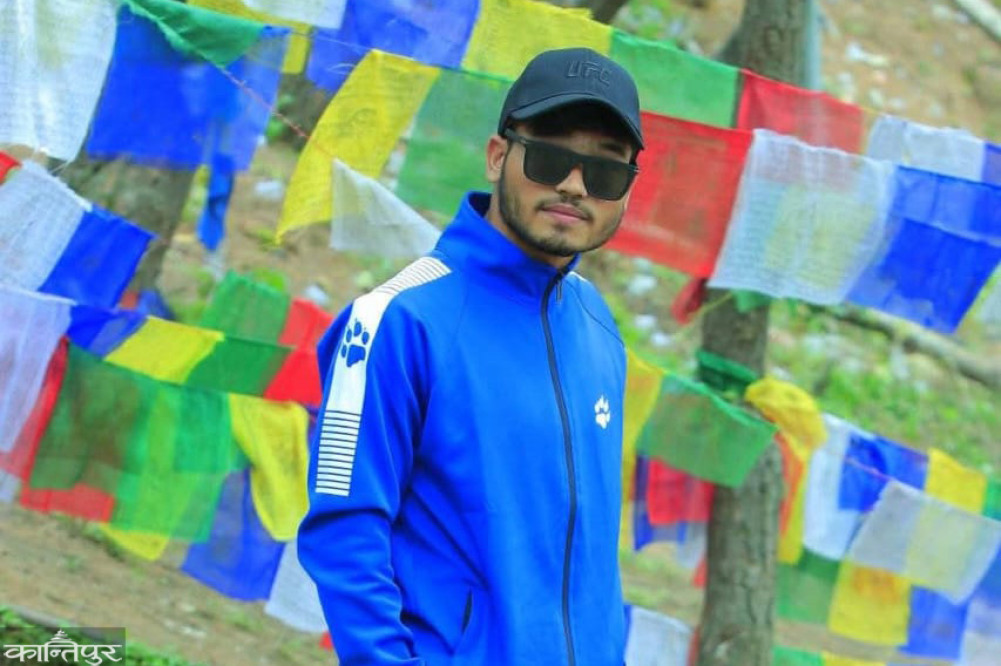
After Ganesh Nepali self-immolated, many recalled the incident of Prem Prasad Acharya, who self-immolated in front of the Parliament building four years ago.
We use Google Cloud Translation Services. Google requires we provide the following disclaimer relating to use of this service:
This service may contain translations powered by Google. Google disclaims all warranties related to the translations, expressed or implied, including any warranties of accuracy, reliability, and any implied warranties of merchantability, fitness for a particular purpose, and noninfringement.
After Kathmandu Metropolitan Police put a wheel lock on the motorcycle of 25-year-old Ganesh Nepali and fined him, the dispute that arose has raised a serious question across the country: “How much does one have to pay for being poor and without options in Kathmandu?” This is a question that both social media and society at large are seeking an answer to, but have yet to find.
Home Minister Sudhan Gurung, Health Minister Nisha Meheta, and officials from the Prime Minister’s Secretariat visited Ganesh at his hospital bed in Bir Hospital, after he attempted self-immolation by pouring petrol on himself in front of the Department of Passports in Tripureshwar. They assured his family not to worry about treatment expenses, and even arranged for an air ambulance to take him to New Delhi for further treatment. However, none of these efforts could save Ganesh; the hospital announced his death on Friday morning.
With Ganesh’s self-immolation incident, many recalled the case of 37-year-old Prem Prasad Acharya from Ilam, who self-immolated in front of the Parliament building four years ago. At that time, Balendra Shah, who was then the Mayor of Kathmandu Metropolitan City and is now the Prime Minister, had said that although there could be many reasons and indications for self-immolating by pouring petrol in front of the Parliament, the biggest reason was the state itself. “And the most terrifying indication is the utter failure of the state,” he wrote on Facebook on 11 Magh 2079, “In his business, in his despair, in his plea for help, in his security, in his rescue, at every stage he experienced, the state has failed. Every layer, body, and organ of the state has failed.”
Now that Balendra Shah has become Prime Minister, that very status is being widely cited as criticism of the government. With Ganesh’s death, many are expressing questions and outrage against the government, saying the cruel behavior of state apparatus officials towards ordinary citizens has been further exposed.
Former RSP leader Sumana Shrestha also said she remembered that incident, stating, “This event has forced us to look beyond the mudslinging of politics and to see the deep and silent aspect of extreme despair caused by this system.”
She further said, “When a citizen finds it easier to set their own body on fire than to fight against disorder, it is not just a rash act in a fit of anger; it is the final and terrifying form of what psychology calls learned helplessness—a mental state where a person makes honest efforts to live, but feels defeated every time.”
Gagan Thapa, President of the main opposition party Nepali Congress, said Ganesh’s death is a painful moment that jolts society, the state, and collective consciousness. “This is not a matter for political debate or blame. This is about a citizen’s life, a family’s unbearable pain, and our human sensitivity,” he said. “Rather than debating whose fault it is, past or present, let us make such incidents a subject of our collective introspection related to state governance.”
RSP MP Ganesh Karki says that if following rules makes it harder for people, or if dying is easier than following rules, then those rules need to be reviewed or more effort is needed to help people understand them. “If someone asks which to choose, people or rules, that is foolishness. But if I must answer, I choose people. What do you choose?” he asked. “Dear RSP and government supporters, let’s not make arguments to save the government and party that outweigh the value of human life.”
According to Kathmandu Police SP Pawan Kumar Bhattarai, three municipal police employees have been questioned to investigate what happened before Ganesh’s self-immolation. “We are collecting incident details, including CCTV footage,” he said. To investigate the incident, police have also formed a probe committee led by Valley Police Office DIG Govinda Thapaliya. According to DIG Thapaliya, the five-member committee includes officials from the District Police Range, Kathmandu, and the Valley Crime Investigation Office. “We are responsible for submitting a detailed report on how the incident happened as soon as possible,” he said. “We have already started work accordingly.”
According to Dr. Piyush Dahal, head of the Burn and Plastic Surgery Unit at the hospital, more than 55 percent of Ganesh’s body was burned. “In a country like ours with limited resources, there is no chance of survival if more than 40 percent of the body is burned. Ganesh’s wounds were very deep, so we could not save him,” Dahal told Kantipur.
After Ganesh’s health began to deteriorate, doctors put him on a ventilator on Thursday itself. The critical care team performed cardiopulmonary resuscitation (CPR) on the patient on Friday morning. Meanwhile, the government had also prepared to take him to New Delhi, India, by air ambulance on Thursday night for further treatment. According to officials related to civil aviation, a Shree Airlines CRJ-200 aircraft (call sign 9N-AMA) was kept ready as an air ambulance. However, after doctors concluded that his condition was not suitable for air travel, Ganesh was not taken to India.
According to preliminary police investigation, Ganesh had arrived at the Department of Passports around 11 a.m. to drop off a passenger. After dropping the passenger at Gate No. 2, he was waiting for another ride request. While looking at his mobile and sitting parked nearby, a female municipal police employee told him not to park his motorcycle there. During that time, there was also an argument between Ganesh and her, according to police officers. “He stayed there for a while after being told to leave immediately, and it seems he went to lock his bike. When his mobile fell, the dispute escalated,” said an officer involved in the investigation. “After that, he rode his motorcycle towards Gate No. 3, where it appears the wheel lock was applied.”
In a video obtained by Kantipur, filmed after the wheel lock was applied, the female police officer is seen scolding, “Won’t you listen to what I say?” She angrily asks, “My mobile fell, why did you run? Who will fix my broken mobile?” Ganesh complains that the wheel lock was applied where he had parked, saying, “If you’re going to lock it, do it there. Why are you harassing people?” He then says he didn’t break the mobile, but that it broke when she came herself. When someone asked what happened, Ganesh replied, “I’m on the bike, they come to lock it below.” When asked, “Were you sitting on the bike?” he repeated that the ticket was issued while he was still on the bike.
According to the details recorded in the Nepal Police incident log, at 1:45 p.m., a Kathmandu Metropolitan team applied a wheel lock to a Pulsar motorcycle (Ba Pra 02–046 Pa 3250) parked at Gate No. 3, after which Ganesh set himself on fire. According to police officers, preliminary estimates suggest he poured petrol on himself about two hours after the ticket was issued for his motorcycle. The municipal police employees questioned by police said that if he had provided his documents, they would have issued the ticket and let him go, but since he was defiant, they called a vehicle to take the motorcycle away. When the municipal police team came to collect the wheel-locked motorcycles, including Ganesh’s, he was seen pouring petrol on himself.
An officer involved in the investigation told Kantipur that after the municipal police team reached near the motorcycle, Ganesh was seen coming from a little distance, pouring petrol on himself. “He ran from a bit higher up and poured petrol on himself. After reaching the municipal police vehicle, he was seen lighting a lighter,” the officer said. “We are studying CCTV footage from different angles.”
In another CCTV footage viewed by Kantipur, Ganesh is seen setting himself on fire right next to the municipal police vehicle. While his body was burning, Ganesh kept moving around. Municipal police employees ran to find something to extinguish the fire, but found nothing. One police officer tried to take out black foam from the vehicle, but stopped, fearing it might spread the fire further. After a while, as Ganesh rolled on the ground, locals poured water to extinguish the fire. Then the police team also arrived and rescued him. In another video circulated on social media, after the fire was put out, security personnel are seen holding Ganesh’s hand and walking him a few meters on the road before placing him in a vehicle. Many have criticized the scene of the severely burned Ganesh being made to walk.
Doctors say there are problems with rescue and management of the injured after disasters and accidents in Nepal. “A few years ago, when a gas cylinder exploded at the Sandar Momo shop, 11 workers were injured,” said Dr. Kiran Nakarmi, director of Kirtipur Hospital. “At that time, the injured were brought to the hospital in a meat truck.” Doctors say that poor management immediately after an incident can worsen the patient’s condition. “Most people around the scene had mobiles in their hands or pockets, but no one called 102 for ambulance service,” he said.
Chief of Kathmandu Metropolitan Police Bishnu Prasad Joshi said that they apply wheel locks if there is an obstruction to public movement or the footpath, and that is what happened on Thursday. “The incident happened after he said he would not pay the fine,” he told Kantipur. “Two hours after the lock was applied, Ganesh said he would not pay the fine and told them to take him wherever they wanted.”
Ganesh, who was originally from Jamaldhara, Ward 6, Soru Rural Municipality, Mugu, had been living in Kamalbinayak, Bhaktapur. According to his elder brother Madan, who lives in Balaju Height, Ganesh had only three months ago mortgaged land in Mugu to buy a Pulsar motorcycle on installment. “He studied agriculture at JTU, but the poor have no chance of getting a job,” he said. “He bought a motorcycle and was driving for Pathao, and this happened.” He said that when he reached Bir Hospital, his brother told him to take care of their parents and blamed the metropolitan police for what happened.
As of late Friday night, the victim’s family had not agreed to receive the body. Ganesh’s family has demanded that he be declared a martyr, that his wife be given a job, that his daughter’s education be funded by the government, and that appropriate compensation be provided before they will accept the body. Ganesh’s body remains at Bir Hospital. The hospital administration has said that, due to lack of necessary infrastructure to preserve the body, it cannot be kept for a long time.
There were protests throughout the day around Bir Hospital demanding justice for Ganesh. Relatives, leaders of political parties, and representatives of civil society participated. A large number of security personnel were deployed at the hospital, and security was tightened. Protests demanding justice for Ganesh were held not only around the hospital but also at Maitighar. The Joint Student Organization also protested against the inhumane oppression, exploitation, and injustice against ordinary citizens and squatters.
Ganesh, who attempted self-immolation, had previously been fined by the municipal police. On 13 Asar, he sent a message to his nephew in the village, which read, “Yesterday, when I went to buy goods, the municipal police locked my bike, man. Had to pay 1,000…” The message ended with two crying emojis.
The municipal police have been imposing a fine of one thousand rupees for unauthorized parking. Traffic police, on the other hand, impose a fine of five hundred rupees. The traffic police have been collecting fines based on Section 164 of the Motor Vehicles and Transport Management Act, 2049, which allows a transport inspector or police officer to impose immediate penalties. Subsection 1 states that for offenses such as parking a vehicle in a public place causing obstruction to others, driving without headlights at night, driving under the influence of alcohol, driving without a number plate, driving without a seatbelt or helmet, or driving recklessly, a first-time offender can be fined 500 rupees, a second-time offender 1,000 rupees, and a third or subsequent offender 1,500 rupees, with the authority to impose such penalties given to a transport inspector or at least an assistant police inspector.
The municipal police, however, have been doing this work according to the provisions of the Metropolitan Police Act, 2080. The constitution gives local levels the authority to form and manage municipal police. Accordingly, Section 7 of the Act made by Kathmandu Metropolitan City, which covers the functions, duties, and powers, states that the metropolitan police are responsible for the supervision and management of markets and vehicle parking areas.
Thus, while the metropolitan police have been locking vehicles for unauthorized parking, they have been taking them to the Valley Traffic Police Office for custody. “They bring them here, but the tickets are issued by the traffic police,” said a traffic police officer. Retired Additional Inspector General (AIG) Bhim Prasad Dhakal, who is also a former chief of the Valley Traffic Police Office, says that different fines for the same offense are inherently inconsistent. He says, “Different fines for the same offense are inherently inconsistent, but both agencies have been doing the same work for a long time.”