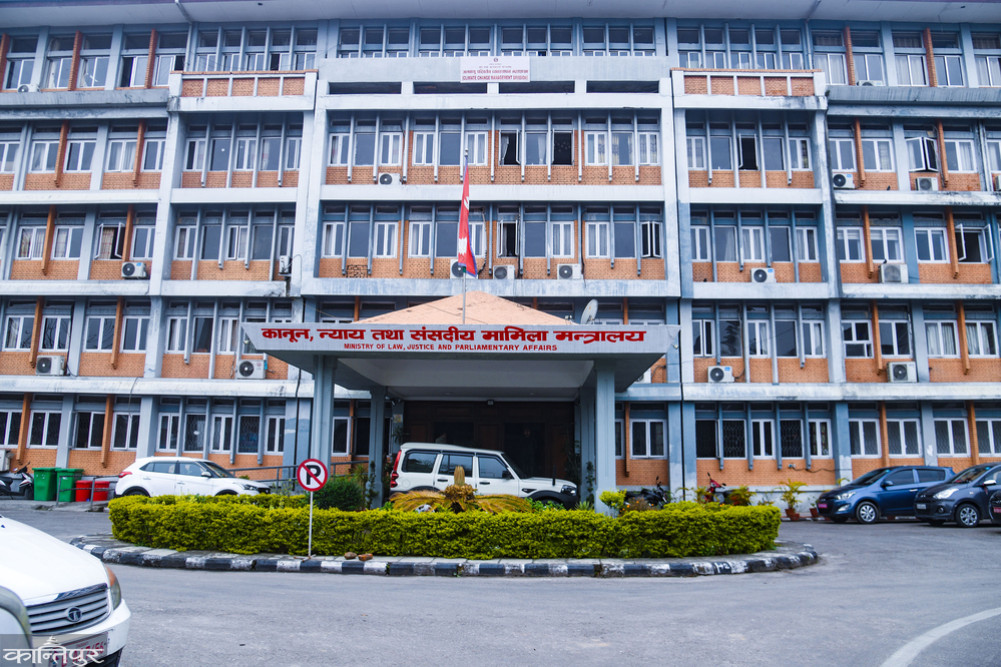
Arguments that are inconsistent with the Constitution and the law, the draft of the Civil Service Bill has been in the Law Ministry since 12th Jestha
We use Google Cloud Translation Services. Google requires we provide the following disclaimer relating to use of this service:
This service may contain translations powered by Google. Google disclaims all warranties related to the translations, expressed or implied, including any warranties of accuracy, reliability, and any implied warranties of merchantability, fitness for a particular purpose, and noninfringement.
The Ministry of Law, Justice and Parliamentary Affairs does not seem to agree with the proposal to provide compulsory retirement to employees who have completed 55 years of age or 30 years of service. Stating that the provision brought in the draft civil service bill is not in accordance with the constitution and the law, the ministry's staff has stated that it cannot be taken as it is.
The Ministry of Land Management, Cooperatives, Federal Affairs and General Administration sent the civil service bill to the Ministry of Law on 12 Jestha. Even after more than a month, the law has not sent the bill back. The process will move forward only after the Ministry of Law gives its consent to the bill.
There is a proposal regarding compulsory retirement in Section 57 of the draft. Its sub-section (1) mentions that civil servants will get compulsory retirement after completing 60 years of age. However, it mentions that employees who have completed 55 years of age or 30 years of service at the time of the commencement of this act will get retirement.
If this proposal is passed as is, employees who have completed 55 years of age or 30 years of service will get compulsory retirement on the day the act comes into force. There is a proposal that civil servants who will complete 58 years of age in the fiscal year in which the act comes into force will get retirement after completing 58 years of age. Section 33 of the existing act provides for automatic retirement for civil servants who have completed 58 years of age.
A law official said that the proposed provision is not in accordance with the constitution and the law, as a result of discussions held at the staff level in the ministry. 'We have informed Law Minister Sobita Gautam about it, and that is not the only provision.' Some other provisions in the bill are also not in line with the constitution,' the official said. 'The departmental minister has been given detailed information on that.'
The law secretary, joint secretary and other officers have joined hands to study the proposed draft of the civil service bill. 'The bill related to the civil service is much awaited.' However, there are many errors in the draft bill. It is a mess and a mess,' said an officer involved in the study. 'We have given a note to the minister explaining the aspects that need to be improved in each section, the advantages and disadvantages of important sections, and why the law is not in line with the constitution.'
It has been argued that trying to grant retirement before the age of 58 is considered a unilateral breach of the service contract agreement entered into by the state with the employee. ‘The state recruits employees to provide certain service facilities to serve the people,’ the official said. ‘The law has expressed a commitment that those service facilities will not be reduced. It cannot be reduced without the written consent of the concerned employee. The current proposal has been brought in violation of the provisions of Section 58 of the Civil Service Act.’
Section 58 of the Civil Service Act states that no change shall be made to the conditions of service of any civil employee in force at the time of his appointment in a manner that adversely affects him without his consent. It states that if a subsequent amendment adversely affects the above conditions of service of any civil employee in office before such amendment, such provision shall not be applicable to him without the written consent of the person who has agreed to make such amendment.’
The ministry argues that giving retirement to employees who entered the service with the condition that they will get retirement after completing the age of 58 without their consent is against Article 58. Similarly, the constitution states that changes in remuneration and other terms and conditions of service can be made only in cases where a state of emergency has been declared due to extreme economic disruption.
The constitution has a provision that the remuneration and other terms and conditions of service of the Chief Justice or a judge of the Supreme Court or an officer of the Constitutional Commission will not be changed to the detriment of them. However, it has been said that this provision will not be applicable in cases where a state of emergency has been declared due to extreme economic disruption. A deputy secretary of the Ministry of Law says that even though it is said in the context of the Supreme Court or constitutional bodies, the principle carried by the constitution remains the same. ‘There was no such provision in the previous constitution.’ Now there is. "Accepting the Supreme Court or constitutional bodies means that it will be applicable to all public servants," he said. "There has not been a declaration of extreme economic chaos at the moment. Since that situation does not exist, it is not possible to change the remuneration and other conditions of service to the detriment of the employees."
If the government wants to reduce the number of employees or recruit only young people with the vision of a smart state, then the old employees can be dismissed without reducing the terms of service they are currently receiving, according to the note submitted to the minister by the ministry's secretariat. If an employee who has completed 55 years of age is to be sent home, it is suggested that he should be given service facilities up to 58 years of service. Or, a suggestion has been given by the legal staff circle that a voluntary retirement scheme can be introduced by giving certain service facilities.
The current law only provides for the mandatory retirement of civil servants after completing 58 years of age. Lowering the age limit or fixing the service period to 30 years is reducing the specified service conditions. ‘The law and the constitution say that this is not possible. We will show that,’ he said. ‘We do not look at who brought the bill for what purpose or for what self-interest. What national, international practice, law and the constitution say. We will give the argument accordingly.’
It has also been argued that it is not fair for employees who have completed 55 years on the day the new act is issued to retire and for employees who have missed reaching 55 years by one day to continue working until 60 years. The fact that people born one day earlier retire at 55 years of age and people born the next day retire after reaching 60 years of age also means that the state is not treating its citizens equally. ‘This shows that the state is cruel to some and generous to others,’ said another law official. ‘The state should not be cruel.’ The state is not an entity that only looks at profit and loss. The state has some special responsibilities. All these issues have been put up for discussion. He mentioned that since it is a policy issue, a decision on this issue will be taken at the political level. The Public Service Commission has been suggesting that the retirement age of employees should be increased to 60 years since 2067 BS. Supreme Court judges and officials of constitutional bodies can remain in service until the age of 65. The retirement age for district and high court judges and university professors is 63 years. The retirement age for health employees in the civil service has already been set at 60 years. Elsewhere, thousands of civil servants can remain in service until the age of 65, but sending thousands of civil servants to retirement at the age of 55 will put a huge financial burden on the state at once. "We have given the minister a complete note including comments on each issue of the bill," the official said. "He is studying it. After discussing it with him, we will discuss it with the Federal Affairs Minister and officials there, who have drafted the bill based on the ministry's opinion."