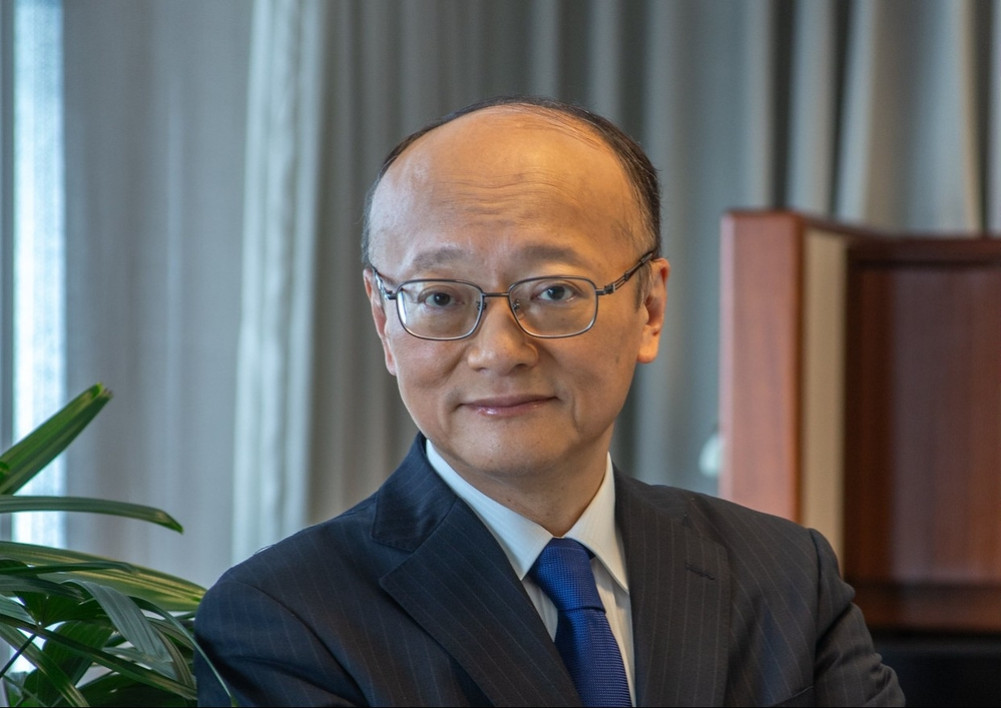
Prime Minister Shah, who has been refusing personal meetings with foreign diplomatic officials, is meeting ADB President Kanda alone for the first time on Tuesday.
We use Google Cloud Translation Services. Google requires we provide the following disclaimer relating to use of this service:
This service may contain translations powered by Google. Google disclaims all warranties related to the translations, expressed or implied, including any warranties of accuracy, reliability, and any implied warranties of merchantability, fitness for a particular purpose, and noninfringement.
Prime Minister Balendra Shah, who has been refusing to meet foreign ambassadors in Kathmandu and foreign high-ranking officials visiting Nepal, is set to meet Asian Development Bank (ADB) President Masato Kanda.
President Kanda will be the first foreign official to meet Prime Minister Shah alone. According to a senior official at the Ministry of Foreign Affairs, Kanda is scheduled to meet Prime Minister Shah on Tuesday. Kanda will also meet Finance Minister Swarnim Wagle and other senior government officials on Monday.
Kanda's visiting team will also include senior ADB officials. This includes Nepali national Sona Shrestha, who is also the Director General of ADB's South Asia Department. Foreign affairs experts have interpreted the strict protocol adopted by the Prime Minister in his meetings with foreign leaders and high-ranking officials as a deliberate attempt to redefine Nepal's diplomatic stance.
They say this signals that the new government will further institutionalize and integrate its authority over foreign policy, control the mixed messages going to the international community, and move from person-centered diplomatic practices to clear, coherent, and institutional diplomatic practices of the state leadership. During his visit to Nepal, Kanda will also monitor various projects implemented with the support of ADB.
In an interview with Kantipur, Foreign Minister Shishir Khanal said that the Prime Minister will meet with foreign heads of state, high-ranking officials, and diplomatic representatives as needed. 'The government's main priority is to ensure good governance and achieve economic progress. That is why the Prime Minister is busy. But he has not banned any meetings or foreign visits. At least I have not heard anything like that from the Prime Minister. The issue of where his first foreign visit will be held has not been finalized yet,' Khanal said.
Earlier, the Prime Minister had not agreed to meet with US Assistant Secretary of State for South and Central Asia Samir Paul Kapur and US President Donald Trump's Special Envoy and US Ambassador to India Sergio Gore. After Prime Minister Shah refused to meet, Indian Foreign Secretary Vikram Misri's visit to Nepal was also postponed.
After becoming Prime Minister, Shah had broken the long tradition of meeting foreign diplomatic representatives individually and informally and had a group interaction with the heads of diplomatic missions in Kathmandu on Baisakh 26. Then on Jestha 26, 23 ambassadors and deputy heads of the European Union in Kathmandu and New Delhi, as well as diplomatic representatives of Thailand, Russia, Australia, Myanmar, UAE, Norway, Finland, Malaysia and Brazil, jointly met with the Prime Minister.
Prime Minister Shah's decision not to meet any foreign diplomats or high-ranking officials in person has been praised by many as a sign of state dignity and adherence to diplomatic protocol.
A loan agreement worth US$50 million is to be signed between the Nepal government and ADB during President Kanda's visit to Nepal. The government has stated that the loan will be used to modernize customs administration, facilitate trade, and support job creation.
According to ADB, the program will modernize customs administration through digitalization, risk-based inspection systems, and procedural simplification. In addition, the transportation and logistics sector will be further strengthened by strengthening infrastructure planning, improving the regulatory framework, and enhancing institutional coordination.