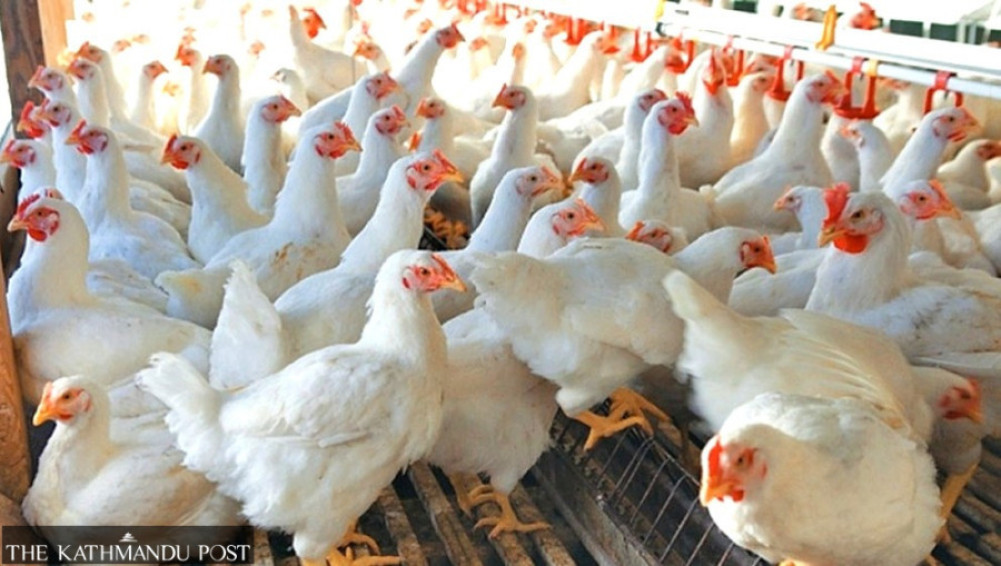
One reason for the shortage of manpower for the poultry culling operation is the low allowance. The government has been providing only Rs. 1,200 per day.
We use Google Cloud Translation Services. Google requires we provide the following disclaimer relating to use of this service:
This service may contain translations powered by Google. Google disclaims all warranties related to the translations, expressed or implied, including any warranties of accuracy, reliability, and any implied warranties of merchantability, fitness for a particular purpose, and noninfringement.
Bird flu has been confirmed in poultry farms in Suryabinayak Municipality and Tarakeswar Municipality in Bhaktapur. However, due to lack of manpower, authorities have not been able to immediately deploy rapid response teams (RRTs) to destroy infected poultry and disinfect the affected farms. In Panauti Municipality in Kavre, three separate teams of veterinarians were deployed on Tuesday to destroy chickens in bird flu-affected poultry farms. 'We are facing a serious shortage of manpower to destroy the remaining chickens in bird flu-affected poultry farms,' said Senior Veterinary Officer Dr. Mukul Upadhyay, Lead Focal Person for Avian Influenza Control Program and Disease Surveillance at the Department of Animal Services. 'Reports of confirmed bird flu outbreaks are coming from many places, but we are not able to immediately send Rapid Response Teams.' Recently, a major outbreak of bird flu has been seen in Kavre along with three districts of the Kathmandu Valley. According to department officials, reports of outbreaks have been received in 58 places in the valley and Kavre.
Since the avian influenza virus is highly contagious, rapid response teams should be immediately deployed in the affected farms to prevent the virus from spreading to humans and other species.
According to officials, one of the reasons for the shortage of manpower for the destruction of chickens is the low allowance. The government has been providing an allowance of only Rs 1,200 per day. 'The workers earn more from their regular work than the amount we pay,' Upadhyay said. 'As per government rules, we can only pay Rs 1,200 per day. As a result, we are facing a serious shortage of manpower.'
Experts have warned that the delay in controlling the virus could pose a serious threat to humans and other species. The H5N1 strain of avian influenza currently circulating in the Valley is considered highly virulent and contagious. This strain spreads rapidly. This strain can cause 100 percent mortality in infected birds.
According to experts, the only effective way to prevent the spread of the infection is to immediately destroy and manage infected birds and ban the movement of poultry products, including chickens and eggs, from affected farms.
Delays by authorities in taking action on affected farms increase the risk of poultry products, including infected chickens and eggs, reaching the market. According to officials, they have urged farmers to properly dispose of dead chickens in pits. But many have dumped dead chickens in the open, where stray dogs, crows and eagles eat them.
'We have not tested dogs and other animals,' Upadhyay said, 'Dogs can also be infected, but the bigger risk is that they carry infected carcasses to other places, which increases the risk of spreading the virus.'
Bird flu in 87 places in 11 districts: Damage over Rs 600 million, budget Rs 20 million
The bird flu outbreak, which started in Morang's Sundar Haraicha and Urlabari last Chait, has now reached its peak in the Kathmandu Valley. The main strain of influenza virus A(H9N2) was responsible for the outbreak in Koshi Province. This virus has caused huge economic losses in the poultry industry. According to officials, the current outbreak in the Kathmandu Valley is A(H5N1).
The first bird flu outbreak was recorded in Nepal in January 2009. Since then, the country has been facing outbreaks of the disease almost every year, in which millions of chickens, birds and large quantities of poultry have been destroyed. Many farmers have left the poultry business due to lack of compensation. According to officials, despite the bird flu outbreak and the huge losses suffered by farmers, the government has not provided compensation to any poultry farmer affected by the current bird flu outbreak.
One person died of the virus in Nepal in 2019. A 21-year-old man from Kavre, a truck driver by profession, died after developing a respiratory infection. He used to transport poultry products including chickens, eggs, and poultry. The Influenza Center, run in collaboration with the WHO in Japan, confirmed that the man had been infected with A(H5N1).