Human cruelty towards animals has increased to such an extent that in some places dogs are killed by hanging them from cliffs, in others monkeys are locked in cages and bitten by dogs. As violence against animals increases in the name of 'views' and entertainment on social media, questions have begun to be raised about compassion and sensitivity.
We use Google Cloud Translation Services. Google requires we provide the following disclaimer relating to use of this service:
This service may contain translations powered by Google. Google disclaims all warranties related to the translations, expressed or implied, including any warranties of accuracy, reliability, and any implied warranties of merchantability, fitness for a particular purpose, and noninfringement.
A video went viral on social media on Sunday. A boy hung a dog from a cliff and threw stones at it. The video, posted by a TikTok ID named Vivek Sunar 790, shows the dog being tortured to death.
The video has now been removed after a social media user ‘mention’ the Nepal Police and animal protection workers. The video, which was posted on the TikTok account with the voice ‘Tell my mother not to become old until my sentence is completed’ without showing the dog’s face, is still visible on the same ID. Many have expressed anger in the comments saying that the video was posted after the dog had already died.
Police Inspector Jang Bahadur Singh of the District Police Office, Humla, said on Tuesday that the person who killed the dog has been taken into custody and an investigation is underway. ‘After investigation, we have arrested six people from Simkot Upper Village who tortured and killed the dog. The one who killed the dog is a minor,’ he said, ‘the rest are under investigation.’
***
Some time ago, a video of a bull being treated in a similar way went viral. A man was torturing a bull. Jaliram Thapa had made a video of the bull’s nose and mouth buried in the soil after it stopped moving while ploughing in the field and posted it.
Jaliram made a video of the bull’s nose and mouth being hit by a car and posted it on Facebook and TikTok. The police arrested Jaliram and registered a case under Section 290 of Chapter 27 of the Criminal Code, 2074 BS, which prohibits cruelty to animals.
***
Similarly, a debate has been raging on social media recently, saying that monkeys have caused suffering to farmers. Some lawmakers have made controversial statements that the monkey should be killed. Meanwhile, a video went viral. One person locked the monkey in a cage. And then sent a dog into the cage and bit it. In the video, the monkey was seen being killed and left to lie down.
But the video was from a while ago. On February 26, 2005, the District Police Office, Taplejung, issued a press release saying, 'A person who treated monkeys inhumanely has been arrested.' Before the House of Representatives elections, the police arrested a person who posted a video on social media of an attack on a monkey caught in a trap set to protect crops. The police handed over the 21-year-old youth, who has a permanent residence in Panchthar, to the Division Forest Office.
It is not yet confirmed who killed the monkey, said Lalit Yadav, head of the Division Forest Office, Taplejung, who is investigating the incident.
‘We are trying to verify whether the person who posted the video and the person who killed the monkey are the same person. This incident is still under investigation,’ he said. It is reported that the person who posted the video on Facebook deleted it after the video went viral on social media.
***
Last year, in December, a person was arrested on charges of hanging his dog at home. Baburam Magar, 44, of Halesi Tuwachung Municipality-2, was arrested in the incident. According to his statement, a local dog had bitten a man. That is why he said that he killed his dog at home out of fear that his dog would also bite others.
***
Similarly, MP Dhruvraj Rai made a statement that he killed about 600 monkeys when he was the municipal chairman. His statement was criticized from social media to the House.
Recently, there are people who have shown goodwill and affection towards animals and birds. Meanwhile, Sneha Care posted a post on Facebook on Sunday. Sneha Shrestha, who has been advocating for the protection of animals and animal rights for a long time, performed a formal funeral after the death of the pig she sheltered.
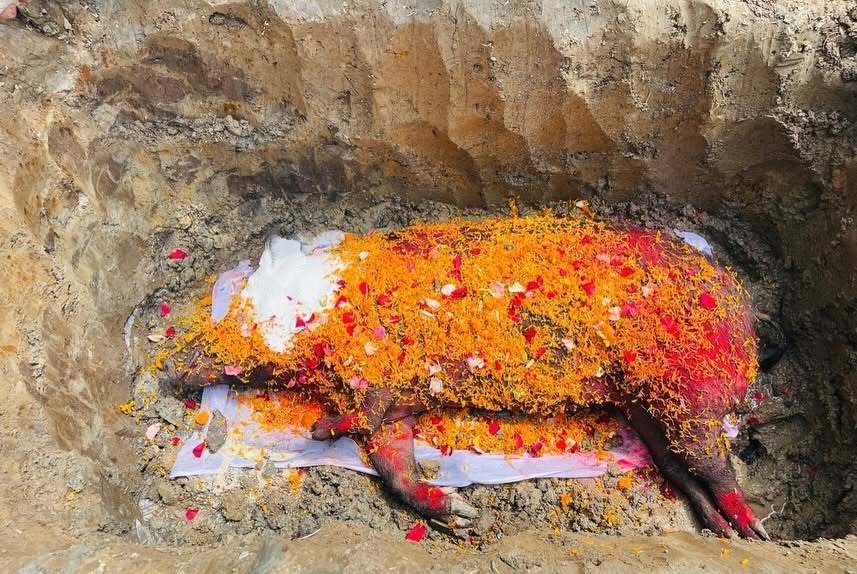
Sneha's post says, 'Goodbye, our dear Carlotta. Seven years ago you came to our shelter. From that day on, you were no longer just a rescued animal, you became an integral member of our family. In these seven years, you have shared countless memories with us. You had made a special place for yourself in the hearts of each of us.'
Sneha rescued Carlotte from a farm in 2019. She wrote on Facebook, 'I still remember that day like it was yesterday - the day I rescued you from a pig farm in 2019. That was one of the happiest days of my life. That day I didn't save a pig, I got my daughter. To many, you were just pork. Just meat for someone's plate. But to me, you were my child - my Carlotte.'
There are many people like Sneha who love animals, but there are also some who enjoy treating animals cruelly. Animal rights activists say that despite public awareness, animal torture is still going on.
If we look at the statistics of the Nepal Police, 128 people, both Nepalese and foreigners, have been arrested for animal-related crimes till April 2020. Cases were registered against 71 of them. From 2078 to 2082, 704 people were arrested, of which 365 cases were registered. If we look at the statistics from 2078 to 2082, 704 people were arrested. 365 cases were registered for animal-related crimes.
Animal rights activist Tularam Rajbanshi says that the trend of torturing animals has not gone away. ‘No matter how much we say that the earth is the common home of all living beings, no matter how much we educate them, the cruel treatment that humans inflict on animals has not gone away,’ he said. ‘Every day, we still see news of killing and torturing many animals, from dogs to cats.’
Tularam says that people keep animals only for their own needs. ‘It is common to keep cows until they give milk and then abandon them on the road. Similarly, there are many cases of loving dogs when they are small and abandoning them when they grow up,’ he said, ‘That is why people are only focused on their own happiness and interests.’
He says that the government should strictly enforce the law to reduce such incidents. ‘Activities like sprinkling hot water on dogs walking on the road, beating them, and painting them are still happening, we have rescued them many times,’ he said.
What action will be taken against those who torture animals?
Senior advocate Padam Shrestha says that Nepal’s National Criminal Code 2074 has made clear legal provisions regarding the treatment of animals. ‘No animal can be killed or treated cruelly. In particular, Section 290 clearly states that cows and bulls should not be killed or beaten,' he said. 'Acts such as stuffing the nose of a bull into the ground, pouring hot water on it, or hitting it with a hot iron rod on the pretext of teaching it to plow are considered cruel and criminal acts under the law.'
Shrestha says that the law does not make any difference between pet dogs and community dogs when it comes to torturing a dog. 'Beating, maiming, or killing a community dog walking on the road is a crime under Section 290 of the Criminal Code.' Even if a dog bites someone, it cannot be killed in retaliation, if it does, it will be punished according to the law,’ he said, ‘A person who commits such an offense can be punished with imprisonment for three months, a fine of up to Rs 5,000, or both.’
Shrestha says that the National Parks and Wildlife Conservation Act, 2029, applies in the case of wild animals. Even though monkeys are classified as not on the list of other wild animals, according to Section 26 (5) (d) of the Act, those who kill or torture wild animals like monkeys will be punished with half the punishment given to protected wild animals like rhinoceros, tigers, Shrestha says.
‘If someone publicly admits to the crime and says in a social media or interview that he killed so many animals, it is considered a legal admission of the crime,’ he said. ‘Even if there is no physical evidence based on the investigation, such a confession made publicly is sufficient grounds for the police to start an investigation and interrogation.’
Shrestha says that although there are laws on animal rights in Nepal, the level of their implementation is very low. ‘There is a Supreme Court ruling and legal recognition that if wild animals destroy a farmer’s farm, the state should bear the compensation,’ he said. ‘It is not possible by killing animals.’ Policy Needs The government needs to come up with concrete policies and control measures to reduce conflicts between humans and wild animals.’