More than 60,000 working families in eastern Nepal are facing unemployment as more than 80 tea factories in Ilam and Jhapa have closed due to India's blockade.
We use Google Cloud Translation Services. Google requires we provide the following disclaimer relating to use of this service:
This service may contain translations powered by Google. Google disclaims all warranties related to the translations, expressed or implied, including any warranties of accuracy, reliability, and any implied warranties of merchantability, fitness for a particular purpose, and noninfringement.
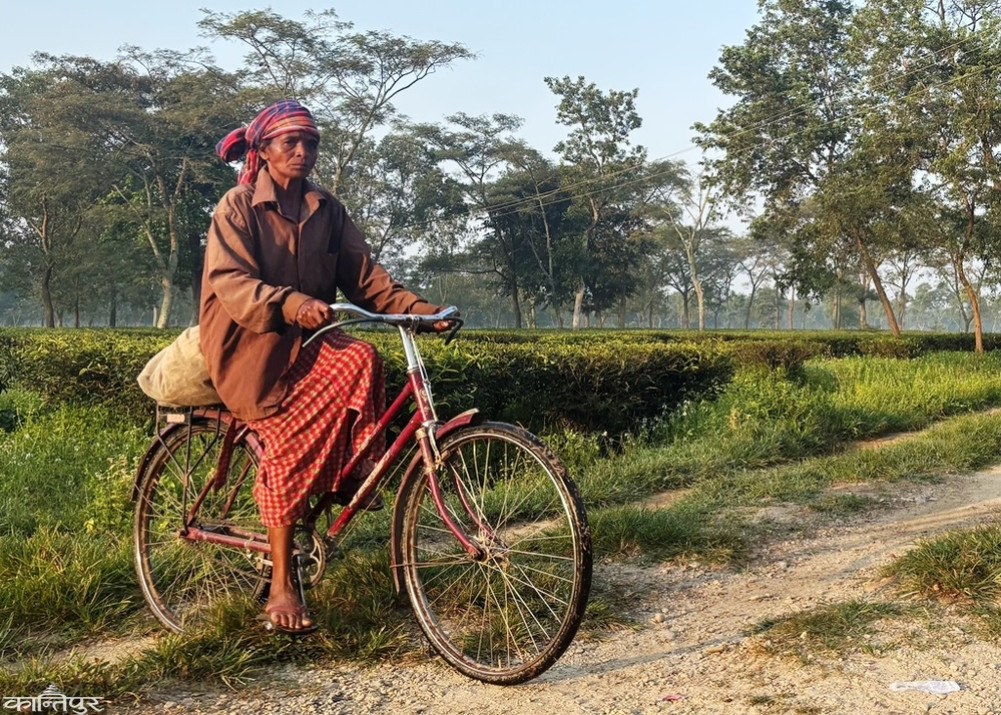
With the beginning of the tea picking season, workers used to be busy in the Giribandhu tea garden in Jhapa since morning. The songs of the workers used to echo throughout the garden while picking the young tea buds. However, now the scene has changed. There is neither the hustle and bustle of the workers in the garden, nor the excitement of work. Instead, there is silence all around.
More than 50 tea industries and gardens in Ilam and more than 30 in Jhapa have been closed in protest against India's obstruction of Nepali tea exports, affecting about 60,000 workers and employees in the east. The biggest hit of the closure of the industries and gardens has been on the daily wage laborer families.
The entire family of 58-year-old Ambar Bahadur Tamang of the Giribandhu tea garden is in trouble after the garden was closed. Not only the Tamang family, but hundreds of workers working in the garden are now facing a livelihood crisis. ‘After the tea plantations closed, it has become a problem to run the house,’ says Tamang, ‘there was only one way of income, and that too has been closed.’ According to him, even a few days of unemployment is a big crisis for daily wage workers. ‘After working all day, the stove would be lit in the evening,’ says Khinamaya Bastola, another worker from Giribandhu. ‘Now there is no work, we are worried about how to light the stove.’
Announcement of closure of 83 tea factories after India’s blockade
According to him, many working families are now forced to take loans to survive. Some families are bringing food on credit from local shops, while some youth are preparing to go to India or the city in search of employment.
According to 58-year-old Parman Murmu, who works at the Kalika Tea Garden in Mechinagar-15, the family's source of income has stopped with the closure of the garden. 'We used to earn some money by working all week, so the family's livelihood has been affected,' says Murmu. 'Now the only way to earn money has stopped.' His wife also works in the same garden. The wages of both of them used to cover the household expenses. However, now that both of them have stopped working, the family's livelihood is in danger.
According to the workers, the crisis in the tea sector is not just a problem for the industry, but a humanitarian crisis linked to the lives of thousands of families. The closure of the tea industry has affected leaf pickers, transport workers, small businessmen, hotel owners and the local economy. Hari Bahadur Limbu, a worker at Kalika Tea Garden, says, ‘Even if the garden cannot do it during a crisis, the state should support the workers.’
The workers have demanded that the problems be resolved immediately and the garden and industry be reopened. They say that Nepali tea exports should be facilitated by taking diplomatic initiatives with India. They have also urged the government to provide relief and social security for the families of the workers until the industry is operational. Shantivati Rajbanshi, a worker at Vaibhav Tea Garden in Mechinagar-15, says, ‘The garden has provided a shelter to live in, but the biggest problem now is what to eat.’
This is the prime time for the first tea picking. The green buds of the garden are swaying. However, due to the lack of workers to pick them, those buds have slowly started withering. There is growing concern that the hopes and future of the workers will also wither along with the tea buds.
More than 60,000 working families in the east are trapped in a cycle of unemployment and uncertainty due to the closure of industries and plantations in protest against the Indian blockade.
After the Indian side created new obstacles in the export of Nepali tea, tea industries and plantations in Ilam and Jhapa have been closed since Asad 1 and last Thursday.
According to a statement issued by the Nepal Tea Producers Association, the industry has become impossible to operate after the ban on the quality testing of Nepali prepared tea at the Indian border. According to the association, the new Standard Operating Procedure (SOP) recently implemented by the Indian Tea Board has affected Nepali tea exports. Industrialists are in trouble after tea, which has been exported for years, has been stopped at the border and the testing process has been made more complicated.
According to the Federation of Nepalese Chambers of Commerce and Industry, Koshi Province, Nepal produces 27.4 million kg of tea annually on an area of about 10,000 hectares, while 25.6 million kg of tea is exported to India alone annually. The tea industry directly employs more than 60,000 people.
The Indian blockade has led to a large amount of processed tea being stopped at the border, leading to increased inventories in industries, cash flow problems, and thousands of farmers, workers, and entrepreneurs being directly affected, according to the federation. Industries have been forced to close indefinitely in the past few days, and it has been warned that this will have a negative impact on the overall regional economy.