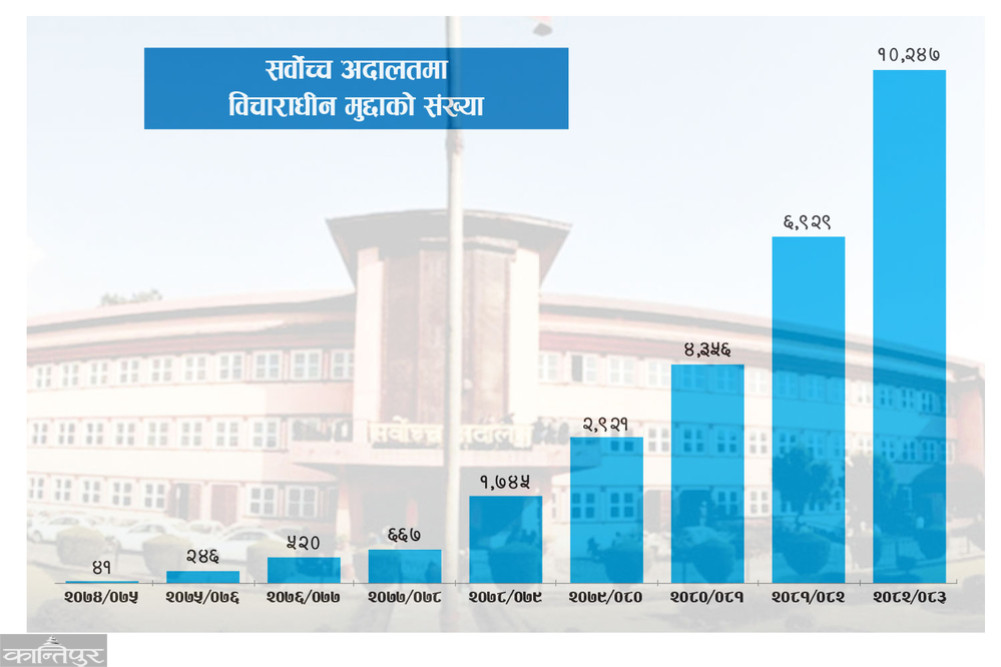
The hearing of cases is slow due to a shortage of judges, the tendency of legal practitioners to frequently postpone cases, the number of parties to the case, the lack of timely filing of case files, and in some cases, judges' reluctance to hear politically sensitive cases.
We use Google Cloud Translation Services. Google requires we provide the following disclaimer relating to use of this service:
This service may contain translations powered by Google. Google disclaims all warranties related to the translations, expressed or implied, including any warranties of accuracy, reliability, and any implied warranties of merchantability, fitness for a particular purpose, and noninfringement.
Bhairam Bote and Khadga Bahadur Bote from East Nawalparasi were resting in the courtyard next to the dilapidated building of the Supreme Court on Wednesday. The brothers, who refused to be photographed, were initially confused when they tried to talk to Kantipur. After some time, they explained the reason for their visit.
They had been approaching the Supreme Court since Bhadra 2075 in a land case. Before that, they had gone from the Land Revenue and Survey Office to the District Court to the High Court in the same case. Their journey of seeking justice began after Meghraj Kafle, a villager, registered the land they had been earning since their ancestors in his name.
A bench of Justices Sunil Kumar Pokharel and Nityanand Pandey finally delivered a verdict in the Bote brothers' case on Wednesday, but not in a conclusive manner. The bench said that they would "enter into the facts and decide" and sent their case back to the High Court. Now they have to go to the High Court again with the same case. It is not certain when the verdict will be reached from there. ‘It would have been resolved by the Supreme Court,’ said Bhairam Bote, ‘now we have to go to the High Court again.’
It has been two years since Muwahang Kirat from Panchthar started approaching the Supreme Court in a general theft case. He was arrested on charges of stealing goods from a shop. After investigation, the police filed a case in the District Court, Kathmandu. Then, the case reached the Supreme Court through a higher court. Earlier, the case was postponed indefinitely, and even on Ashad 1, the hearing was not held after the legal practitioner filed a petition to remove it. The Bote brothers and Kirat are the only two representatives who have been approaching the Supreme Court for a long time. More than 27,000 cases are pending in the Supreme Court. Of these, 41 are more than 7 years old. The oldest and most famous case pending in the Supreme Court is the Lauda plane fare irregularities. The court journey of this case, filed against the then Minister of Culture, Tourism and Civil Aviation, Tarini Dutta Chataut, including 10 people, began in 2058.
Since 2064, it has been going through one bench after another in the Supreme Court. The Supreme Court delivered its verdict on the writ petition filed against former Speaker and NCP leader Agni Prasad Sapkota on 7 Mangsir 2069 after 14 years on 11 Jestha 2082. However, the verdict has not been implemented due to the lack of a full text of the verdict, meaning that Purnimaya Lama, who filed the writ petition, has not been able to get justice.
The sayings ‘Delayed justice is justice denied’ and ‘Hasty justice kills justice’ are common in the judicial sector. However, justice is delivered very slowly in the Supreme Court.
Due to the shortage of judges and the tendency of legal practitioners to frequently postpone cases, it takes years for cases to be resolved in the Supreme Court. Hearings are also delayed due to factors such as the large number of parties to the case, the failure of the case file to arrive on time, and in some cases, the judges’ reluctance to hear politically sensitive cases. Some cases are pending in the court even after the death of the plaintiff or the defendant.
Supreme Court spokesperson Arjun Koirala says that the delay in the verdict occurs because the case gets bogged down in the process. "The Supreme Court has significantly reduced the backlog of old cases by running a campaign for a few years," he said. "With the help of a strategic plan and the Bar Association, cases that are five years old are being decided with priority."
The Constitution provides for a maximum of 20 judges in the Supreme Court in addition to the Chief Justice. Currently, 18 judges are in office. Legal practitioners say that this number of judges is insufficient when compared to the pending cases.
That is why the Nepal Bar Association and the Attorney General's Office have suggested that the Constitution Amendment Task Force make arrangements to add more judges. They also suggest making the Constitutional Bench permanent and regular. The Bar has also demanded that the jurisdiction of the Supreme Court be redefined. The Bar suggests that the jurisdiction of the Supreme Court be redefined to limit it to constitutional and fundamental rights issues, issues related to federal laws, and serious civil and criminal cases.
Nepal Bar President Bijay Kumar Mishra says that if the constitutional bench can be made permanent and regular, the problem of five judges getting stuck in it will be eliminated and the people's cases will get more time.
Nepal Bar General Secretary Kedar Koirala said that all three tasks of adding judges, making the constitutional bench active, and expanding the powers of high and district courts should be done simultaneously. "If we want to reform the courts and provide justice to the people quickly, the practice of bringing all cases to the Supreme Court must be stopped," he said.
Now, should we add judges or transfer powers?
There are two main options in the public debate to find a solution to the problem of slow justice in the Supreme Court. First, increasing the number of judges. Second, changing the jurisdiction. There is an argument that more powers should be transferred to lower courts.
The Interim Constitution 2063 had provided for a maximum of 15 judges in the Supreme Court, including the Chief Justice. There was also a provision that temporary judges could be appointed as needed. The 2072 Constitution, however, increased the number of judges, including the Chief Justice, to 21, but closed the way for temporary appointments.
Nepal Bar General Secretary Koirala says that the number of judges in the Supreme Court is insufficient. He argues that the experience of neighboring India is also relevant here. As of April 2026, more than 92,000 cases were pending in the Indian Supreme Court. Keeping this in mind, the Indian government decided to increase the number of judges from 34 to 38 in May. 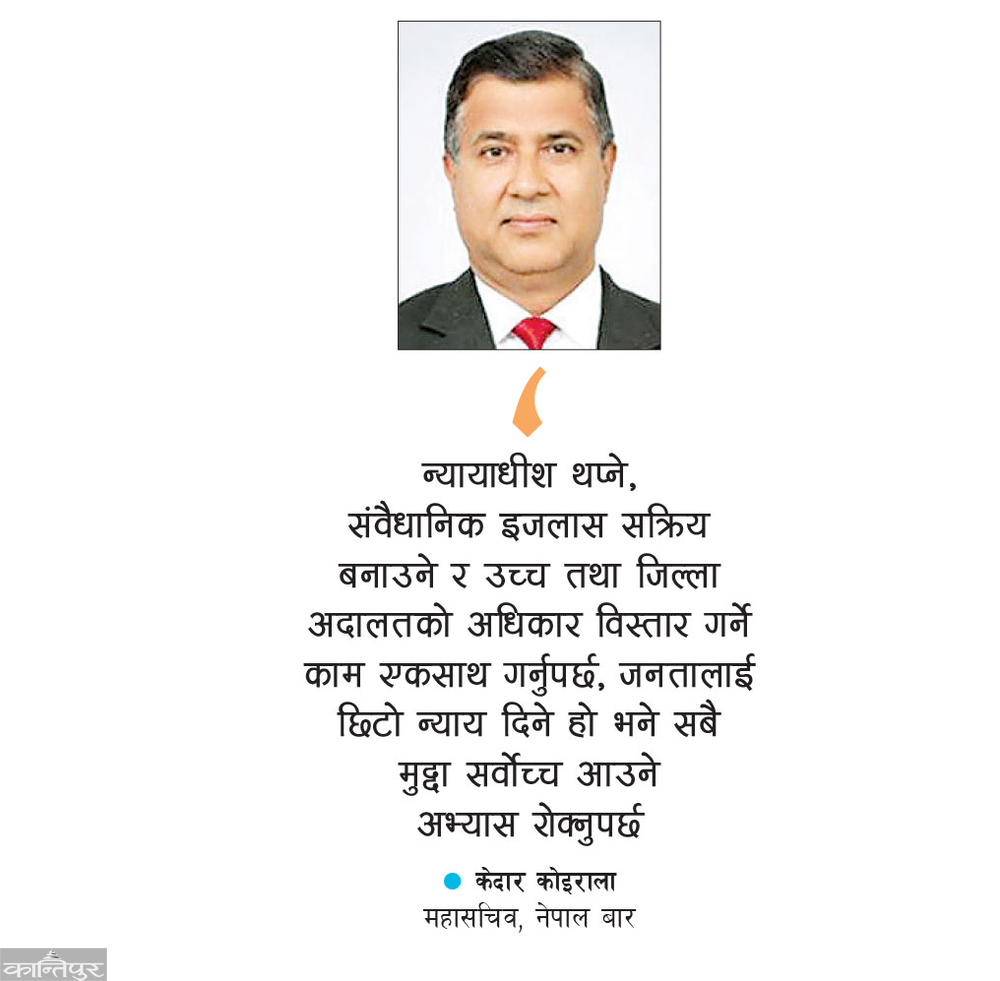
Some experts in the judicial sector say that the problem lies more in the nature of the cases that reach the Supreme Court than in the number of judges. Former Supreme Court Justice Ishwar Prasad Khatiwada says that the court, the bar and the service recipients should all play a common role in how to manage the cases rather than reducing them. According to former Supreme Court Justice Balram KC, the high court can be given the power to issue a writ. He argues that when writs and cases of public concern are decided by the higher courts, about half of the people's cases can get their turn in the Supreme Court.
Former Secretary General of Nepal Bar Advocate Anjita Khanal says that meaningful reform is possible only by redefining jurisdiction. "Unless the situation where service recipients have to travel from Karnali for a week and from Madhesh barefoot to the Supreme Court is stopped, trust in justice cannot be maintained for a long time," she said.
What do the study reports say?
In 2078, a study committee formed under the leadership of the then Judge Harikrishna Karki concluded that the jurisdiction of the Supreme Court should be reviewed. Page 142 of the Karki Committee report states, "Since the current legal system regarding jurisdiction has increased the workload of the Supreme Court excessively and has led to delays in the delivery of justice... the law should be amended to grant the district court the jurisdiction to hear all types of original cases except in exceptional circumstances, and the high court should be given the power to make final decisions under appellate jurisdiction."
In 2078, a task force formed by the Ministry of Law during the tenure of the then Law Minister Dilendra Prasad Badu had suggested amending about two dozen laws to reduce the workload of the Supreme Court. The task force concluded that the number of cases should be reduced by amending laws including the Supreme Court Act and the Administration of Justice Act. The report suggested that the trend of filing writ petitions directly in the Supreme Court should be controlled even when alternative legal remedies are available. It was proposed that the Chief Registrar himself should be able to file petitions in cases where alternative remedies are available. Similarly, the report pointed out that the ‘double-entry’ petition system, which currently consumes a lot of time in the Supreme Court, needs to be improved.
The task force had proposed that a three-member bench of the High Court itself should first examine the petition filed against the decision of two judges of the High Court and allow it to go to the Supreme Court only if serious legal questions are found. Similarly, it was suggested that a limit should be set on the scope of appeal. The report suggested that only cases that can carry a prison sentence of seven years or more and involve a loss of more than Rs 5 million should be taken to the Supreme Court for appeal.
Former Minister Badu says that after the study conducted during his time, some reforms were attempted and some were implemented. ‘But the issue of not being able to do so without amending the constitution got stuck. Now that the debate on amending the constitution is underway, all these issues should be covered,’ he says.
Why the reluctance to change the structure?
The 2072 Constitution was expected to reduce the workload of the Supreme Court by converting the Court of Appeal into a High Court and granting it writ jurisdiction. In theory, this was a reasonable expectation. But even after a decade, the number of cases in the Supreme Court has not decreased, but rather has increased.
Despite giving the High Court many powers, the Supreme Court has become the final destination for appeals, ‘repeat’ petitions and writs. The question is also raised whether uniformity in judicial interpretation can be maintained across the country by making High Court decisions broadly final. When different High Courts come up with different interpretations, the responsibility of unifying them will ultimately lie with the Supreme Court. But former Justice KC does not agree with this argument. According to him, the higher courts can also set precedents and, if there is a difference in the final interpretation, the higher courts can be given the power to issue a decree, keeping the path to the Supreme Court.
The Constitution Amendment Task Force is currently collecting suggestions from various bodies. In this context, the debate on the judiciary has mostly focused on the appointment of judges, parliamentary hearings, or the structure of the Judicial Council. But legal experts say that the question of the structure and jurisdictional review of the Supreme Court is also becoming equally important.