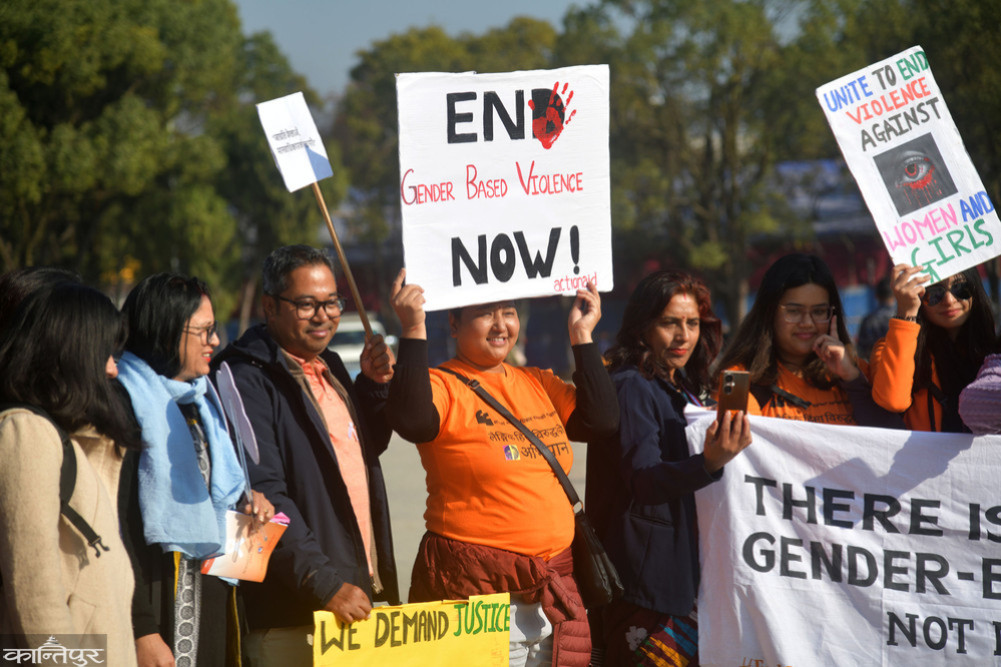
In the current fiscal year, 68 women have been murdered by their husbands and 528 in the last six years, with the highest incidence in Koshi, Lumbini, and Madhesh.
We use Google Cloud Translation Services. Google requires we provide the following disclaimer relating to use of this service:
This service may contain translations powered by Google. Google disclaims all warranties related to the translations, expressed or implied, including any warranties of accuracy, reliability, and any implied warranties of merchantability, fitness for a particular purpose, and noninfringement.
On June 22, during a domestic dispute in Lolang Paiyutar, Tarakeswor Municipality-6, Kathmandu, 42-year-old Kumar Thapa 'Nepali Bro' hit his wife Ishwari Bhujel with a rod. Ishwari was seriously injured. She was taken to the hospital, but the doctor declared her dead during treatment.
According to Ishwari's relatives, there had been a dispute between the couple for some time. Kumar had repeatedly threatened to kill Ishwari. Ishwari had even filed a complaint at the police station. But the station had suggested that they reconcile, calling it a 'normal domestic dispute'. The family said that Ishwari and Kumar were in the process of divorcing before the incident. Ishwari was serving as a subedar in the Nepali Army.
***
Last year, in Shrawan, 58-year-old Jange Sarki, who lived in a squatter settlement in Rithepani, Pokhara-27, was arrested on charges of murdering his wife. Neighbors had informed the police after a foul smell came from the house of Jange and his wife Jamuna Nepali. When the police opened the door, they found 53-year-old Jamuna dead. On Shrawan 8, the police found Jamuna's body in a decomposed state.
According to the police, there was a fight between the husband and wife on Shrawan 6 over the sale of their land. During the fight, it was revealed that Jange punched her twice and knocked her against the wall, killing her. According to the Gandaki Province Police Office, Pokhara, Jange has been sent to jail for remand as per the order of the Kaski District Court on Bhadra 2, 2082.
***
Last year, on April 28, 35-year-old Kaviraj Hemaram killed his wife with a khukuri in Sukedangi, Kankai Municipality-2, Jhapa.
***
Looking at the statistics of the current fiscal year 2082/83, it is seen that 68 women were killed by their husbands. From the fiscal year 2077/78 to the current fiscal year 2082/83, 528 women have lost their lives at the hands of their own husbands. The incidence of wife murder is high in Koshi Province. After that, there are many cases of husbands killing their wives in Lumbini and Madhesh Province.
In recent times, cases of wives killing their husbands have also been made public. In the current fiscal year, 7 men have been killed by their wives. In the last 6 years, a hundred men have lost their lives because of their wives.
***
Former AIG Durga Singh Chand says that ups and downs in relationships, suspicions and extramarital affairs can lead to domestic violence and even murder. ‘In this day and age, extramarital affairs, suspicions and lack of transparency in relationships are seen as major challenges,’ she said. ‘In many relationships, whether female or male, extramarital affairs are also seen more.’
Singh says that the recent incidents of murder and violence should not be understood as planned crimes. ‘Murder incidents in the family are not decisions made in a single day, they are due to various long-term mental stresses,’ she said. ‘I will kill’ is not planned from the beginning.’ But due to continuous stress, distrust, insults, financial problems, or conflicts within the relationship, the mental pressure on the person increases and eventually that pressure leads to the decision to take steps up to murder.’
Singh says that the incidents have also increased due to changing family life and social styles. ‘Earlier there were joint families. There was active monitoring of neighbors and the community. Also, such incidents were less common as moral control kept a person’s behavior balanced, but now it is the opposite. That is why such incidents have increased,’ she said.
***
Senior psychologist Prof. Dr. Ganga Pathak says that in recent times, violence has started increasing as people have become self-centered. ‘Nowadays, human feelings, love, and sympathy are weakening in society. Their place is being taken by anger and resentment. Violent behavior seems to have increased due to inability to control anger,’ she said. ‘People are becoming self-centered. The tendency to try to fulfill their desires immediately has also reduced sensitivity to pain and emotions.’
Pathak says that a person reaching the point of murder is not a sudden decision. ‘Rather than a sudden decision to kill someone, such incidents are linked to factors such as mental health problems, personality disorders, wrong upbringing and family environment, stress in relationships, and behavior learned from society,’ she said. ‘No person is born a criminal. It is the family environment and the behavior learned from society that shape their personality.’
Psychologist Pathak says that people with a violent nature tend to lack love and sympathy. ‘People with a violent nature often have personality disorders. The symptoms of which start appearing from the age of 14/15,’ she said. ‘The signs of this are that they are suspicious of others without reason, cannot control their anger, and show excessive anger even on ordinary matters.’ Similarly, as they grow older, they become involved in activities that go as far as violence against others.''
Similarly, Pathak says that the amount of hormones such as 'oxytocin', which is related to love, sympathy and happiness, may decrease in the brain of such people, and elements that promote negative thinking, revenge and aggressive behavior may become more active. 'If timely consultation, counseling and access to mental health services can be increased, violent tendencies can be controlled and future crimes can be prevented,' she said.
Laxman Prasad Sharma, Associate Professor of Sociology at Tribhuvan University, says that explaining personal violence, family disputes and social disorders on the basis of social production, economics and politics and interpersonal relationships rather than the product of personal thinking and behavior can bring us closer to the truth. 'Every incident is created as a result of social structure, relationships and interactions. It can be easily seen that the capitalist economy that has been growing globally in recent times has brought about extensive changes in the structure, relationships and interactions of Nepali society,' he said, 'which is the result of which such incidents occur.'
Associate Professor Sharma says that recent changes have been seen in social structures such as family, kinship, marriage, politics and economy. 'The atmosphere of showiness, formality and distrust is becoming stronger in society,' he said.
What is the legal system like?
The Nepali Criminal Code divides murder-related crimes into different categories based on their nature and intent, and the punishment is determined based on the nature of the murder, says Advocate Prakash Niraula. 'Murder committed with the intention to kill someone falls under intentional murder. Sections 177 and 178 of the Criminal Code apply to this. There is a provision for life imprisonment for such a crime,' he said. 'In such a case, the perpetrator is sentenced to 10 to 15 years in prison and a fine of Rs. 100,000 to Rs. 150,000.'
He says that the incidents of quarrels and murders between husbands and wives occur for various reasons and there is a legal provision for punishment depending on the nature of the murder.
'There are cases of murders after various types of disputes. There are many cases of property and financial disputes, disputes over dowry or property, which have led to murder,' said Advocate Niraula. 'Family distance and suspicion created due to foreign employment, disputes due to suspicion and relationship with other women or men, and minor domestic disputes caused by consuming alcohol are more common.'
According to Section 41 of the Criminal Code, if a person commits six types of crimes and commits murder, there is a provision for life imprisonment (sentence for life) Niraula says. Niraula says that there is a provision for life imprisonment for murder by torture or brutal dismemberment, murder by hijacking or bombing an airplane, murder by kidnapping or holding a person hostage, murder by poisoning a drink or food item consumed in public, destruction of a community with the intention of committing genocide, and murder by rape.
Although the purpose of the law is not only to punish but also to reform criminals, Niraula says that there is a lack of clear laws on employing prisoners in Nepal's prisons.
Women's rights activist Rita Sah says that women are still insecure within the family due to patriarchal thinking and structure. 'In recent times, the level of education, mobility and economic empowerment of women have increased.' Similarly, with increased access to technology and information, women have become aware of their rights, freedom and rights over their bodies,' she said. 'However, as women have become more empowered, society and families have not been able to accept it, which has led to strained and complicated relationships.'
Sah says that when women claim their rights, society is still unable to digest such things. 'Everyone wants women to be empowered.' But no one wants to adopt empowered women,' she said. 'Society still cannot digest women claiming their rights or raising their voices for their rights and interests. Patriarchal thinking is still more visible in the Terai.'
Sah says that the technology to kill women in very brutal ways has increased. 'Nowadays, the nature and trend of violence has changed.' Nowadays, there are very brutal types of violence, such as killing one's own wife and taking her head to the police station or mutilating her limbs,' she said. She says that domestic violence is the most common type of violence in Nepal after cybercrime.
She says that the perpetrator's morale increases because society tends to blame the victim.
'There is a high tendency to blame the victim in our society. When a woman cannot bear the violence and raises her voice or files a case, she is uncooperative from both her family and home,' she said. 'This further increases the perpetrator's morale. He even contemplates murder.'
Although there are adequate laws and structures against domestic and sexual violence in Nepal, their implementation is very complicated, and the process is long, which makes women suffer even more, says Sah.
'The way we raise sons and daughters is different in our society. "While daughters are taught to be shy and stay indoors, sons are not taught how to treat their girlfriends with respect," she said. "Sons are learning the same behavior their fathers do at home. When they grow up, they put that into practice."