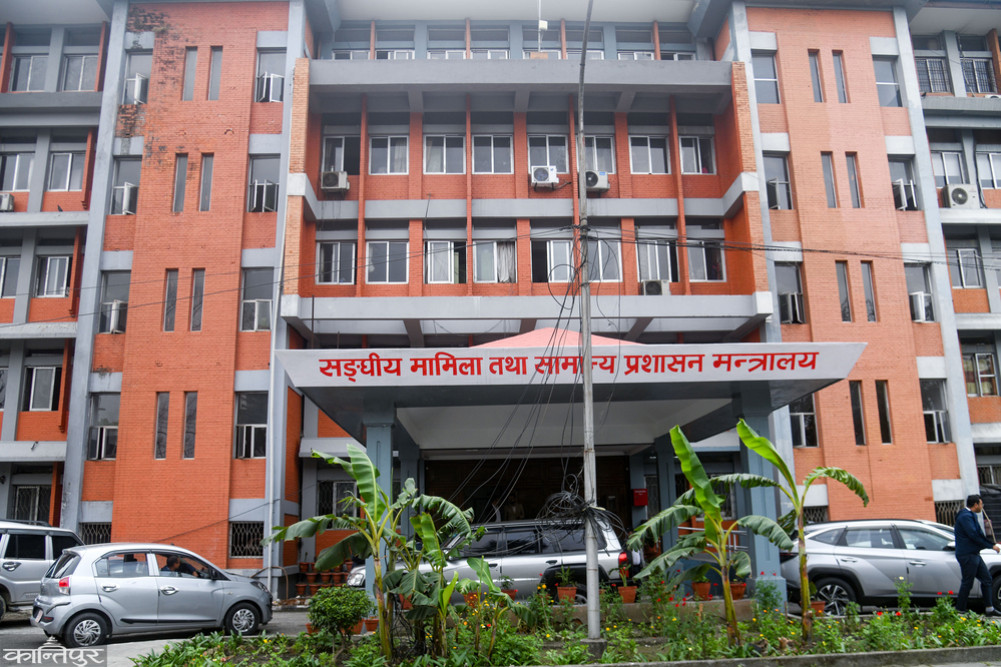
The ministry is changing the provision in the Local Government Operation Act, 2074 BS, which allows changes in the number and boundaries of rural municipalities or municipalities at least one year before the election date, to allow changes in the number and boundaries of local levels six months in advance.
We use Google Cloud Translation Services. Google requires we provide the following disclaimer relating to use of this service:
This service may contain translations powered by Google. Google disclaims all warranties related to the translations, expressed or implied, including any warranties of accuracy, reliability, and any implied warranties of merchantability, fitness for a particular purpose, and noninfringement.
The Ministry of Land Management, Cooperatives, Federal Affairs and General Administration has started preparations to change the number and boundaries of local levels before the local elections. The five-year term of elected people's representatives at the local level is ending on 31 Baisakh 2084. Accordingly, there is not even a year left for the elections. The Local Government Operation Act, 2074 BS, has a provision that allows the number and boundaries of rural municipalities or municipalities to be changed at least one year before the election date. Therefore, the ministry is going to change the current provision of amending within one year and make it possible to change the number and boundaries of local levels six months in advance.
The Good Governance Roadmap prepared by the Office of the Prime Minister and Council of Ministers also recommends reducing the number of municipalities in various recommendations to reduce expenditure. The ministry has already prepared and made public the criteria related to the number and boundaries of municipalities and wards and their merging or merging with each other. The ministry has started preparations for the amendment to take this matter forward.
The government had determined the number of local levels in 2073 BS on the recommendation of the Local Level Restructuring Commission formed under Article 295 of the Constitution. Currently, there are 753 local levels, including 6 metropolitan cities, 11 sub-metropolitan cities, 276 municipalities and 460 rural municipalities. 6,743 wards have been determined. The Local Government Operation Act, 2074 BS has made provision for the number or boundaries of rural municipalities or municipalities to be changed or merged with each other. However, since the provision of the act that such changes should be made one year before the election is currently hindering it, an official of the ministry said that preparations are being made to amend it. If the number or boundaries of rural municipalities or municipalities need to be changed or changed, a proposal must be passed by a two-thirds majority of the local level assembly concerned and sent to the provincial government. The draft provides that the province should study such a study proposal and recommend it to the Government of Nepal within 15 days. Earlier, although the province was said to send a recommendation to the Government of Nepal, no deadline was set.
The criteria itself has formed a committee under the leadership of the coordinator of the District Coordination Committee to study and report on the number and boundaries of municipalities and the existing classification of municipalities. The criteria state that the village assembly or municipal assembly can take a decision as per the provisions of the act based on the study report of the committee. There are about a hundred applications in the ministry alleging that the boundaries of the wards do not match. Similarly, some municipalities have sought to be 'upgraded' because they have met various criteria. Prakash Dahal, Chief Joint Secretary of the Federal Affairs Division, said that the act is being amended to resolve some of the problems seen regarding the boundaries and to facilitate the 'upgrade' of municipalities by merging them with each other or other reviews. Stating that the draft amendment to the act has been made public for the opinions and suggestions of stakeholders, he said that the draft bill will be finalized by incorporating the suggestions received. He mentioned that the need for amendments to the act has been felt to resolve the dilemmas and problems encountered in the implementation of the act as well as some difficulties encountered in the practice of local government operation.
A new provision has been included in the act that allows the Government of Nepal to reclassify rural municipalities and municipalities every ten years by analyzing various grounds. There has been no change in it since the formation of rural municipalities and municipalities in 2073 BS.
The ministry has also sought to find a solution to the issue of the inability to hold municipal executive meetings due to political disputes, in addition to the number and boundaries of municipalities, through the amendment. In the existing system, the presence of more than fifty percent of the current members for an executive meeting is considered a quorum. By changing this system, if the quorum is not reached for three consecutive meetings, it has been sought to make it so that if more than 33 percent of the current members of the executive, including the chairman or mayor, are present, the quorum for the meeting is considered to have been reached. Similarly, an attempt has been made to amend the provision that decisions of executive meetings are made by consensus. By changing this provision, if a decision cannot be made by consensus, the decision made by the majority of the members present at the executive meeting, including the chairperson or mayor, will be the decision of the executive.
It has been said that all or some of the resources provided by the Government of Nepal and the provincial government, including grants, to the local level that does not hold a village assembly or a municipal assembly, may be withheld until such a meeting is held. Similarly, it has been tried to make a provision that if the Chief Administrative Officer is not present by the rural municipality or municipality, the account of such a rural municipality or municipality may be frozen. The draft has made a provision for the Government of Nepal to appoint the Chief Administrative Officer at the local level through the provincial government. It is said that the work descriptions of local service employees will be updated, and the arrangements for filling posts, transfers and promotions will be in accordance with provincial laws.