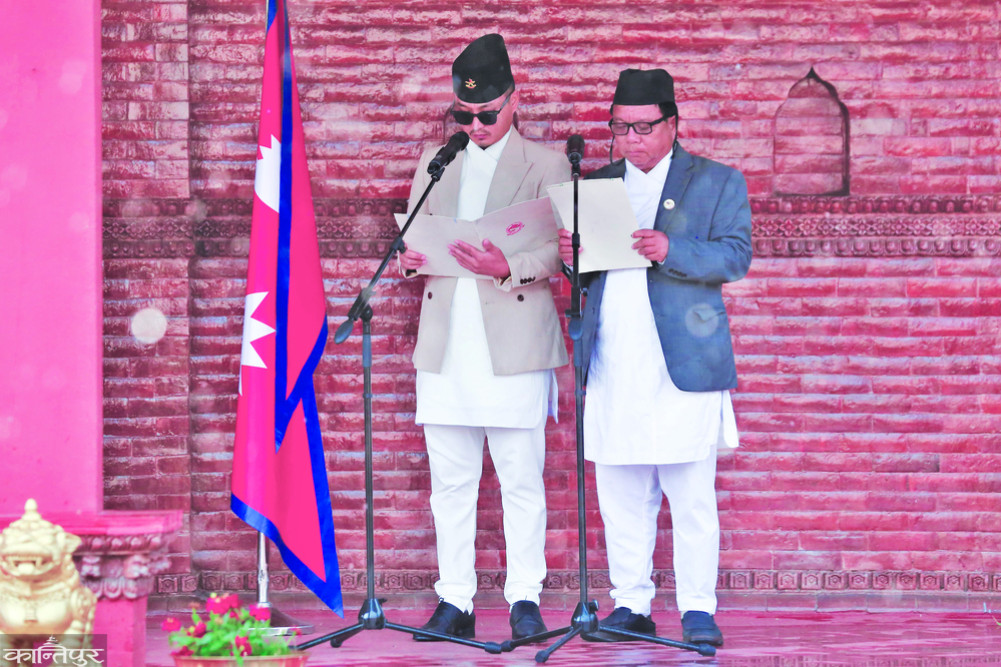
Sudhan Gurung to be Home Minister and Mahabir Pun to be Science, Technology and Innovation Minister
We use Google Cloud Translation Services. Google requires we provide the following disclaimer relating to use of this service:
This service may contain translations powered by Google. Google disclaims all warranties related to the translations, expressed or implied, including any warranties of accuracy, reliability, and any implied warranties of merchantability, fitness for a particular purpose, and noninfringement.
Mahabir Pun, the Education Minister of the interim government formed after the Gen-G movement, and former Home Minister Sudhan Gurung, who had earlier resigned over a property dispute, have been reappointed as ministers. Two months after resigning on the recommendation of Prime Minister Balendra Shah, Rashtriya Swayamsevak Sangh (RSS) MP Sudhan Gurung has returned to the Home Ministry.
Pun, who was elected as an independent candidate from Myagdi, has been appointed as the Minister for Science, Technology and Innovation. He had earlier demanded in parliament that the ministry be renamed the Ministry of Science, Technology and Innovation Research.
A committee led by former judge Achyut Prasad Bhandari submitted its report on Friday, saying that former Home Minister Gurung's 'assets do not appear to be unaccounted for'. After that, Prime Minister Shah recommended Pun and him for ministerial appointment on Tuesday. Gurung and Pun, who were appointed ministers, took the oath of office and secrecy from President Ram Chandra Poudel on Tuesday evening.
After assuming charge of the ministry, Home Minister Gurung has said that 'every file will be opened' by making the Central Investigation Bureau (CIB) of the police more powerful and effective. He has directed that the files currently under investigation be brought to a speedy conclusion. He has also decided to form a thematic and specialized group to investigate heinous, economic crimes, organized crimes and other serious cases in the bureau. Home Minister Gurung has also decided to move forward with the investigation into the palace massacre. The entire family of the then King Birendra Shah was murdered in the palace on 19 Jestha 2058.
Home Minister Gurung has also decided to form a special task force to study whether criminal cases registered in incidents related to the Gen-G movement can be withdrawn. He has also decided to form a 'Sensitive Information Vigilance Team' (SIVT) in the security agencies to closely monitor and take action to prevent sensitive information leaks from the Ministry of Home Affairs and security agencies.
Gurung had resigned on 24 April after details of his investment in a company linked to controversial businessman Deepak Bhatt were made public. The government had formed a committee headed by former Justice Bhandari and comprising Comptroller General Shobha Kant Poudel and Associate Attorney Achyutmani Neupane to investigate the questions raised against him. The cabinet meeting held on Tuesday decided to accept the report submitted by the committee stating that Gurung's 'direct relationship and financial transactions with businessman Bhatt could not be confirmed'. Prime Minister Shah appointed him as the Home Minister without a detailed study of the report and its publication.
The National Human Rights Commission had recommended the government to conduct further investigations into Gurung after investigating the incidents of 23-24 Bhadra. Human Rights Commission officials have expressed dissatisfaction that he was made Home Minister even after the recommendation. Commission member Lily Thapa, who led the investigation, said, 'What can we expect when the person recommended for investigation is the one who is in the place where the investigation is conducted? Even during the conflict, the investigation could not be concluded after bringing people under investigation to the policy-making level, and the same trend may repeat itself now.'
Gurung, the founder of 'Hami Nepal', who came to the fore after the Gen-G movement on 23 Bhadra, had ordered the arrest of former Prime Minister KP Sharma Oli and former Home Minister Ramesh Lekhak on the evening of 13 Chaitra 2082, the same day he became Home Minister. Gurung had ordered their arrest to implement the report of the commission formed to investigate the incidents of 23 and 24 Bhadra. Oli and Lekhak were released on the order of the Supreme Court.
Gurung had announced during his previous 26-day term that he would make the police uniforms worth seeing. When IGP Dan Bahadur Karki said that he preferred the uniforms to be 'black rather than blue', he said that he would focus on improving the uniforms. He had also announced that a domestic clothing industry for the police would be opened. However, this time the budget of the entire Home Ministry has been reduced. In this case, he also faces the challenge of moving forward with the plans he himself announced in the past. The Nepal Police is still running on the basis of the 2012 Act.
While various provinces have brought in the Provincial Police Act, the Nepal Police Act has not been able to come. Preparations were underway to bring in a new Act for the Armed Police Force. In this case, the responsibility of bringing in the Acts of both police organizations has once again fallen on his shoulders. Gurung, who was elected as a member of the House of Representatives from Gorkha-2, is a leader who joined the Gen-G movement through volunteer work. In the discussion held at the Jangi Adda on 25 Bhadra, he became the coordinator of the negotiating team on behalf of Gen-G. After that, he emerged as a leader.
Appointed Minister of Science, Technology and Innovation, Pun was elected as an MP as an independent candidate in the 21 Falgun elections. The Rashtriya Swayamsevak Sangh supported him by not fielding a candidate from Myagdi. Pun was the Minister of Education in the Sushila Karki-led government formed after the Gen-G movement on 23-24 Bhadra.
Pun said that he was completely unaware of becoming a minister until Tuesday afternoon. When the news of his becoming the Minister of Innovation spread and he was surrounded by ‘content creators’, Pun had said, ‘Don’t ask what you are doing now after bringing a book seller here and making him a minister without any hesitation. The first thing I will do is go to the ministry and understand what is going on.’ Earlier, while speaking in Parliament, he had complained that the government had neglected the subject of science and innovation in the policy and program and budget.
Born in Nangi, Myagdi, Pun’s father was in the British army. He completed his SLC from Chitwan and his ISC from Amrit Science Campus in Kathmandu. He reached the US at the age of 33 for higher education. The University of Nebraska there had offered him a full scholarship. In 1989, Pun completed his master’s degree in science education.
After returning from the US, he taught mathematics and science in Chitwan for about 13 years. Returning to his village, he expanded the school that taught up to grade 8 to grade 10. In 1997, he established a computer lab at Himachal Secondary School with four old computers gifted by an Australian student. Since there was no electricity to run those computers, he started computer education in the school by connecting a small hydro-generator to a nearby stream.
Pun had brought internet to remote villages in Myagdi using wireless technology in the 2050s. For that initiative, he was awarded the 'Roman Magsaysay Award', which is considered Asia's Nobel Prize, in 2007. Later, he also received various honors such as the 'Internet Hall of Fame', the Overall Social Innovation Award, and the Jonathan B. Postal Award. The University of Nebraska in the United States also awarded him an honorary doctorate. Pun also ran a restaurant called 'Nepal Connection' in Thamel, Kathmandu around 2075. The concept of the National Innovation Center was born in that restaurant.