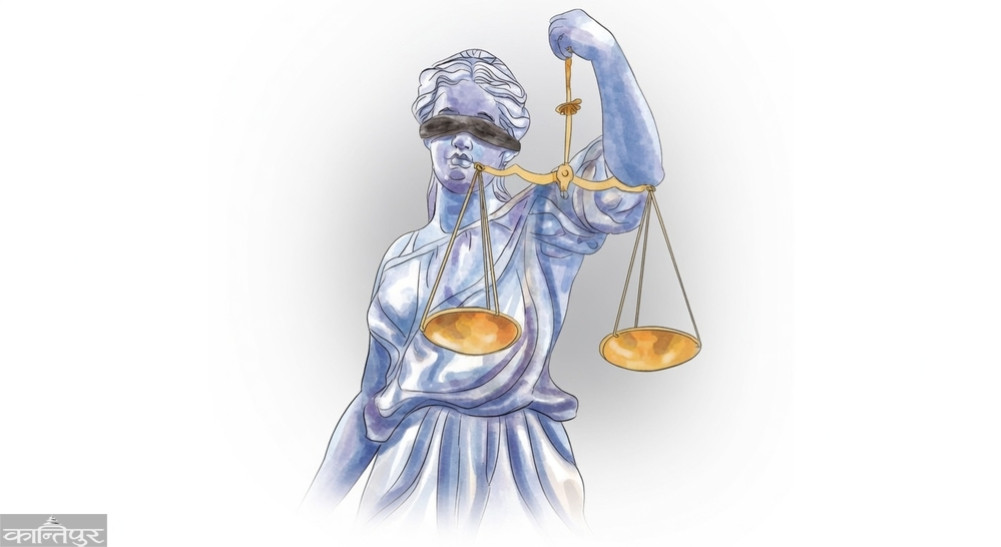
A legal provision that determines whether an employee convicted of corruption by a court will receive pension benefits based on whether they were still in office or retired when the case was registered.
We use Google Cloud Translation Services. Google requires we provide the following disclaimer relating to use of this service:
This service may contain translations powered by Google. Google disclaims all warranties related to the translations, expressed or implied, including any warranties of accuracy, reliability, and any implied warranties of merchantability, fitness for a particular purpose, and noninfringement.
Navin Pokharel, Deputy Secretary of the Ministry of Forests and Environment, who was found guilty in a corruption case related to the purchase of security printing equipment, was found dead at his own home in Lokanthali on 11 Jestha 2081. A ‘suicide note’ was also found later. . Pokharel had been convicted by a special court just three days before the incident.
The court had also convicted Bikal Poudel, the then executive director of the Security Printing Center, in the same case. Pokharel was sentenced to six months in prison and a fine of about 58.5 million and an equal amount of money. After the court’s verdict, Pokharel was dismissed. He also lost his pension benefits. “There was only one and a half years left to retire, but he was removed from service after being found guilty before that, and there was a provision that even the pension that had accrued would not come,” said a member of Pokharel’s family.
This incident has highlighted an issue that has not been discussed much in public debates about the legal system against corruption in Nepal. According to the current law, government employees lose their pension if they are found guilty of corruption while in service. There is no clear law to withhold pension benefits for employees convicted after retirement. Therefore, they continue to receive their pension. Even if they are convicted of the same type of corruption offense, the different treatment given to employees by the state based on whether the verdict was given before or after retirement is also seen in much-publicized corruption cases.
Three former Inspectors General of Nepal Police, Om Bikram Rana, Hem Bahadur Gurung and Ramesh Chand Thakuri, were found guilty by the Supreme Court on 3 Jestha 2080 for irregularities in the procurement of Armed Personal Carriers (APCs) for the Nepal Police's 'Firm Police Unit' (FPU) deployed in the African country of Sudan for UN peacekeeping.
When the CIAA initially registered the case, Rana and Gurung had already retired, while Thakuri had been transferred from Inspector General of Police to the Prime Minister's Security Advisor. The initial decision-making process related to the Sudan scam was during the time of the then Inspector General Rana. The final payment of the same decision was during Chand's time, so he was dragged into the case. Even though Thakuri was found guilty in the same case, he does not get a pension, but the benefits of the other two continue.
Similarly, in the case of embezzlement of government land at Lalita Niwas in Baluwatar, the Special Court found 131 people, including government employees, guilty on 3 Falgun 2080. Among them, Deep Basnyat (also the former head of the authority) and Chhabiraj Pant (also a minister in the Khilraj Regmi cabinet) and Tikaram Ghimire, retired employees receive pensions, but employees of the then Ministry of Land Management, including Mani Kumar Rana and Phanindra Prasad Dahal, who had served more than 20 years, do not.
The people mentioned above, whose pension benefits were taken away, were serving employees when they were found guilty of corruption by the court. Those whose pensions continue, had already retired from service when they were found guilty of corruption.
According to the current law, if a government employee retires from service, the retiree gets this facility for life, and if the retired employee dies, the husband or wife also gets this facility for life. In Pokharel's case, his wife has been deprived of this facility. 'The service period for him (Pokharel) to receive pension had already expired. However, because he was found guilty, the civil service library refused to make a pension contract,' said a family member.
The members also said that it was not good to treat one person one way and another the other. 'Pension is a facility given for service, but the decision that found Pokharel corrupt should not have been punished for the facility given for service,' he said.
The arrangement for government employees to receive pension after retirement is also seen as a respect and appreciation for the public service they have rendered for years. Pension is not only for the employee, but is also related to the security of the family. If a government employee dies, the husband or wife also gets pension facilities. This prevents their family from suddenly losing income. It reduces the likelihood of financial hardship in old age and prevents the family from becoming completely dependent on children or relatives. In this sense, Nepal's pension system is not only a way to reward employees for their service but also an important social security foundation for maintaining the financial security of the family.
Some people also question why the government continues to provide benefits to employees who have been proven to have committed corruption from the treasury collected from taxpayers.
Pension-related provisions are regulated by the Civil Service Act in the case of government employees and the Police Act and Regulations in the case of police. According to these provisions, if a serving employee is found guilty, he or she is deprived of future government service benefits upon dismissal, but there is no mention in the law in the case of retired employees. Due to this unclear provision, employees who have been convicted of corruption cases after retirement are regularly enjoying pension benefits. Experts point out that this legal anomaly needs to be corrected.
The Federal Civil Service Bill, which was presented to the House of Representatives on 21 Falgun 2080 by the then Minister of Federal Affairs and General Administration Anita Devi, included a provision that a person who is found guilty in a case after retirement will not receive a pension. Section 68(1) of the bill stated that after the commencement of the Act, ‘A person who is receiving a pension or family pension after retirement will not receive such a pension if he is found guilty by a court of law of corruption... or other criminal offenses involving moral turpitude.’
After a general discussion in the House of Representatives, the bill was sent to the State Affairs and Good Governance Committee, and a subcommittee was formed and a clause-by-clause discussion was held. The subcommittee had amended the provision that the pension would not be available and ‘dual benefits should not be availed’. However, before this issue reached the Parliament from the State Affairs Committee, the elected government formed after the Gen-G movement dissolved the House of Representatives.
After further discussion in the State Affairs Committee, everyone agreed that pension would not be given to those found guilty in a case after retirement or while serving, but the bill did not move forward after the dissolution of the House of Representatives on 27 Bhadra last year, said the then chairman of the committee, Ramhari Khatiwada. “The committee had decided that the government should not provide pension facilities to those found guilty of corruption, whether they are serving or retired, and that the facilities should not be provided,” he told Kantipur. “How the new government will take this forward, how the parliament will accept it, is now a matter for the parliament and the government.”
The ordinance on civil servants brought by the Balendra Shah-led government before the current budget session of the House of Representatives does not cover this issue.
Senior advocate Srihari Aryal says that a clear law should be brought to ensure uniformity in the pension facilities of employees found guilty of corruption after retirement and while serving. ‘Pension is a financial facility given to an employee for the rest of his life as a contribution made by him in government service,’ says Aryal, who is also the former president of Transparency International Nepal. ‘Even when someone is dismissed, it is customary to thank them for their work done so far. If someone is tried while he is still in office and found guilty, how can his previous contribution be reduced to zero? The settlement of the case will be based on the decision or offense made by the employee!’
The Supreme Court in India has interpreted pension as a right of the employee for his service, not a favor from the government. There is also a provision in Indian law that allows the pension of a person convicted of corruption or other serious offenses to be withheld, where the law clearly provides.
The state government had demoted and dismissed Deokinandan Prasad, an employee of the Education Department of Bihar state, in 1960 and also withheld his pension. His challenge to this in the lower court reached the Supreme Court through various levels. After 11 years, in 1971, a constitutional bench headed by Chief Justice SM Sikri declared the administrative decision of the state government to demote, dismiss and even withhold pension of the employee as illegal.
The judgment explained that even if the employee is guilty and his pension is to be withheld, it should be made according to the law and should be done accordingly, but it cannot be stopped by administrative decision. After that, the government brought the Government Service Pension Rules, 1972, which gave the government the power to withhold pension of serving and retired employees who have been found guilty by the court.
According to legal experts, although the example of India seems to indicate that the pension of an employee who has been found guilty can be withheld, it should be based on a clear legal provision, and pension cannot be deprived based on an administrative decision. Currently, in Nepal, the facilities available to employees convicted of corruption before retirement and employees convicted after retirement are different. The Pokharel family's complaint is precisely on this issue. His family is challenging the special court's decision in the Supreme Court.
There is a law that if the deceased is found guilty, the prison sentence will be waived, but the amount of the fine will be transferred to the next of kin. Even after Pokharel's death, his family is currently fighting a case against him after the liability imposed on him was transferred to his family.