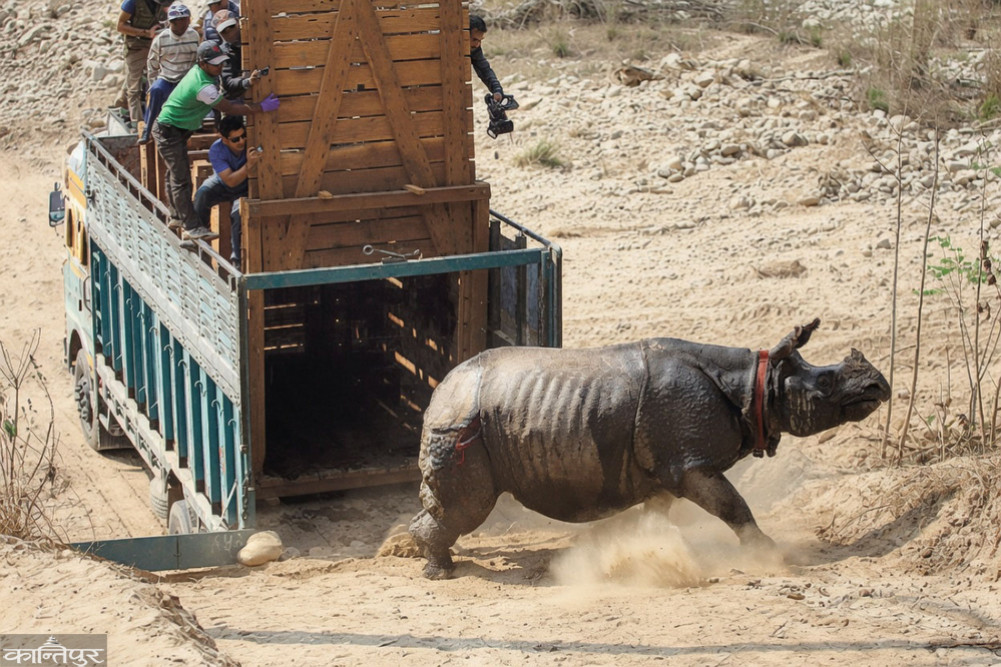
How deadly and counterproductive can unplanned wildlife translocation practices be? A prime example of this is the Babai Valley. Out of the 83 rhinos relocated here, 36 fell victim to poachers, while 24 died.
We use Google Cloud Translation Services. Google requires we provide the following disclaimer relating to use of this service:
This service may contain translations powered by Google. Google disclaims all warranties related to the translations, expressed or implied, including any warranties of accuracy, reliability, and any implied warranties of merchantability, fitness for a particular purpose, and noninfringement.
It is considered risky from a conservation perspective to confine the habitat of rare wildlife to a single area. To avoid the risk of an entire species becoming extinct due to epidemics, natural disasters, or human encroachment, it is wise to spread wildlife across multiple locations. In line with this strategy, the practice of moving (translocating) animals that are in high numbers in one habitat to another area with a similarly favorable environment began in Nepal four decades ago.
As the latest in the same practice, preparations are underway to bring the black deer, which is native to Bardiya, to Chitwan. While these preparations are underway, how successful or unsuccessful have past attempts at wildlife translocation been? This interest and debate has resumed in conservation circles.
From 1986 to 2023, a total of 104 rhinos have been relocated from Chitwan to Bardiya, Shuklaphanta and Koshi Tappu. 10 years ago (Falgun 2072), after the government decided to relocate rhinos from Chitwan National Park to Bardiya National Park, conservationists in Chitwan demonstrated in front of the District Administration Office with placards: ‘We had sent 83 rhinos, now there are only 29, why are you taking them again?’ However, the government continued to relocate rhinos.
According to the Chitwan Park Office, from 1986 to 2023, a total of 104 rhinos have been relocated from Chitwan to Bardiya, Shuklaphanta and Koshi Tappu. According to Abinash Thapa Magar, Information Officer of Chitwan Park, the highest number of rhinos went to Bardiya nine times from 1986 to 2017, a total of 91 rhinos. From 2000 to 2018, 11 rhinos went to Shuklaphanta in three times.
In 2023, two female rhinos were first taken to Koshi Tappu from Chitwan. The two rhinos, who were rescued and raised under human care, live in a large cage in Koshi. The two rhinos that were transferred were not raised as they should have been and in the environment they should have been. Similarly, in Bardiya and Shuklaphanta, male and female rhinos were transferred together, but the number did not increase.
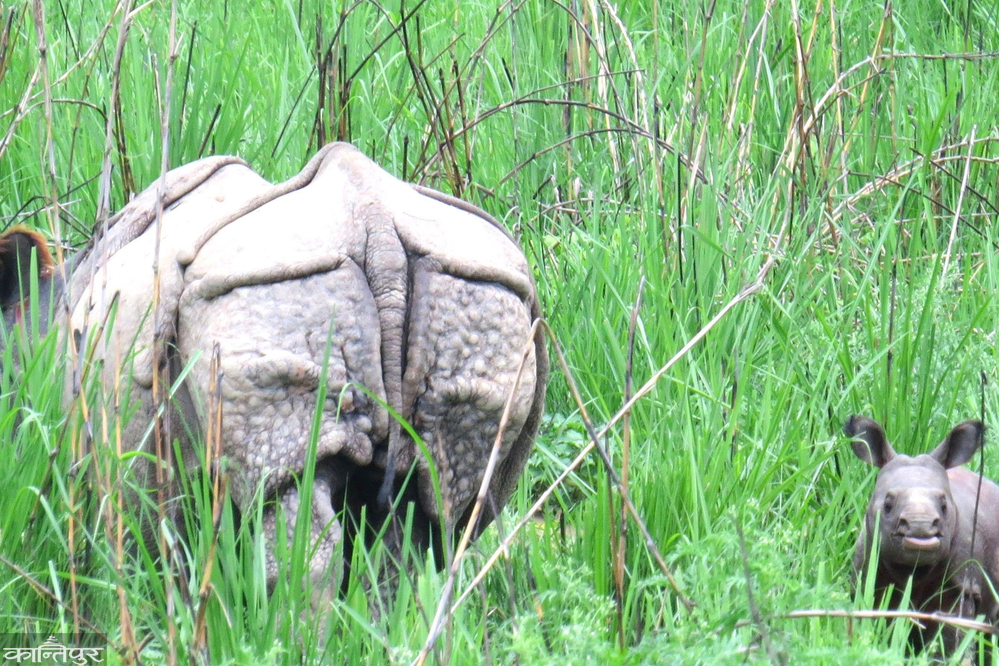
Chitwan could not save the rhino brought from Koshi. The condition of the buffaloes is almost the same. The results of the latest rhino census did not show the results of the transfer to be satisfactory. According to the results of the rhino census made public at the end of Chaitra 2077, out of 752 rhinos in the country, there were 694 in Chitwan. 38 were found in Bardiya and 17 in Shukla. Apart from these parks, three rhinos were found in Parsa National Park, which is connected to Chitwan. 91 rhinos were brought from Chitwan to Bardiya, but only 38 were found. Shukla showed a slight improvement.
Just as the rhinos from Chitwan reached Bardiya, Shukla and Koshi, wild animals have also been brought from outside to Chitwan. The condition of the rhinos brought from Koshi Tappu and the buffaloes brought from Shukla is even more sad. Chitwan could not save the rhinos brought from Koshi. The condition of the buffaloes is almost the same. The rhinos and buffaloes were kept in a large area fenced off inside the park.
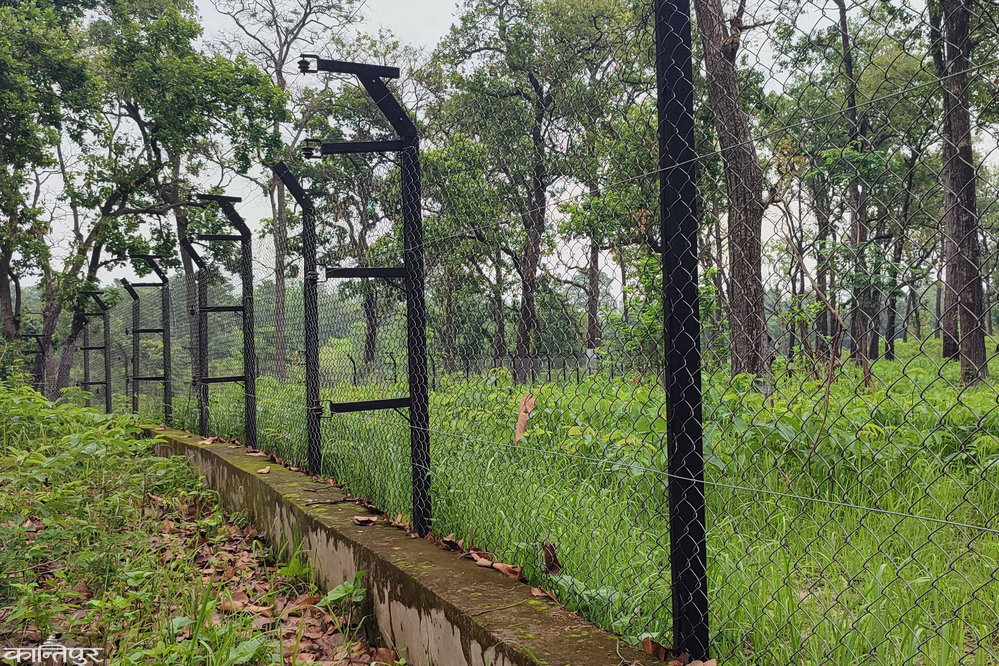
The settlement of Padampur has been moved outside as it falls within the boundaries of the Chitwan National Park. In the ‘enclosure’, which was prepared by fencing off 30 hectares of land left vacant after the settlement was moved, the ‘enclosure’ was started in 2073 Magh. A total of 15 annas were kept there, 12 from Koshi and three from the Sadar Zoo in Jawalakhel. The annas had already started giving birth.
The excitement among conservationists was evident as the babies started to be born, but it did not last long. A flood entered the ‘enclosure’, and a tiger and a python also entered. The flood in 2074 Shrawan drowned two annas and killed them. The three annas brought from the zoo had already died before that. The annas fell ill after the flood. The annas in the ‘enclosure’ were destroyed by the flood, tigers and pythons.
The Arna's cub and mother were killed by a tiger. One of the cubs was eaten by a python. Finally, after the three remaining Arna were killed by a tiger that entered the 'enclosure', all the Arna that reached Chitwan were gone by Shrawan 2079. ‘The relocation was good for the annas, as is confirmed by the fact that the annas gave birth to seven babies upon reaching there.’ However, some natural and other managerial reasons are the reason why the Arna did not survive, says Ramchandra Kandel, who was the head of Chitwan National Park at the time of bringing the Arna.
The natural reason for the problem was the flood. However, Kandel argues that the crisis was compounded by the fact that the plan to immediately increase the number of Arna to 25 and release them in their natural habitat, and not keep them in the 'enclosure' all the time, was not completed on time. 'Even after the flood, if monitoring had been increased and good attention had been paid to their diet, the Arna would not have become sick and weak,' he says, 'If they could have been released into the natural environment, it would have been an experiment.' 15 were taken . 25 were not reached, and instead of leaving without reaching 25, it was a crisis on top of a crisis .’
The baby and mother of the Arna were also killed by a tiger . One baby was eaten by a python . Finally, after the three remaining Arna were killed by a tiger that entered the ‘enclosure’, all the Arna that reached Chitwan were gone by Shrawan 2079 .
The issue of Arna relocation is also mentioned in the Auditor General’s report . In the 59th annual report of the Auditor General, it was warned that ‘the concerned sector should pay attention to making Arna relocation systematic and sustainable only on the basis of studies and research’. The Auditor General’s comment also shows that Arna relocation, which is becoming rare, has not been systematic . Along with Arna, a buffalo was also brought to Chitwan and kept in the ‘enclosure’ of Padampur .
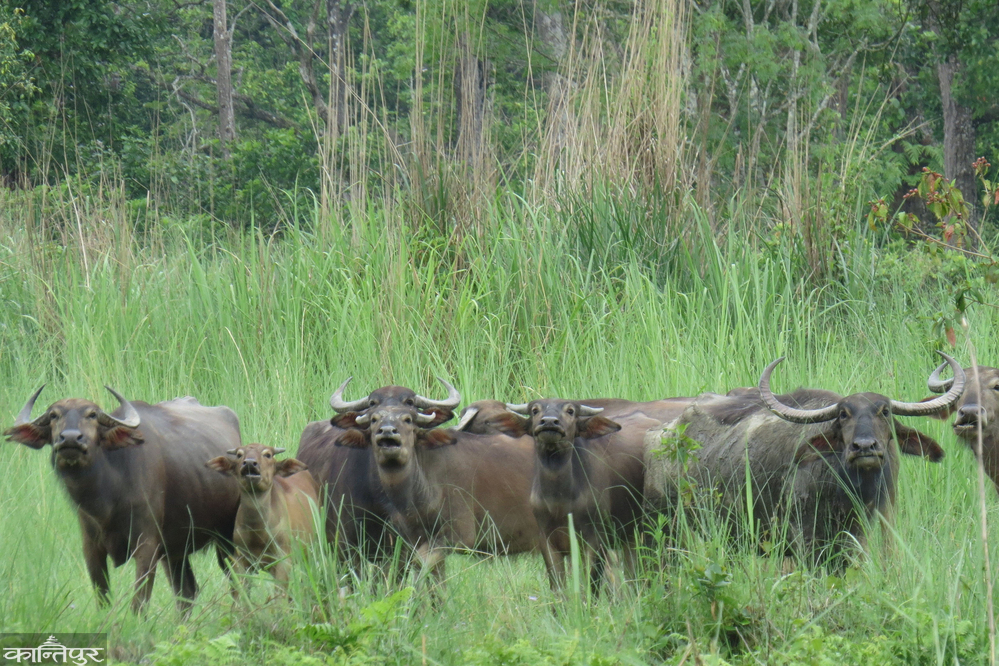
Seven bison were brought to Chitwan from Shuklaphanta. Two of the bison died soon after being brought. Similarly, more bison died in the flood in Shrawan 2074. Although it was thought that all the bison died in that flood, a bison was seen in Kumroj forest a year ago in Jestha.
If an animal is brought and relocated, it should be released in its natural habitat. - Kamaljung Kunwar , Former Chief of Chitwan National Park Such impacts associated with relocation have raised voices that the relocation of black rhinoceros should be sensitive. ‘I am against bringing an animal and keeping it in an enclosure for a long time and showing it to tourists like a zoo. If it is relocated, it should be released in its natural habitat.’ "They will keep them in enclosures only until they get used to the new environment," says former Chitwan National Park chief Kamal Jung Kunwar. He is also the author of the book 'Ghindalai Char Sar'. Kunwar says that good habitat and security are the main issues for wild animals. He said that there are fewer rhinos in Bardiya than those taken from Chitwan due to security and habitat. "If the habitat is good, the rhinos are healthy. They reproduce. And if the rhinos grow, if the security arrangements are good, poaching will not occur. In the past, there was a lack of security in Bardiya," Kunwar said. He said that the habitat there was also not good. He said that there should be plenty of grasslands and mud for rhinos to play in. Chitwan has such an environment. Kunwar says that even though Bardiya has a large river, the Karnali, and a medium-sized river, there is a lack of small and large rhinos. Therefore, he believes that relocating rhinos by focusing on improving their habitat and increasing security will yield effective results. He has suggested that not only Shuklaphanta, Bardiya or Banke National Parks, but also the community forests around the parks should be developed as habitats.
The main challenge for rhinos relocated to Bardiya National Park is habitat. Four decades ago, 13 one-horned rhinos were first relocated to Bardiya from Chitwan National Park. Since 2043, 88 rhinos have been relocated to Bardiya from Chitwan National Park several times. Of those brought to Bardiya, 47 were males and 41 were females. After the relocation, the number of rhinos has been decreasing instead of increasing.
According to Bardiya National Park, the first 13 rhinos were released in the Karnali River coastal area. Then, from 2044 Magh to 2072, 75 rhinos were released in the Babai Valley. The last time 5 rhinos were transferred was in 2072. However, Ramesh Thapa, former Chief Conservation Officer of Bardiya National Park, says that many of the rhinos transferred in this way did not survive. ‘Problematic, awkward and orphaned rhinos were brought,’ he says, ‘that is why the first 15/16 rhinos died naturally upon being brought.’
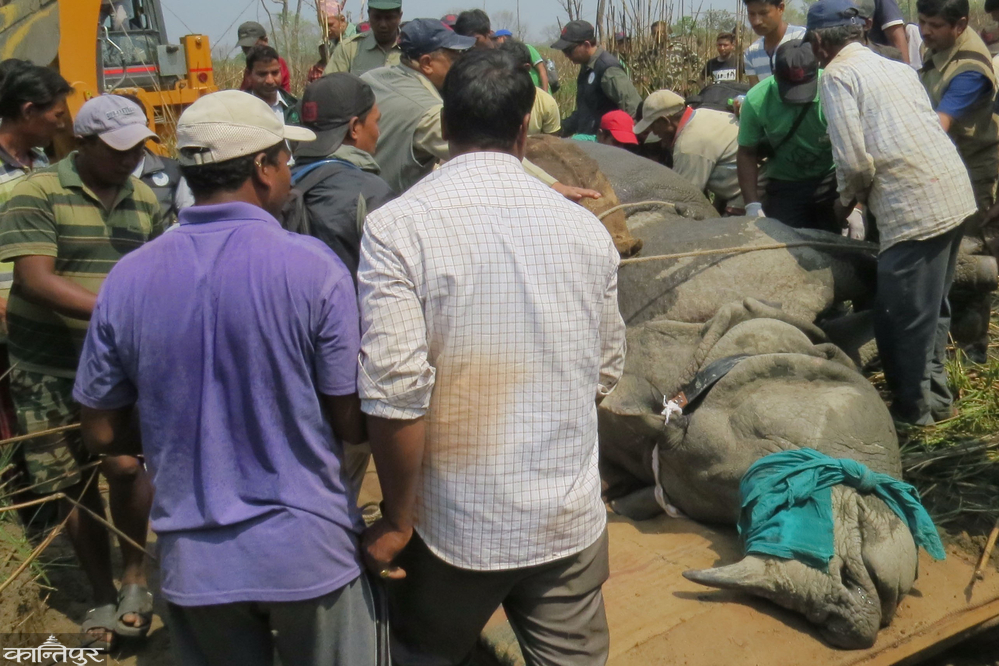
The problem arose due to the lack of natural habitat for rhinos. -
Ajit Tumbahamphe
, Head of the National Nature Conservation Fund Bardiya program Most of the rhinos transferred later were killed during the crisis during the armed conflict. Thapa said that poaching increased after the army post deployed to protect the park was removed. That is why there were no rhinos there in 2065 BS. Then, the last time three female and two male rhinos were brought and released there in 2072 BS. There are only five rhinos in the Babai Valley now. Although an adult male/female pair released in the Babai Valley in 2072 BS died naturally, the surviving rhinos have now reached five due to reproduction. Security posts have now been added to Babai. It is said that food, shelter, water and artificial arrangements have been made for the rhinos, so it will now be a good 'habitat'. A study has shown that 25 to 50 rhinos can have a good diet in the Babai Valley area. Although the rhinos were relocated, the number could not increase through reproduction. The relocated rhinos are not safe and are declining even more, so is Bardiya National Park suitable for rhinos? This debate is ongoing.
The Karnali River coastal area has more rocky and gravel areas, so the problem has arisen due to the lack of natural habitat for rhinos, said Ajit Tumbahamphe, head of the National Nature Conservation Fund's Bardiya program.
The Babai Valley is also facing a problem due to the lack of grazing and grazing areas for rhinos. Although the Babai Valley area is considered a suitable habitat for rhinos, it is a mountainous and riverside area, so there are many small rocks. Therefore, it is difficult for rhinos to move around.
From 2044 Magh to 2059 Chait, 70 rhinos, including 25 males and 45 females, were relocated to the Babai Valley alone. However, in 2065 BS, not a single rhino was found.
Bardiya National Park Chief Conservation Officer Dr. Ashok Ram said that the number of rhinos in Bardiya has not increased due to the lack of suitable natural habitats, including grasslands, required for rhinos. Rhinos need suitable grass, including bamboo, for grazing in the riverine areas. However, there is a problem in Bardiya due to the lack of suitable grass and grass for rhinoceros in the riverine areas. When rhinos do not find suitable habitat in Nepal, Nepali rhinos also migrate to the Indian territory bordering the park. Some return, while most stay there. Bardiya National Park Information Officer Sarojmani Poudel says that 38 rhinos were found in the park during the 2022 census. This is now considered the official data. There are 33 rhinos along the Karnali River and five towards Babai. In the 2005 census, the number of rhinos in Bardiya was 67. By 2008, the number had dropped to 22. In the 2015 census, there were 29 rhinos. Rhino censuses are conducted every 4/4 years, but this year there will be none.
From 2044 Magh to 2059 Chait, 70 rhinos, including 25 males and 45 females, were relocated to the Babai Valley alone. However, in 2065 BS, not a single rhino was found in the Babai Valley. The report issued on 2065 Chait 5, 2065 BS, during an investigation by the then Ministry of Forests and Soil Conservation, states that out of the 83 rhinos relocated to Bardiya, including the Babai area, 36 were killed by poachers and 24 rhinos died of natural causes.