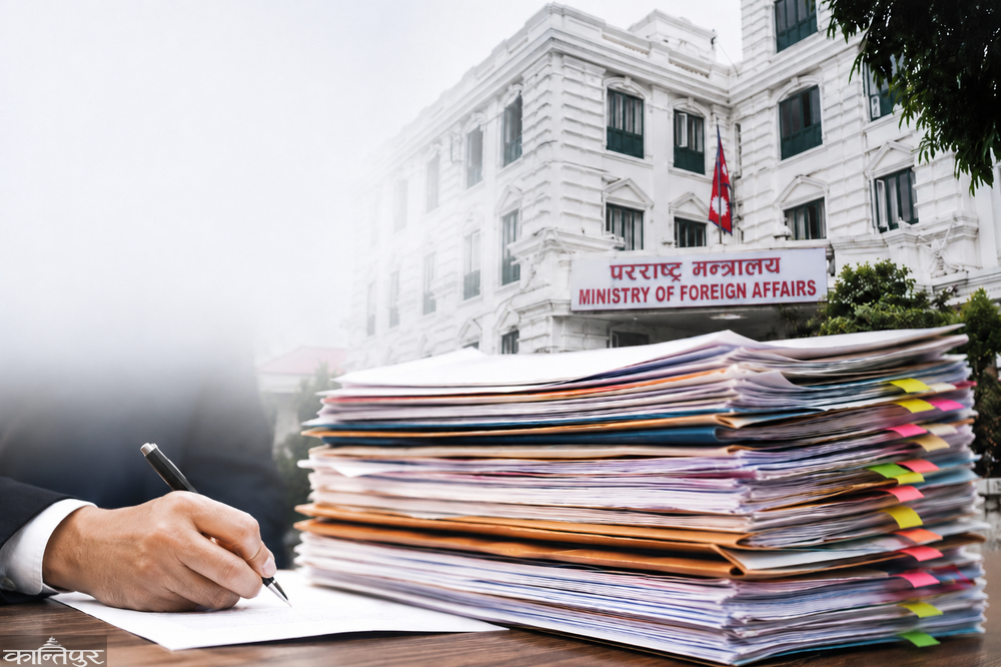
For the first time in Nepal's history, applications for 13 ambassadorial posts were invited through open competition, with around 3,000 applications received. Preparations are underway to remove duplicate applications.
We use Google Cloud Translation Services. Google requires we provide the following disclaimer relating to use of this service:
This service may contain translations powered by Google. Google disclaims all warranties related to the translations, expressed or implied, including any warranties of accuracy, reliability, and any implied warranties of merchantability, fitness for a particular purpose, and noninfringement.
For the first time in Nepal's history, there has been a lot of interest in the call for the appointment of ambassadors through open competition. As of Friday (the last day for applications), about 3,000 applications have been received for the posts of 13 ambassadors and permanent representatives.
The government had published a seven-page notice on 14 Jestha inviting applications from eligible Nepali citizens and a seven-page procedure for the selection process. According to a senior official at the Ministry of Foreign Affairs, applications have been received from candidates from various fields. 'We have received an overwhelmingly encouraging response and applications,' the ministry official said. 'Some applications have been repeated due to repeated recommendations. There is a possibility of removing the repeated applications and making the exact figures public by next Monday.'
Due to server problems and technical glitches, some have submitted applications more than once, while others have sent personal details (biodata) through the ministry's official address, email and post. Another official who is monitoring the process said that the ministry will remove repeated applications and begin the initial selection of candidates from next week.
It is not yet clear who the applicants are. However, according to officials, current employees, retired security officers, former employees, university and college professors/teachers, journalists, people working in various international organizations and professionals with higher education in subjects such as international relations, politics and economics have applied.
After receiving a large number of applications, the ministry issued a notice last Wednesday, saying that some applicants were facing server problems due to high traffic. The ministry's information technology team had also arranged another alternative link for the application process. Some applicants had also contacted the Post after the 'Kathmandu Post' first published this news.
Two of the former high-ranking employees said that they were motivated to apply because the government had committed to transparency, meritocracy, competitiveness and promotion of qualified individuals in various political appointments.
Many countries prefer 'career diplomats' in the appointment of ambassadors. Similarly, there is a practice of making political appointments. When selecting ambassadors through political appointments, they are trusted by the political leadership, have reputation, contacts, and language skills, so they get the opportunity. There has also been criticism for demanding open applications for the post of ambassador, saying that the practice of appointing through open competition is practiced only in a few limited countries. This move by the government comes at a time when there is a debate on whether to appoint ambassadors through open competition or directly appoint experts and experienced people. Earlier, in Nepal, ambassadorial appointments were divided equally between political quotas and 'career diplomats' of the Foreign Service.
The ministry has opened applications for the post of ambassador in accordance with the government's policy of 'merit-based appointments' and open competition in public posts. However, the seven-page Terms of Reference (TOR) that was made public does not mention which country the successful candidates will be sent to. According to officials at the Ministry of Foreign Affairs, the initial selection of applications will begin next week, as the deadline for submitting applications expired on Friday.
After Foreign Minister Shishir Khanal returns from New Delhi, the ministry will begin the process of preparing a shortlist of candidates and selecting qualified candidates for interviews and presentations. After the interview, the proposed names will be sent to the Council of Ministers for recommendation. However, since the prerogative of appointing ambassadors lies with the government, it is certain that all 13 posts will be filled from among the applicants.
The ministry has said that the ministry has invited applications from eligible Nepali citizens in accordance with Section 45 of the Good Governance (Management and Operation) Act, 2064 and the Guidelines on Appointment of Ambassadors, 2075 (amended in 2079). These provisions guide the appointment, responsibilities and tenure of ambassadors, permanent representatives and special envoys. Currently, 17 diplomatic missions are vacant, and seven more missions will be leaderless by mid-Bhadra. With this, a total of 24 ambassadors will have to be appointed, according to officials at the Ministry of Foreign Affairs.
Applications have been invited for appointments to countries and international organizations including India, China, the US, the UK, Australia, Israel, South Korea, Austria, Bahrain, Bangladesh, Malaysia, Oman and Saudi Arabia under open competition. While the government is preparing to screen the applications received, the Supreme Court has sought a written response from the government regarding the non-compliance of the previous criteria in the entire process of appointing ambassadors. The writ petition filed by advocate Deepak Bikram Mishra has demanded that the decision be quashed as the government had prescribed qualifications through public notice without following the criteria it had previously formulated.
The writ petition has alleged that Section 3(f) of the guidelines on ambassadorial appointments approved by the government on 24 Ashad 2075 BS provides that at least 50 percent of the total ambassadorial posts should be appointed from among the gazetted distinguished or first-class serving officers of the Nepal Foreign Service. The bench of Justice Abdul Aziz Musalman has ordered the government to clarify whether there is a violation of the process as claimed by the writ petitioner.
The writ petition states that the guidelines will direct the ministry to make an initial selection from a group of eligible candidates and then recommend senior officers of the Nepal Foreign Service or distinguished individuals who have made significant contributions to Nepal's foreign policy, international relations and diplomacy. The writ petition has alleged that the government's current process is contrary to these provisions. Although the petitioner sought an interim order to stop the entire current process, the Supreme Court has refused to issue an interim order, saying that a decision on the matter will be taken only after discussions between both parties.
The writ petition also alleges that many ambassadorial posts abroad have been lying vacant for a long time due to the Ministry of Foreign Affairs deliberately not recommending candidates in a timely manner. The writ also demands that the Ministry should make an initial selection from a pool of qualified candidates as per the current guidelines and then recommend senior officers of the Foreign Service or distinguished individuals who have made significant contributions to Nepal's foreign policy, international relations and diplomacy. The writ also claims that the government's current process violates these provisions.