After the death of her husband Bheshraj, Vimala's only concern is, 'How will she feed and raise her young father? When will she find a good place to live?'
We use Google Cloud Translation Services. Google requires we provide the following disclaimer relating to use of this service:
This service may contain translations powered by Google. Google disclaims all warranties related to the translations, expressed or implied, including any warranties of accuracy, reliability, and any implied warranties of merchantability, fitness for a particular purpose, and noninfringement.
‘Now there is no money to find a room and stay somewhere else. Now we only trust the government - wherever it takes us, we will come there. Now the government should make arrangements for those who have nothing like us,’ Bheshraj Darji had said while talking to Kantipur some time ago. He had a great desire to live in the place given by the government, but Bheshraj passed away before that desire could be fulfilled.
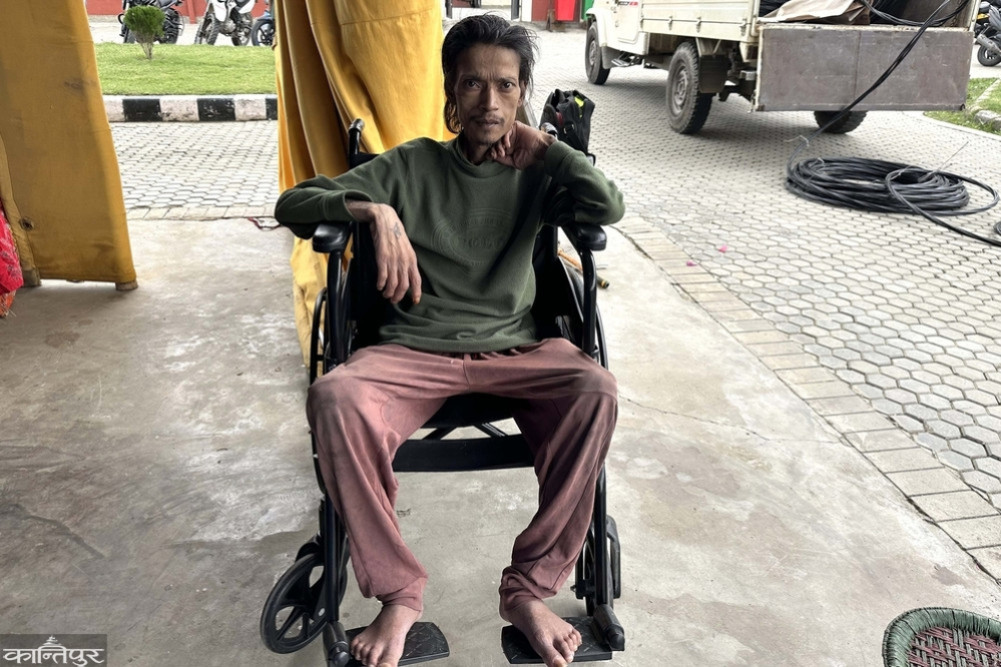
Bheshraj Darji, who was living in the ‘Holding Center’ at the Radhaswamy Satsang Center in Kirtipur, has died after the government used a dozer in the slums of Thapathali. 36-year-old Bheshraj died during treatment at Bir Hospital on Thursday. According to Mrs. Bimala Sunuwar, Bheshraj had problems with his lungs and pancreas. Even though he had been ill for 8 years, he could not get treatment at a good hospital.
In an interview with Kantipur in the second week of Baisakh, he said that he could not get treatment due to financial constraints. 'The doctor had already said that there was water in his lungs.' He had said, 'I went to the hospital three years ago, but I did not go because I did not have money. Whatever I do, I need money. How can I go to the hospital without money? Instead, I sat in my room, enduring the pain no matter what. The dozer also started in that room.'
Gradually, he became unable to walk. Bheshraj used to sit in the courtyard of the holding center in the morning and evening with the help of a wheelchair. Bheshraj not only suffered deprivation and sorrow, but also physical pain.
Bheshraj, his wife and two-year-old He and his son lived in a slum in Thapathali for 5,000 rupees per month. Bimala earned 8,000 rupees per month by doing housework in two places. After paying 5,000 rupees per month for the room, 3,000 rupees remained. Bheshraj had said that it was not even enough to pay the balance of the shop that brought ration and vegetables.
They had been making a living by borrowing and taking out loans. When asked why he did not go to the hospital when he was so sick, he had said, 'Everyone says why he did not go to the hospital.' The situation is like this. How can he go? He has not seen a doctor for three years.'
He said that even though he was born in Jhapa, his family had not had a single piece of land in his name for two or three generations. In Jhapa too, he lived on rent in a slum. When he fell ill, he came to Kathmandu.
After the dozer was used in the slum, Bimala also lost her job. Before the dozer was used, an organization had given her a wheelchair after seeing her health condition. Bheshraj had hoped that the government would take care of her health care.
Only after her health condition deteriorated was Bheshraj taken to Bir Hospital with the help of Kathmandu Metropolitan City on 18th Jestha. The city had written a letter to the National Institute of Medical Sciences (Bher Hospital) requesting free treatment. Bimala said, 'Even though the doctors tried hard to save him, they said they could not.'
After the death of her husband Bheshraj, Bimala has only one concern, 'How will I feed and raise my little father? When will I get a good place to live?'