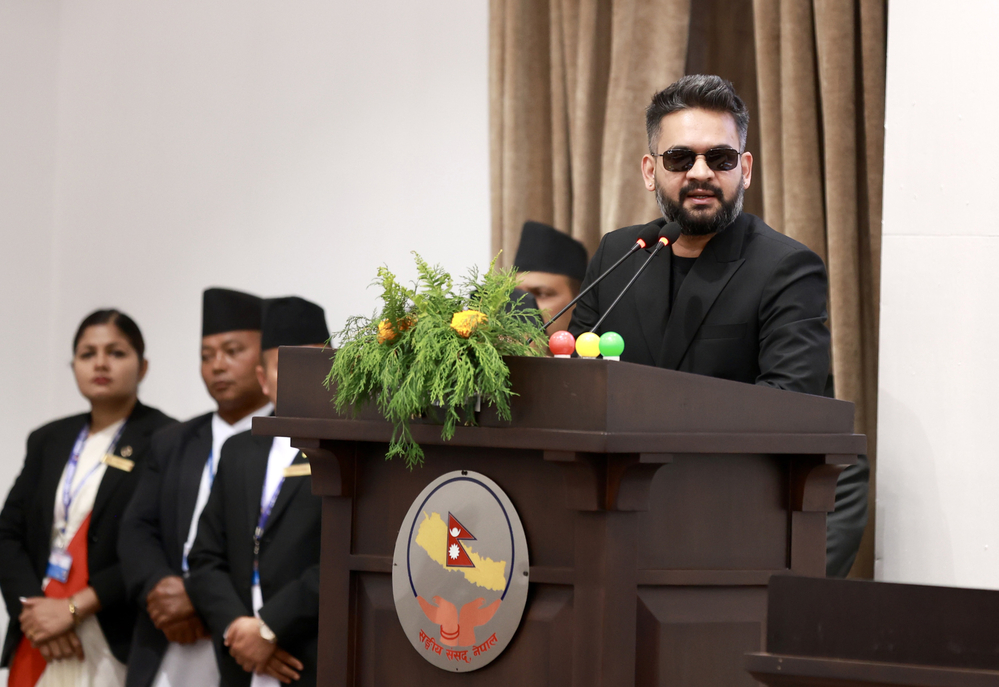
Prime Minister Shah had expressed in the House of Representatives on Sunday that 'England' (Great Britain) should also be concerned about the Lipulekh-Limpiyadhura issue.
We use Google Cloud Translation Services. Google requires we provide the following disclaimer relating to use of this service:
This service may contain translations powered by Google. Google disclaims all warranties related to the translations, expressed or implied, including any warranties of accuracy, reliability, and any implied warranties of merchantability, fitness for a particular purpose, and noninfringement.
The Nepal-India border dispute has taken a new turn after Prime Minister Balendra Shah, while addressing the House of Representatives, said that Britain should also show interest in the historical relationship of the 1816 Sugauli Treaty. Prime Minister Shah had also said that diplomatic dialogue is underway with China and England (UK) on the issue of Lipulekh.
Responding to a question from lawmakers in the House of Representatives on Sunday, Shah had said, "We have talked not only with India and China but also with the government of England (UK). Since the problem of being British India is still happening to us, we believe that England should also be concerned. I would like to inform you that all these matters will be resolved through table talk and diplomatic means."
India, however, has firmly rejected the idea of third-party involvement in the border dispute with Nepal. It has reiterated that the remaining issues will be resolved through bilateral mechanisms.
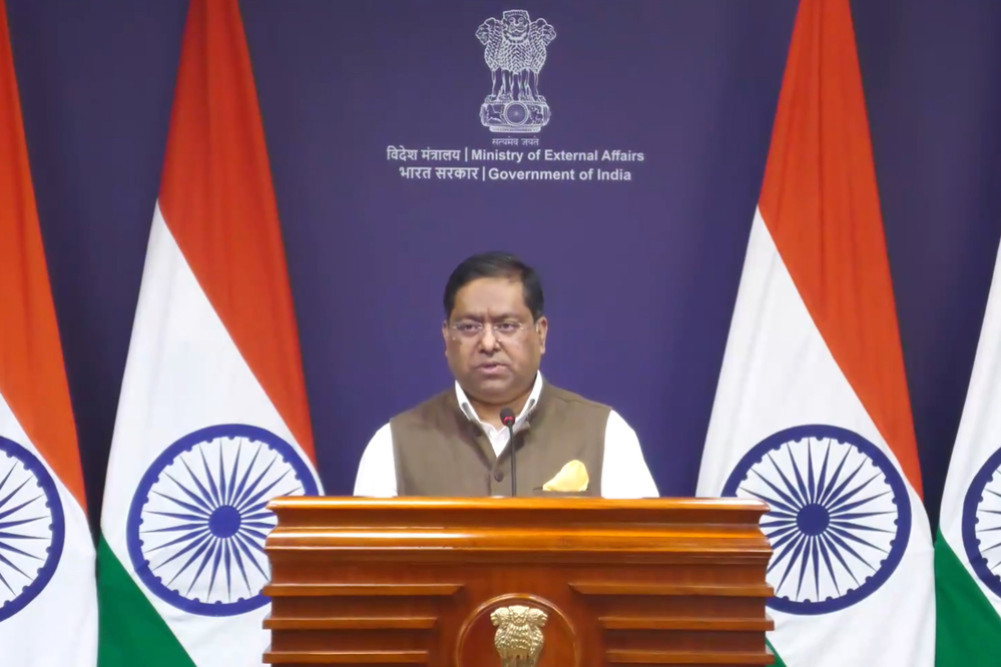
At a regular press conference held at the Indian Ministry of External Affairs in New Delhi on Tuesday, Ministry Spokesperson Randhir Jaiswal denied the role of a third party.
When asked by Indian journalists about Prime Minister Shah's statement on the border dispute in the House of Representatives on Sunday, Spokesperson Jaiswal informed that efforts are being made to resolve the border dispute between Nepal and India. 'We have formed a bilateral mechanism to resolve border-related issues.' All concerned should be clear that there is no need for any third party's role in all bilateral issues between India and Nepal,' he said.
Indian Ministry of External Affairs Spokesperson Jaiswal said that he had seen the comments of Prime Minister Shah and the Ministry of Foreign Affairs on the India-Nepal border. Claiming that 98 percent of the border between Nepal and India has been demarcated, he said, 'There are problems in some parts. They are yet to be resolved. This situation has arisen due to the change in the course of the Gandak (Narayani) river. In addition, there are issues of cross-border encroachment and encroachment on no-man's land (Dasgaja) in the designated part of the border. The work of mapping is being done jointly.'
This is the second time since the formation of the new government led by the Rashtriya Swayamsevak Sangh (RSS). Earlier, Nepal had sent separate diplomatic notes to both India and China, protesting India's decision to start the Kailash-Mansarovar Yatra through Nepali territory through Lipulekh. India had responded to Nepal's protest on May 3, saying, 'Lipulek Pass is an old route established for the Kailash-Mansarovar Yatra since 1954 and the journey has been going on through this route for decades. This is not a new development.'
Diplomats, border experts and opposition parties have opposed Prime Minister Shah's statement on the border in the House of Representatives on Sunday. There has also been a reaction from the southern neighbor. Responding to a question about the Lipulekh, Limpiyadhura and Kalapani disputes, Prime Minister Shah had said, ‘You may be surprised, I also came to know recently after becoming Prime Minister that India has not only encroached on Nepal’s land, but Nepal has also encroached on India’s land in many places.’ Shah’s statement has been widely criticized from various quarters. Opposition parties have continued to obstruct both houses of the federal parliament, demanding that Shah apologize and remove his comments from the parliamentary records.
Prime Minister Shah had commented on Britain’s concerns during the question-and-answer session. At that time, he mentioned the Sugauli Treaty of 1816.
It is believed that the dispute over Kalapani and other border issues began after the Sugauli Treaty of 1816. After the Sugauli Treaty, the then British India Company ruled India until 1947. According to Nepali border experts, the maps were prepared by the then British India Survey Department in the Sugauli Treaty and in 1819, 1827, 1834, 1835, 1837, 1846, 1850, 1856, 1860 and 1879. Nepal has been taking the same historical maps produced by the ‘Survey of British India’ as evidence to confirm its claim to Limpiyadhura, Kalapani and Lipulekh. But there is no consensus between the two sides on these maps and records.
In 2007, Nepal and India had prepared 182 ‘strip maps’ (maps) using the ‘Global Positioning System’ (GAPS) technology of the border except for Susta and Kalapani. Based on these maps prepared by the technical committee, the ‘Boundary Working Group’ (Border Working Group) is working to resolve other border issues between Nepal and India besides Susta and Kalapani. ‘In addition, there have been incidents of border crossings and encroachment of ten yards in the demarcated areas, which are currently being jointly mapped,’ Jaiswal said.
In this context, some of Prime Minister Shah’s aides had spoken to British Ambassador to Nepal Rob Fenn and discussed how Britain could help resolve the border dispute in the Kalapani region, which began after the Sugauli Treaty between the East India Company and Nepal in 1816. An official familiar with the matter said that the Indian side had been informed about the discussions with the British side. ‘We have already informed the Indian side about the discussions and meetings with the British ambassador, so it is not a matter that needs to be repeated,’ he said.
A senior official in the Ministry of Foreign Affairs told Kantipur that Nepal has never sought the involvement of a third party to resolve the border dispute with India. “We released the new map in 2020 when the border dispute was at its peak, and even then we did not seek third-party mediation. We are clear that this is a bilateral matter between Nepal and India. Therefore, there is no question of seeking third-party mediation in this matter,” the official added.
Former Nepali Ambassador to India Shankar Prasad Sharma said that he did not think India would accept the involvement of any third party in resolving the border dispute. “In the past, some countries had proposed to mediate between Nepal and India, but the Indian side flatly rejected it,” said Sharma, who returned from Delhi only last month. “The work of demarcation is ongoing as per the strip map that we have prepared. Instead of seeking third-party involvement, we should start informal dialogue with the Indian side and strengthen our position.”
The ‘BWG’, which had been inactive for a long time, had resumed work last year. According to Sharma, the plan is to complete all border-related work by 2028.
As the controversy over Prime Minister Shah's statement escalated, government spokesperson Sasmit Pokharel on Tuesday claimed that the Prime Minister's statement was misinterpreted. 'The Prime Minister said that he was surprised when he heard that Nepal had also encroached on the border from the other side while taking forward the work related to the border dispute. He had also mentioned this incident in the House,' Minister Pokharel said, 'The issue that in some places the land being used by India may fall on Nepal and the land being used by Nepal may fall on India has been raised by those mechanisms. The Prime Minister is of the view that the two countries should sit down and resolve the dispute through mutual discussions on such issues. The Prime Minister did not make any statement that would create a controversy.'
Ruling party Rashtriya Swayamsevak Sangh (RSS) General Secretary Kabindra Burlakoti also said that the party's view is clear that Nepali territory should not be encroached on. 'The party's view is clear. Our territory should not be encroached on. "The party's official view is that diplomatic initiatives should be taken to bring back those territories," he said.