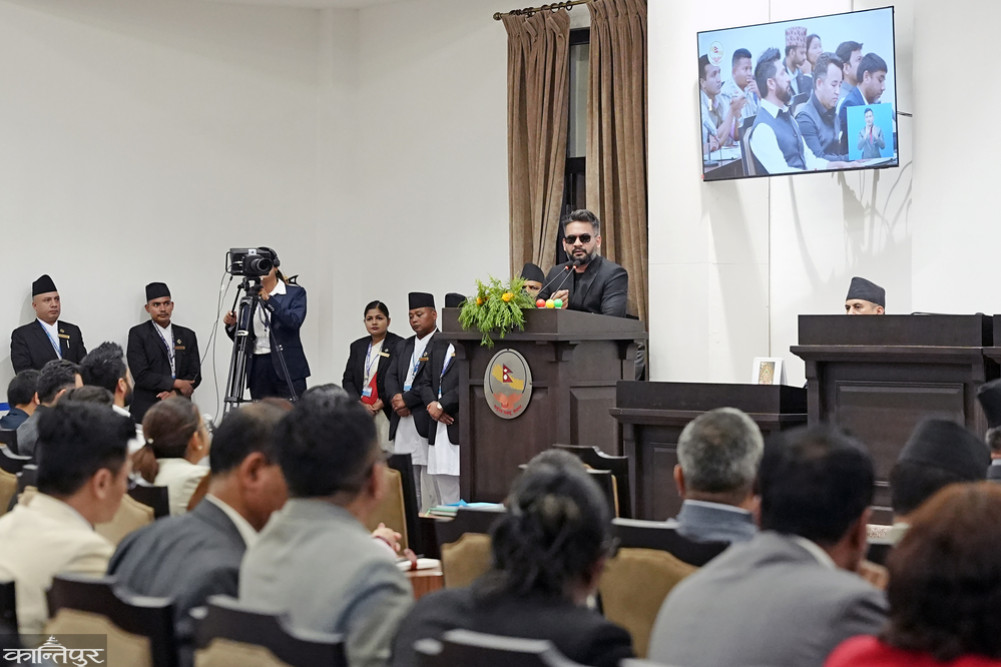
Experts say that the parliament should be given a sensible response to Prime Minister Balendra Shah's controversial remarks regarding the Nepal-India border, but that the focus on his attire and other activities should not affect the debate on issues of public concern and the formulation of necessary laws.
We use Google Cloud Translation Services. Google requires we provide the following disclaimer relating to use of this service:
This service may contain translations powered by Google. Google disclaims all warranties related to the translations, expressed or implied, including any warranties of accuracy, reliability, and any implied warranties of merchantability, fitness for a particular purpose, and noninfringement.
Parliament, which should be representing the people and debating issues of common concern and enacting necessary laws, is focusing on Prime Minister Balendra Shah's border-related statements, his attire and activities. This has overshadowed the discussion on tax policies that burden the people, increased prices due to the West Asia conflict, and the government's own preparation for making nearly four dozen laws.
Experts say that the parliament should be given a satisfactory answer to the controversial statement made by Prime Minister Shah on 17 Jestha regarding the Nepal-India border. However, they say that the debate on issues of common concern and the enacting of necessary laws should not be affected by focusing more on Shah's attire and other activities.
President Ram Chandra Poudel presented the government's policy and program for the upcoming fiscal year 2083/84 in a joint meeting of the House of Representatives and the National Assembly on 28 Baisakh. In the meantime, as Prime Minister Shah left the parliament meeting at the beginning, the parliament 'leaked' the debate.
Prime Minister Shah wore white shoes, a black T-shirt and a black coat-and-pants at the meeting to present the policy and program. The Prime Minister was sitting in his chamber in the Parliament building while the policy and program were being presented for about 50 minutes. This is why the Parliament, which was supposed to discuss the policy and program, focused on the Prime Minister's absence from the meeting. Opposition party leaders accused the Prime Minister of not respecting the dignity of Parliament in the meeting on 29 Baisakh.
Finance Minister Swarnim Wagle presented the proposal for discussion on the policy and program instead of the Prime Minister, and he also answered the questions raised. While Wagle was answering, the opposition parties protested, boycotted and surrounded the well. The Congress protested, the NCP, the RPP and the Labor Party boycotted and the UML was surrounding the well when Minister Wagle answered. This is why neither the MPs were able to have an in-depth discussion on the policy and program nor was there an environment for the minister to answer properly.
Former Secretary General of Parliament Surya Kiran Gurung says that in the past, any impasse in the parliament was resolved with the facilitation of the Speaker, and says that the Speaker should also take the initiative now. He says that the opposition should not forget their dignity when they appear in parliamentary activities. ‘Decisions should not be made in a hurry when the parliament is obstructed. The House of Representatives Rules were passed by provoking the opposition,’ he said. ‘Opposition parties should not present themselves in an unruly manner when protesting in the parliament.’ He says that the Speaker cannot play a neutral role if the shadow of power falls on the parliament.
‘The Speaker should hold an all-party meeting and reach an understanding. When the opposition demands an answer from the Prime Minister, the Speaker can facilitate,’ he added. ‘The Speaker can coordinate the Prime Minister’s response through the Minister of Law, Justice and Parliamentary Affairs and the Chief Whip.’
Parliamentary affairs expert, writer and journalist Hari Bahadur Thapa says that there is a risk that issues of public concern will be overshadowed as the conflict between the ruling party and the opposition spills over into the parliament. He said that the problem has arisen recently when the ruling party tried to move forward forcefully and the opposition took the path of resistance. ‘If this situation continues, citizens may become more disillusioned with the parliament,’ Thapa said. ‘If many of the people’s questions and expectations cannot be voiced in the parliament, citizens may consider the road as an alternative to the parliament. Therefore, the responsibility of the ruling party is not to make the road active, but to make the parliament active.’
On 31 Baisakh, the Finance Minister presented the principles and priorities of the appropriation bill for the upcoming fiscal year. There was no in-depth discussion on that either. Immediately after the pre-budget discussion, on 7 Jestha, the opposition parties again reached the well, demanding that they be allowed to have a question-and-answer session with the Prime Minister. The House of Representatives rules stipulate that MPs should have a question-and-answer session with the Prime Minister in the first week of every month. The opposition parties obstructed the parliament, demanding the implementation of that provision.
The uproar has started again in the parliament since Sunday regarding the Prime Minister’s issue. While answering a question from a lawmaker, Prime Minister Shah could not enter the agenda of the House on Monday after the opposition party protested his statement that Nepal had also encroached on Indian land. The National Assembly has also been disrupted over the same issue.
Prime Minister Shah had said in the House of Representatives meeting on Sunday that efforts were being made to resolve the Lipulekh, Kalapani and Limpiyadhura disputes diplomatically while answering a question from Shram Sanskriti Party lawmaker Aren Rai. But during that meeting, he had said, ‘You may find one thing surprising. I also came to know after becoming Prime Minister recently that not only India has encroached on Nepal’s land, Nepal has also encroached on many lands of India.’ The meeting of both houses of the federal parliament could not enter the agenda on Monday after Prime Minister Shah’s statement was caught in a controversy.
In the House of Representatives meeting on Monday, UML Chief Whip Ain Bahadur Mahar criticized the Prime Minister’s attire and behavior in parliament. ‘The dignity of parliament should be maintained. This is not a place to play football, this is not a place to hold a fashion show, it has its own dignity and dignity,' said Mahar, 'The Prime Minister wears Nepali attire, daura-suruwal, to programs organized and managed by the army. When he comes to the House, he comes wearing a football-playing dress. What is his view of the House? He has neglected and disrespected the House.'
RSVP MP Bipin Acharya says that it is too early to judge how the Parliament will move forward in the coming days by looking at the current activities. 'However, the gravity of the House is so great that it seems like the Parliament is moving beyond that,' he said. He said that the Parliament should fulfill its responsibility as the state will invest a large amount of financial and other resources from the election to the operation of the Parliament.
Since the House is a place to find solutions to the problems of the citizens, Acharya also said that the ruling party will make sincere efforts to prevent it from becoming a failed Parliament like the past. "It is more important for the citizens to win through our activities than whether the ruling party wins in parliament," says Acharya. "We have forgotten to discuss the merits and demerits in parliament. No matter how good the ruling party is, the opposition does not accept it. Even if the opposition brings a good amendment, it has become a tradition to ask whether it is corrupt when it is accepted."
Speaker DP Aryal says he will do his best to bring the parliament into order. He told Kantipur that the parliament was not included in the agenda so that there could be a discussion between the ruling party and the opposition. "It is so that the opposition can communicate with the government, which was not included in the agenda in today's meeting. I had called a meeting on business, but the opposition parties did not come. I am trying to resume parliament from my place and I will try my best," said the Speaker. "The opposition's religion is to protest. On my part, I try to conduct the assembly in a civilized manner. My request is that the parliament should focus on the issues of the people. Laws should be made. There are issues of the people. This is a request for this. If that work is not done, then the question may arise as to what was the difference between the previous parliament and the current parliament.'
The recent controversy in the House is also related to the House of Representatives Rules. The opposition had demanded further discussion on the House of Representatives Rules. 'It was seen that the Speaker was trying to move the process forward based on the strength of the majority. Having a majority does not mean gaining unlimited power,' says Thapa, an expert in parliamentary affairs, 'If decisions are made by force without respecting the democratic process, it can create more problems.' Since the role of the Speaker in the Parliament is like that of a referee, it is the Speaker's responsibility to prevent unnecessary influence of the government in the Parliament and parliamentary committees, to make the government accountable to the Parliament, and to protect the parliamentary process, he says.
NCP MP Barshaman Pun accused the government of casting a shadow over the House of Representatives even though the opposition has passed the necessary bills from the National Assembly and supported the ruling party. 'The Speaker should act according to his dignity. It is wrong to always try to outsmart the opposition,” he said. “If the opposition keeps raising slogans and the Speaker keeps pushing the process forward, the problem can worsen.”
UML MP Arjun Kumar Karki said that this is also happening because new people have come to the government and parliament. “We should not forget that parliament is a political forum. Another thing is that this has happened because everything is new. Especially the Prime Minister is new. He has not even been in politics for six months. New people make a lot of mistakes,” he said. He said that the MPs are taking up the time of the people of their constituencies during zero, special and emergency hours. Karki said that they should move forward by raising the issues of the people with restraint.
Rashtriya Swayamsevak Sangh (RSS) whip Prakash Chandra Pariyar said that an attempt was made to balance the government’s ‘speed’ and the ‘spirit’ of the RSS. “We have tried to follow the method and process,” he said, “but there is uncooperation from the opposition.” We respect the feelings of the opposition but have urged them to be responsible.'
The ruling party Congress expressed dissatisfaction after the Speaker of the first parliament after the 2046 people's movement, Damannath Dhungana, said that 'the parliament belongs to the opposition'. Similarly, when the Congress-RPP government was formed after Bhadra 2052, the UML accused the then Speaker Ram Chandra Poudel of leaning more towards the ruling party. Thapa, an expert in parliamentary affairs, said that Poudel had shown loyalty to the government when the Local Self-Government Act was passed on 1 Asoj 2055 and was accused of disrespectful conduct. 'At that time, there was widespread vandalism inside the parliament, chairs were broken, and it became impossible to run the parliament for a few days,' he said.
Then, when Taranath Ranabhat became the Speaker, the opposition used to call an all-party meeting to find a solution when genuine questions were raised and run the parliament on that basis. Thapa has experience that when Subash Nembang was the Speaker in 2006, he tried to protect the parliament from the shadow of power, create an environment of dialogue and consensus, and run the parliament smoothly, based on his long parliamentary experience. ‘But the subsequent Speakers became controversial. They were criticized for not advancing proposals, being accused of being at the behest of the government, and not being able to play an impartial role in controversial issues,’ he said.
Looking at the Gen-G movement and the parliament formed after the elections, Thapa understands that Speaker Aryal has shown a tendency to make decisions faster than all-party discussions and consultations. ‘In some situations, it feels like he is presenting himself more like a party leader than the Speaker,’ he said. ‘Initial signs show that they want to find results quickly but do not want to give enough importance to the process. The time given to the Prime Minister recently is an example of that.’
Thapa says that although the Prime Minister can address the parliament at any time, there will be a question-and-answer process in the parliament. "If the Prime Minister wants to address, the time is arranged based on prior information and agreement. It is not common for Prime Ministers or former Prime Ministers to raise their hands in the House and ask for time," he added. "If the Prime Minister wanted to participate in the Q&A session, the questions from the MPs should have been asked first. By ignoring the process, it was seen that the Prime Minister himself was in an uncomfortable position."