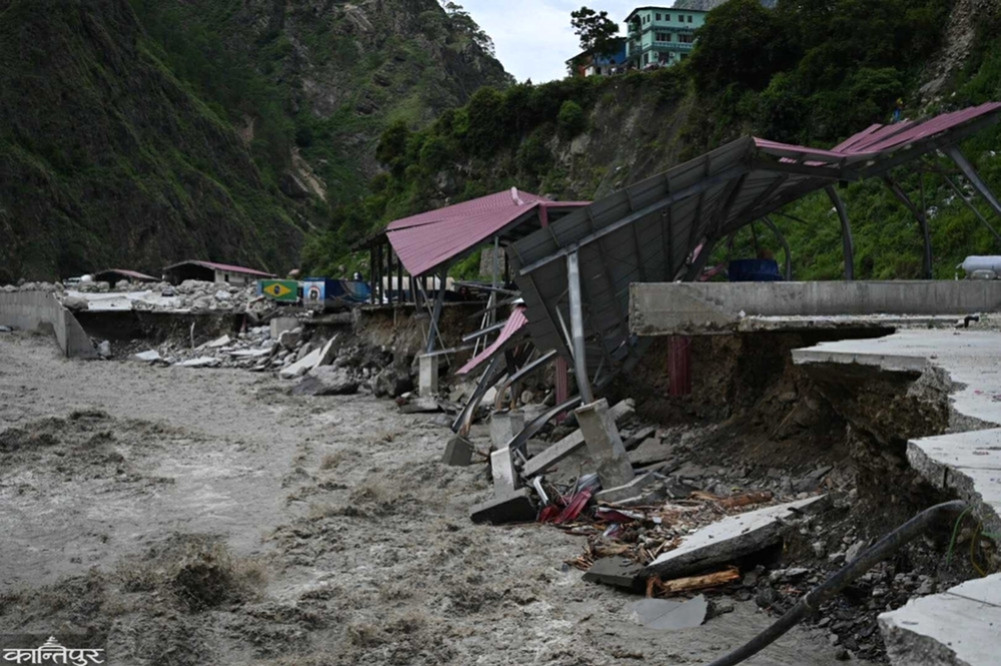
The National Disaster Risk Reduction and Management Authority has warned that the risk of temperature rise, flash floods, landslides, and glacial lake outburst floods will increase this year.
We use Google Cloud Translation Services. Google requires we provide the following disclaimer relating to use of this service:
This service may contain translations powered by Google. Google disclaims all warranties related to the translations, expressed or implied, including any warranties of accuracy, reliability, and any implied warranties of merchantability, fitness for a particular purpose, and noninfringement.
Over 3,000 people have died in Nepal due to monsoon-related disasters in the past decade. According to the 'Monsoon Preparedness and Response National Action Plan-2083' released by the National Disaster Risk Reduction and Management Authority, 3,074 people have died due to floods, landslides, heavy rains and lightning strikes from 2073 to 2082.
During that period, 502 people went missing, 4,769 people were injured, and 33,198 families were affected.
According to the authority, landslides have caused the most damage in a decade. In just 10 years, 5,032 landslides have occurred. In those incidents, 1,483 people have died, 232 people have gone missing, and 1,347 people have been injured. 8,183 families have been affected by landslides, and 5,973 houses have been damaged.
Similarly, 678 people have died in 2,358 floods. 269 people have gone missing, and 23,805 families have been affected. There are data that 2,248 houses and 2,378 livestock have been damaged by floods.
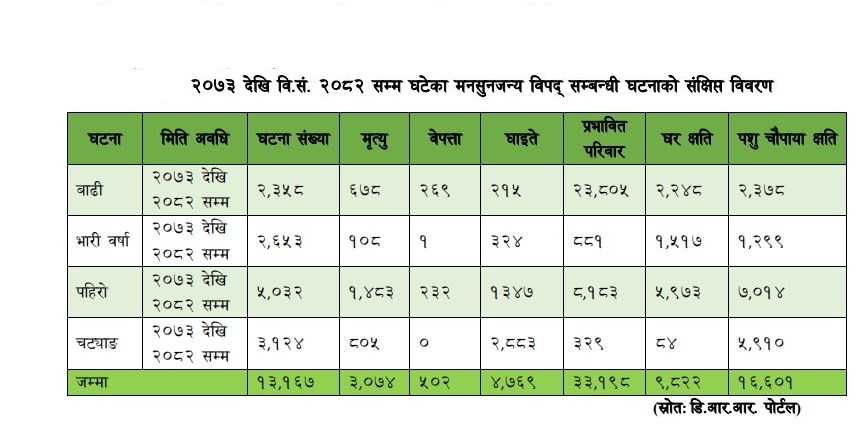
Lightning strikes also appear to have caused great human losses. In 10 years, 805 people have died and 2,883 people have been injured in 3,124 lightning incidents. Similarly, the NEA has given details of 108 deaths in 2,653 incidents of heavy rain.
The NEA has concluded that the nature of monsoon-related disasters has become more complex in recent years. It is mentioned that the incessant rains from Asoj 17 to 20 caused great damage in 2082 BS. During that time, a 'red alert' was issued in 26 districts of Koshi, Bagmati, Gandaki and Lumbini provinces, including Madhesh Province. After heavy damage in Ilam, the government declared the district a disaster-hit area.
In the 2082 BS monsoon, a drought situation was created due to low rainfall in Madhesh Province. As water sources dried up, the drinking water crisis deepened and the government had to declare Madhesh Province itself a disaster-hit area.
The NEA has stated that temporary shelter, food and non-food items, health services and emergency education have been provided to families displaced by floods, landslides and inundation during the monsoon period. It is mentioned that the injured were rescued by helicopters and on-site means and treated free of charge. The report also states that immediate repairs were made to restore blocked roads, electricity, drinking water and communication services.
The risk is projected to be high in this year's monsoon as well. According to the NEA, it is estimated that 226,661 people from about 51,868 households across the country may be affected by the 2083 BS monsoon. It has been warned that the risk of temperature increase, sudden floods, landslides and glacial lake eruptions will increase.
With the assessment that there is a high possibility of an increase in daily temperatures, there is a possibility that the general public in the southern Terai region of the country may also be affected by extreme heat or heat waves (Lu). The authority has stated that this year's monsoon forecast is similar to the monsoon seasons of 2014, 2016 and 2022.