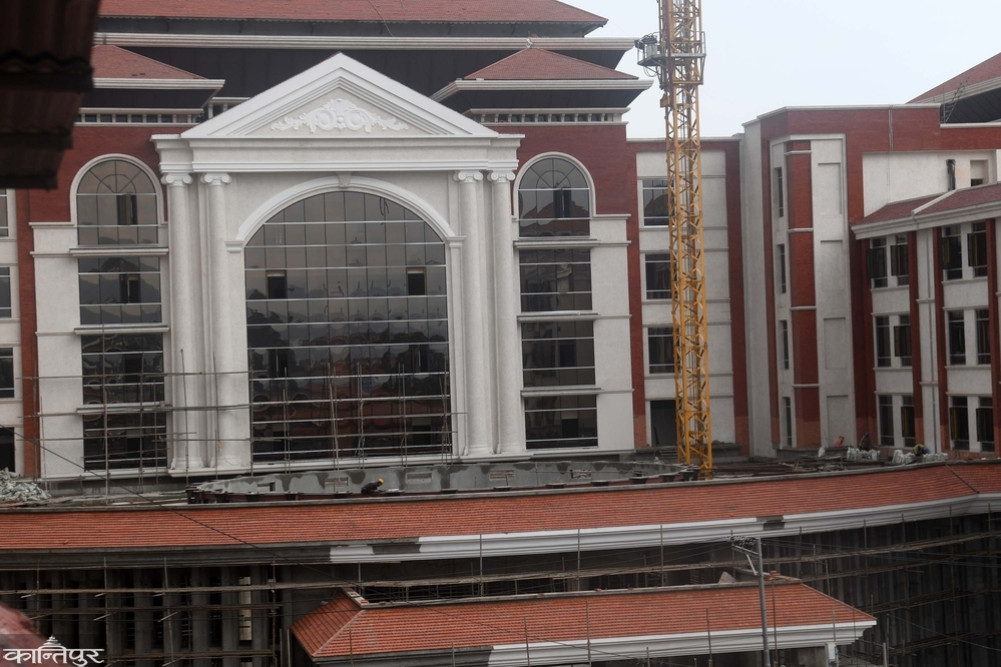
Since the Chief Justice's recommendation, four interim orders have been issued against the government's actions, leading to debate over whether the government made the decision without following the process or whether judicial activism has been demonstrated.
We use Google Cloud Translation Services. Google requires we provide the following disclaimer relating to use of this service:
This service may contain translations powered by Google. Google disclaims all warranties related to the translations, expressed or implied, including any warranties of accuracy, reliability, and any implied warranties of merchantability, fitness for a particular purpose, and noninfringement.
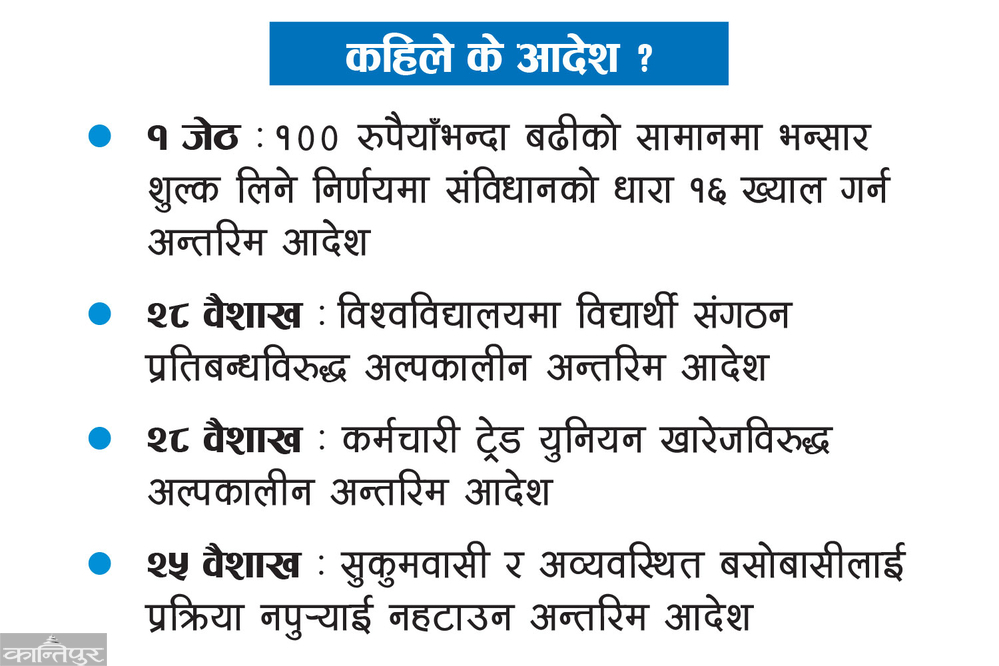
The Supreme Court has issued interim/short-term interim orders against four important decisions of the government within about a week, staying their implementation . Before that, the court had also questioned and stayed some of the steps taken by the Balendra Shah-led government . There is also a debate going on whether the government is making decisions without following the process or whether judicial activism has suddenly increased .
The Supreme Court has recently issued an interim order on the government's move to collect customs duty on goods worth more than Rs 100 on 1 Jestha. Before that, separate benches of the Supreme Court had issued short-term interim orders on the government's decision to dissolve the employee trade union and ban student organizations in universities . Similarly, on 25 Baisakh, an interim order was issued to prevent the eviction of squatters and unorganized settlers without following the process .
The four orders mentioned above have been issued since the Constitutional Council led by Prime Minister Shah recommended Manoj Kumar Sharma as the Chief Justice, violating his seniority. The council had recommended Sharma as the Chief Justice on April 24. Although these court orders are not long-term, the government cannot implement its decision until the next hearing.
The interim order regarding customs duty was issued on Friday by a joint bench of Justices Hari Prasad Phuyal and Tek Prasad Dhungana. Although there was already a provision to pay customs duty when importing goods worth more than Rs 100 through land borders, it was not being implemented. However, on April 19, the Central Revenue Leakage Control Committee convened by Finance Minister Swarnim Wagle decided to tighten the provision.
Amitesh Pandit, Akash Mahato, Suyogy Singh and Prashant Bikram Shah had filed a writ petition against the government's move on April 14. The Supreme Court has issued an interim order in the name of the Office of the Prime Minister and the Council of Ministers and the Ministry of Finance. The order states, ‘Every person shall be treated with respect and shall be treated with respect in a manner that does not violate the right to live with respect as stipulated in Article 16 of the Constitution.’
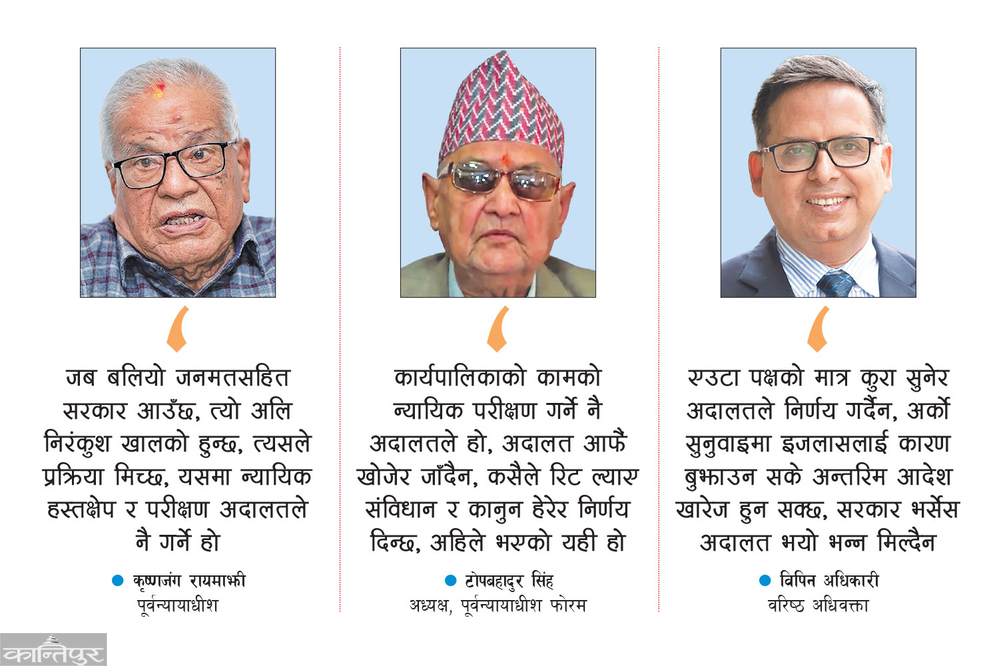
When a government comes with strong public opinion, it becomes a bit autocratic, it distorts the process, and judicial intervention and review in this matter should be done by the court: Krishna Jung Rayamajhi, former judge After the government brought some Nepal Act amendment ordinances and abolished the employee trade union, the President of the Civil Servants Organization, Bhawani Dahal, and others filed a writ petition. The Constitutional Bench heard the matter.
There was a difference of opinion among the judges in the bench on the issue of issuing a short-term interim order. Acting Chief Justice Sapana Pradhan Malla, Justice Kumar Regmi, and Hari Prasad Phuyal were of the opinion that a short-term interim order should be issued, while the bench of Justices Binod Sharma and Saranga Subedi held a different opinion. The order was issued in accordance with the opinion of the majority of judges.
The judges who issued the interim order argued that the constitution has restricted the power to make laws through parliament by adjourning the already convened parliament session and bringing an ordinance. The judges who held a different opinion argued that the constitution itself has given the government the right to bring an ordinance and that it will be tested in parliament. The judges who are in favor of the short-term interim order are now higher in rank than Sharma, who has been recommended for the post of Chief Justice.
The decision to ban student organizations in the university was made through the University Grants Commission. The '100 Agenda' for governance reforms approved by the Council of Ministers on Chaitra 13 mentioned that the structure of party student organizations would be removed from the hands of schools/universities within 60 days and a student council and voice of student mechanism would be developed within 90 days. On that basis, on Chaitra 20, a meeting chaired by University Grants Commission Chairman Devraj Adhikari and attended by Minister Pokharel and Vice-Chancellors decided to remove the structure of political party-affiliated student organizations.
ANNFSU President Deepak Dhami and others had filed a writ petition against the government's move. In it, a single bench of Justice Shrikant Poudel called both the parties for discussion on Jestha 4 and issued a short-term interim order till that period. The order states that the ban on student organizations should not be implemented.
Similarly, Gopal Ranpaheli and others had filed a writ petition in the Supreme Court on 11th Baisakh, as soon as the government issued an order to vacate the squatter settlements in Kathmandu. After the removal of the settlements began on 12th Baisakh by mobilizing security personnel, more writ petitions were filed. But on 25th Baisakh, a bench of Justices Kumar Regmi and Nityanand Pandey issued an interim order not to remove the squatters and unorganized settlements without completing the process.
The Supreme Court has stated that it issued the interim order in the name of the government after hearing the views of the writ petitioner, the government, and the National Human Rights Commission. There has also been public comment that the interim order came after the demolition of the squatter settlements in the capital.
It is the court that conducts judicial review of the executive's work, the court does not go looking for it on its own, if someone brings a writ, it gives a decision after looking at the constitution and the law, this is what has happened now: - Top Bahadur Singh, Chairman, Former Judges Forum The Supreme Court has also asked for effective management of basic needs such as housing, education, health, and food for the displaced squatters and unorganized settlements.
Some other decisions made by the government have also reached the court for judicial review. The writ regarding the qualification of Attorney General (legal advisor to the government) Narayan Dutt Kandel and the formation of the Assets Investigation Commission is also pending in the Supreme Court.
The writ regarding Kandel's qualification was initially filed by the Supreme Court administration. Later, after it was presented in the bench, an order was issued to register it. The Supreme Court, while holding the first hearing on the writ, has issued a show cause order and called for a discussion on the interim order. The government has been summoned for a discussion by issuing a show cause order in two writs filed in the Supreme Court against the Assets Investigation Commission formed under the leadership of former Supreme Court Justice Rajendra Kumar Bhandari.
Former Supreme Court Justice Krishnajung Rayamajhi says that disputes will continue in the courts and interim orders will continue to be issued until a political decision is made. ‘The selection of judges is also wrong in our country.’ This is also why judicial decisions are controversial, he says. ‘But when a government comes with strong public opinion, it becomes a bit autocratic and suppresses the rights of the people, which distorts the process. Judicial intervention and review in this is the responsibility of the court.’
 Former Justice Rayamajhi said that the government did not follow the legal process while banning student organizations. ‘At a time when the country has transitioned from democracy to republic, trying to stop the issue of opening organizations and developing leadership by joining them was a wrong step in itself,’ he said. ‘If student organizations were not necessary, a law should have been made after extensive discussion in parliament.’ The same law could have also been used to regulate them. It is wrong to take such a step based on a directive or order and program of the executive.'
Another former Supreme Court judge and former Judges Forum president Top Bahadur Singh said that it is the court's job to judicially review the work of the executive. 'The constitution itself has given this right to the court,' he said, 'The court does not go looking for itself, if someone brings a writ or case, it gives a decision after looking at the constitution and the law.'
 Singh says that the issue of moving forward by making a law through parliament has been raised because an ordinance was brought, and this is why the court stopped it. ‘The constitution has given the government the right to bring an ordinance only if it is hindered from doing any work immediately,’ he says. ‘The court should stop it when the government makes an immature decision.’
Senior advocate Raju Chapagain says that the Supreme Court has stopped the demolition of the squatter settlements because the government did not comply with the previous decisions of the Supreme Court and the High Court and did not complete the legal process. ‘In the case of the squatters, the government seems to have violated the law and process. If the court’s decision is not followed in this, then the fundamental rights granted by the constitution have been violated,’ he said. ‘The court should not obstruct the right work done by the government. But when the government is arbitrary, the court should stop it.’
In the order issued on 20 Poush 2080 by the then Supreme Court bench including Justice Anand Mohan Bhattarai to protect an additional 20 meters along the river bank, it was said that the settlement should be moved after proper management. Similarly, in another writ petition, the Patan High Court on 17th Shrawan 2080 had ordered proper management of squatters and unorganized settlers and only then to displace them. Chapagain said that the Supreme Court stopped the process after the government suddenly moved towards displacing them without even giving sufficient information.
Senior advocate Bipin Adhikari also considers the interim order made by the court in the case of squatters to be fair. 'The court should protect the fundamental rights of the people. The court provides some protection in the case of the weaker sections,' he said, 'This is what has happened in the case of squatters too. The court will continue to do this. If the court tries to help the government, justice may die.'
Senior advocate Adhikari said that the Supreme Court issued the interim order because the decision to ban such student organizations should have been taken after extensive discussions in Parliament rather than through an ordinance. He argues that it would be a wrong practice for the government to try to stop the right to organize activities in universities as it was not brought suddenly but gained through a long struggle and movement. ‘If the law had been made after extensive discussion in Parliament, the dispute would not have reached the court,’ he said.
 Senior Advocate Adhikari says that there is no greater public policy document than the Constitution and that laws should be made by Parliament on matters of long-term importance and impact within the law-making process. ‘The court can give directions or stop them if they are not in accordance with the Constitution,’ he says. ‘The Supreme Court has also stopped government actions in the past. The court will not intervene if the legal standards are not violated while implementing the program.’
Senior Advocate Adhikari says that the court will not make a decision by listening to only one side. Supreme Court spokesperson Arjun Prasad Koirala said that it is not possible to comment on interim orders and other orders issued by the bench. He says that he has no comments as the judges involved in each bench are free to give their opinions.
Some suspect that the conflict between the court and the government has increased because the Constitutional Council led by the Prime Minister recommended the Chief Justice by violating the order of precedence, but former Justice Rayamajhi says that it cannot be called a conflict. 'Initially, it looks like a conflict between the court and the executive, but this cannot be said to be the case,' he said, 'We had a long discussion about this at the Former Judges Forum on Law Day. When there is a strong government, the court should be active in favor of the rights of the people. In such a situation, there are differences, but the recommendation made without considering the order of precedence has made it complicated.'
The court does not decide by listening to only one side, if the reasons are explained to the bench in the next hearing, the interim order can be revoked, it cannot be said that it is government vs. court: – Bipin Adhikari, Senior Advocate Even constitutional law experts are divided on the issue of the Constitutional Council recommending the Chief Justice by violating the order of precedence. There is dissatisfaction among one side within the Supreme Court over the recommendation of Manoj Kumar Sharma, who is fourth in the order of precedence, leaving Sapana Pradhan Malla, Kumar Regmi and Hari Prasad Phuyal, who are higher in the order of precedence.
Senior Advocate Upendra Keshari Neupane says that the Judicial Council recommended the names of six people who met the qualifications as per the constitution and the council selected one of them, so there is no conflict between the law and the law. ‘This recommendation is not unconstitutional or against the law. The constitution does not say that the first person on the roster should be recommended,’ he said, ‘but what was the past law or tradition, it has not been followed.’
A glimpse of the coldness seen between the government and the judiciary was seen on Law Day. Acting Chief Justice Malla had invited President Ram Chandra Poudel, Prime Minister Balendra Shah, Speaker DP Aryal and Minister for Law, Justice and Parliamentary Affairs Sobita Gautam, among others, to a program organized on Saturday on the occasion of Law Day. But the President, Vice President and Speaker were present, while the Prime Minister and Law Minister were not present. At the event, Acting Chief Justice Malla said that she would not be afraid even if the government had a two-thirds majority. She said that justice should be administered without fearing the judges. Then, at another event, Rashtriya Swayamsevak Sangh (RSS) President Ravi Lamichhane defended the government's decision and challenged the Supreme Court to use it against him as it has a weapon. 'While such statements are being made, one dispute after another has entered the court and the court has also issued an interim order, so there is an understanding that a clash has developed,' said senior advocate Chapagain.
Earlier, the Supreme Court had issued an order to release former Prime Minister KP Sharma Oli and former Minister Ramesh Lekhak. Some Supreme Court judges believe that these orders also played a role in the recommendation of the Chief Justice. ‘The government is in favor of the understanding that the prisoners including Oli and the writer had to be released by the Supreme Court’s order,’ said a judge. ‘The reason for the change in priorities is that the Supreme Court expected the government to obstruct one task after another.’
The Cabinet meeting held on Chaitra 13, the same day the government was formed under Shah’s leadership, had decided to implement the report of the inquiry commission on the incidents of Bhadra 23 and 24. Oli and the writer were arrested the next morning after the decision was made to form another investigation committee in the case of the security personnel and to implement the report in the case of others. The police had taken them under control by issuing the necessary arrest warrants. After that, Oli and the writer’s family filed a petition in the Supreme Court claiming that they were being illegally detained.
A bench of Justices Binod Sharma and Sunil Kumar Pokharel had ordered an investigation to be conducted by keeping Oli and the writer out of custody. Former Minister Deepak Khadka, who was arrested in a money laundering investigation after his house was found burnt during the Gen-G movement, was also released by the Supreme Court. On April 21, the Supreme Court had ordered that businessman Shekhar Golchha, who was arrested for money laundering, be kept outside custody for investigation. Although he was arrested again immediately, the District Court refused to extend his detention. He was released after the District Court did not extend his detention, saying that he could be investigated on bail as per the Securities Act.
Nepal Micro Insurance Chairman Ashiq Shrestha was also released from custody based on Golchha's example. Similarly, Nepal Investment Mega Bank Chief Executive Officer (CEO) Jyoti Prakash Pandey has also been released from custody by the Supreme Court. He was released on Friday after the Supreme Court ordered that he be investigated without being kept in custody. Senior advocate Chapagain says that the prisoners and other government decisions should not be viewed in conjunction. ‘The Supreme Court has set a precedent by creating a standard for petitions for the release of prisoners.’ On the basis of that, even during the conflict, the court would have ordered the release of prisoners,’ he said.
Corrected: