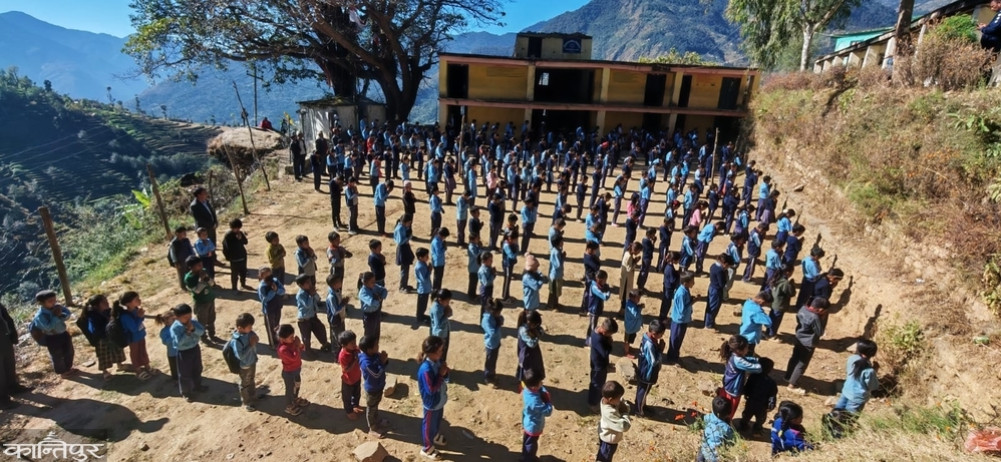
Poverty, child labor, migration of parents to India, child marriage, and teacher shortages have made it difficult to keep students in school in Karnali.
We use Google Cloud Translation Services. Google requires we provide the following disclaimer relating to use of this service:
This service may contain translations powered by Google. Google disclaims all warranties related to the translations, expressed or implied, including any warranties of accuracy, reliability, and any implied warranties of merchantability, fitness for a particular purpose, and noninfringement.
15-year-old Naveen Sarki from Gairigaun, Sannitriveni Rural Municipality-6, Kalikot, enrolled in Grade 8 at Badrukh Basic School in Baisakh last year. He attended school for about 5 months from Baisakh to Bhadra. But due to the poor financial condition of his family, he left his studies and went to Shimla, India in the second week of Bhadra.
He returned home last Magh after working in India for about 6 months and has not gone to school since then. ‘Father is gone. I have to meet all the expenses of my two brothers and one sister,’ he said, who now returns home and works locally. ‘What will we poor people do if we want to study? We have to work in the villages, it is difficult to manage the household expenses.’
Teacher Yashoda Sarki said that out of the 219 students enrolled in the school last year, 26 children dropped out of school. According to her, 6 children have dropped out of school in Child Development, 3 in Grade 1, 2 in Grade 2, 3 in Grade 6, 5 in Grade 7 and 7 in Grade 8. ‘Most of the children say they dropped out of school due to poverty,’ she said, ‘We went door to door 3/4 times to bring the students back, but despite all our efforts, we could not get the students back to class.’ Nishan Bik, 9, of Khandachakra-4 Tadi in Kalikot, was admitted to Grade 3 at the local Navajyoti Basic School Gaira in April last year.
He went to school for about two and a half months from April to August. But he dropped out of school after his parents sent him to a monastery in Kathmandu. ‘Even though they say admission is free, they charge 5-10 thousand rupees a year under some pretext,’ said his father, Banche BK, ‘The education in the monastery is good, the care arrangements are also there, and the car rental is also available.’
Harilal BK, a teacher at a school in the ward, said that 17 children have gone to various monasteries in Kathmandu. According to him, 7 children studying in the school last year have gone to India with their parents. Another teacher, Hasta BK, said that even though children are admitted to schools where the majority of the Dalit community is, there is a problem of not coming to school. He said, ‘Some of them go to India after getting admitted to schools, but return here only 2-3 months before the annual examination.’ He said that there is a tendency for students who return only for the annual examination to fail the examination and then drop out of school.
The government has been providing mid-day meals, scholarships, free textbooks and sanitary pads to girls to bring children into the mainstream of education. Rights activist Dan Bahadur BK said that despite providing special scholarships to children from Dalit and underprivileged communities, most children from the Dalit community are enrolled in schools but are not regular and have a problem of dropping out. ‘Investment is being made in public education with the goal of attracting, sustaining, teaching and expanding schools,’ he said, ‘but only 30 percent of the children enrolled in most schools in Kalikot pass the basic level, while not even 20 percent pass the secondary level.’
7 percent of children are out of school
According to the National Census-2078, out of 16,88,412 people in Karnali, there are 677,048 children. Of these, 345,492 are boys and 331,556 are girls. Of these, 48,071 (7.1 percent) children in Karnali are out of school, according to the Ministry of Social Development of Karnali Province.
According to the ministry's data, the highest number of children in Jumla and Dolpa are out of school, while the lowest number of children in Surkhet is 6.1 percent. The reasons for children being out of school include poverty, parental negligence, losing parents at a young age, being far from school, parents going to India for work and taking their children with them when they go there, said Balbir Sunar, a senior education officer at the ministry.
The data from the National Census-2078 also confirms this. According to the census, 18,543 children in the age group of 5 to 12 in Karnali are deprived of education. Of these, 8,939 are girls and 9,666 are boys. According to a study conducted by the ministry in 100 schools in Karnali in the academic session 2079, out of 100 students enrolled in grade 1 across the province, only 80 reach grade 5. The school dropout rate is increasing at a rate of 20 percent in each grade, said Senior Education Officer Sunar.
Students declining in community schools
The problem of student shortage in community schools in Karnali has become acute due to the school dropout rate. Only 40 students have been admitted to Balmandir Basic School in Birendranagar, Surkhet, which had about 400 students eight years ago. Last year, 90 students were admitted to the school, but only 45 students participated in the annual examination. 'Nearby private schools are full of students,' said school teacher Shanta Khatri, 'It is difficult for us to get students.'
Similarly, only 13 students have been admitted to Nepal National Basic School Kharela in Simta, Surkhet this year. Last year, out of 35 students enrolled, only 20 participated in the annual examination, said school teacher Narendra BK. 'At one time, up to 500 students used to be enrolled in this school,' he said, 'now, even the students who have been enrolled have stopped coming to school regularly.' He complained that the lack of students was due to lack of awareness about education among parents, children going to work as laborers with their parents, and the attraction of students to private schools. Min Bahadur Pun, former principal of Tribhuvan Janata Secondary School in Rukum West, said that community schools are facing the problem of student shortage due to increasing migration to urban areas, increasing attraction to private schools, ineffective teaching and learning due to lack of teachers, and neglect by parents.
According to the Ministry of Social Development, there are fewer than 30 students enrolled in 860 basic schools in Karnali. According to Balbir Sunar, an officer of the Ministry's Education Division, nearly 515,000 students are studying in 3,266 child development, basic and secondary community schools across the province. Of these, 1,152 schools have fewer than 45 students enrolled. Govinda Koirala, provincial president of the Federation of School Management Committees, said that students are also dropping out due to the lack of regular teaching due to the lack of teachers. “There is a shortage of subject-specific teachers in schools, and regular teaching is not possible due to the lack of teachers,” he said. “That is also increasing the number of children dropping out.” There are 18,946 teachers working in Karnali, but 5,540 posts are vacant. Sunar, a senior education officer, said that there are 24,486 posts at the school level across the province. “It is even more difficult to find teachers for English, mathematics and science at the secondary level,” he said. “Due to the lack of teachers, teaching is not effective and students drop out.” Another reason for ‘dropouts’ in Karnali is child marriage and child labor. The National Council for Child Welfare has data showing that nearly 41,000 children were married off last year. According to the council, 137,000 children are forced to engage in various forms of child labor. They are forced into child labor due to family, geographical, and lack of awareness among parents, said Manvir Oli, child rights officer of Sanibheri Rural Municipality in Rukum West. “Child marriage is widespread in rural areas, some children get married when they are in grades 7/8,” he said. “They get caught up in domestic affairs at a young age and their education stops midway.” Laxman Sunar, a teacher at Simta Basic School, said that child marriage has the biggest impact on children’s education.
Similarly, the council has data showing that 25,363 children are separated from their parents. ‘Some children are forced to lose their parents at a young age, their lives are disrupted due to the lack of close relatives,’ he said, ‘Due to the lack of parents, some children are far from school, while some are dropping out of school.’
According to the educational overview published by the Ministry of Social Development of Karnali Province last year, the net enrollment rate at the basic level in Karnali is 93.4 percent, while the number at the secondary level is only 46.4 percent. Last year, 58,158 students were enrolled in Child Development Centers, 311,000 in grades 1-5, 144,000 in grades 6-8, and 126,000 in grades 9-12.
According to the Ministry of Social Development, in Karnali, in the academic session-2072 BS, 71,246 students were enrolled in grade 1, but only 38,379 students participated in the SEE last year. ‘The dropout rate in Karnali can also be estimated based on the number of students admitted to class 1 and the number of students who take the SEE,’ said Sunar, a senior official at the Ministry of Social Development. ‘Despite the provision of scholarships, free textbooks, free admission, mid-day meals, etc. to keep students in school, it has been difficult to keep students.’ According to the ministry, the number of students admitted to class 1 in 2071 BS was 72,304, while 37,911 students took the SEE in 2081 BS. Out of 67,898 students admitted in 2070 BS, 35,808 participated in the SEE in 2080 BS. Of these, 59.6 percent passed the SEE in 2082, while 61.81 percent passed in 2081 and 65 percent before that.
Snowfall and herb season disrupt students' attendance
Heavy snowfall has disrupted teaching and learning in 5 local levels of the high-mountainous districts of Humla, Mugu and Dolpa in Karnali, and students have been absent due to the heavy snowfall.
Due to heavy snowfall, the settlements of Namkha in Humla, Mugumkarmarong in Mugu and Charkatangsong, Shefoksundo and Dolpobuddha rural municipalities in Dolpa are deserted from the first week of Kartik to the last week of Falgun every year. ‘When parents go to Aun and Terai districts to escape the winter, children also go there,’ said Mugamkarmarong Rural Municipality Chairman Tshiring Kapne Lama, ‘That is why there is no development work in the village or teaching in schools for at least 4 months.’
According to him, even during the Yarsa season, children go to Patan with their parents for about a month in Jaith-Asar, so teaching is disrupted. He said that the lack of regular teaching has also affected the quality of education. He says that the results are getting weaker year by year.
According to Kamal Lamsal, an associate professor at Madhya Paschim University who has been involved in educational research for a long time, schools in the mountainous and hilly districts of Karnali are closed for two months in Asar and Shrawan due to one month of annual vacation and one month of winter vacation. The vacation time varies according to the local level of Karnali. Most local levels give annual leave from Asad 15 to Shrawan 15, while winter leave is from Poush 15 to Magh 15.
Similarly, there is a month of leave during Dashain-Tihar, about 15 days during the admission campaign, and about 15 days after the annual exam. Municipalities get 5 days of leave, while the provincial government gives about a week of leave. 'Even then, students and teachers do not come until a week before and after the festival, teachers who live far away take 1/2 week to return during the festival,' said Bijay Lama, a civic leader from Humla. 'The schooling in the Himalayan settlements is 4 to 5 months.' He said that daily classes are held only in Jestha, Bhadau, Mangsir and Falgun.
According to the education regulations, schools should be open for 220 days a year, and there should be 180 days of teaching. According to a study conducted by the Directorate of Education Development in 2079 BS in 100 schools in Karnali, it was found that schools were open for an average of 180 to 200 days, while classes were held for 140 to 160 days in the Himalayan district. 'When schools were open for fewer days, there was no way to complete the course, and the academic quality of students also deteriorated,' said Balbir Sunar, a senior officer at the Educational Planning, Statistics and Research Branch of the Ministry of Social Development. 'The declared holidays in schools last for about 3 months, and there are irregularities between teachers and students for about 3 months due to local holidays and various other reasons.'
Pitambar Dhakal, former dean of Madhya Paschim University, said that this problem would be reduced if all stakeholders became responsible. 'If the government, parents and schools become responsible, 'dropouts' can be prevented.' There is a lot of poverty in Karnali, most of the children studying in community schools work as laborers, some even make them work as laborers along with them,' he said, 'If parents can only introspect and say, 'What happened to me when I didn't study?'
He said that 'dropouts' can be reduced if teachers can also continuously evaluate students, create a learning-friendly environment in schools, and provide parental education. He said that scholarships and mid-day meals have helped in regularizing the education of underprivileged children. He says that even if child marriage can be stopped in rural areas, 'dropouts' can be prevented.
Damodar Poudel, former principal of Amunananda Model Secondary School in Rukum West, said that the school dropout rate is increasing even though the teaching method is not student-friendly. According to him, if children from tribal communities can be educated in their mother tongue, it will help reduce the school dropout rate.
‘Our education at the school level has become more theoretical, if we can provide skill-based education according to the students’ interests, their interest in studies would increase,’ he said, ‘Schools can also reduce dropouts by creating a learning-friendly environment through extracurricular activities.’ He informed that even if local governments can connect parents to local employment, it will help in the regular education of underprivileged children.
Caption:
1) Students studying at Panchadeval Secondary School Mehelmudi in Sannitriveni Rural Municipality of Kalikot. Photo: Tularam Pandey/Kantipur
2) Students of Rama Secondary School Kumalgaun in Narharinath Rural Municipality-3 of Kalikot. Photo: Tularam Pandey/Kantipur
3) Students of Shanti Secondary School in Narharinath Rural Municipality-6 of Kalikot. Photo: Tularam Pandey/Kantipur