Ordinance may become inoperative if rejected by National Assembly, where ruling party presence is zero
We use Google Cloud Translation Services. Google requires we provide the following disclaimer relating to use of this service:
This service may contain translations powered by Google. Google disclaims all warranties related to the translations, expressed or implied, including any warranties of accuracy, reliability, and any implied warranties of merchantability, fitness for a particular purpose, and noninfringement.
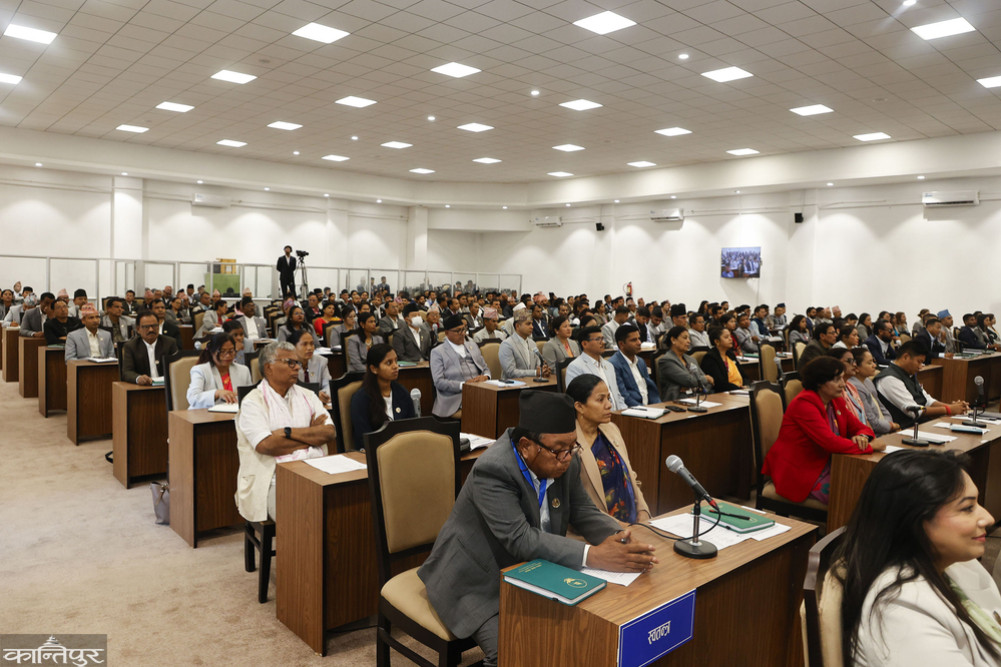
The future of the eight ordinances introduced by the government will depend on the decision taken by the opposition parties in the National Assembly. There is a constitutional provision that if only one of the House of Representatives and the National Assembly rejects the ordinance, it will automatically become invalid. The ruling Rashtriya Swayamsevak Sangh (RSS) does not have representation in the National Assembly.
Clause (a) of Article 114 (2) of the Constitution states that ‘the ordinance shall be presented to both Houses of the Federal Parliament sitting after its promulgation and shall automatically become invalid if not accepted by both Houses.’ Clause (b) states that the ordinance can be revoked by the President at any time. Clause (c) provides that even if it is invalid under clause (a) or not revoked under clause (b), it will automatically become invalid 60 days after the meeting of both Houses.
Since the ruling Rashtriya Swayamsevak Sangh (RSS) has almost two-thirds of the seats in the House of Representatives, there is no problem in approving the ordinance. There are only opposition parties in the National Assembly. The opposition parties have not yet made an official statement on whether to support the ordinance. If the ordinance is rejected by the National Assembly, the government will have the option of moving the regular bill through the parliament. In that case, even if it is rejected or amended by the National Assembly, the House of Representatives can move the bill forward without including it.
Opposition parties are doing their homework to form a common opinion on the ordinance In accordance with the provision in Article 114 (1) of the Constitution, which states that ‘if it is necessary to do something urgently, except when Parliament is in session, the President may issue an ordinance on the recommendation of the Council of Ministers’, President Ram Chandra Poudel has issued eight ordinances on the recommendation of the Council of Ministers. About 150 laws have been amended through these ordinances. Article 114 (1) of the Constitution states that ordinances shall be valid as acts.
President Poudel had issued the Cooperatives (First Amendment) and Public Procurement (Second Amendment) Ordinances on 17 Baisakh. On 18 Baisakh, the Prevention of Money Laundering (Third Amendment) Ordinance was issued. On 19 Baisakh, an ordinance was issued to amend some Nepal Acts related to the Institute of Health Sciences, special provisions related to the removal of public officials, and some Nepal Acts related to universities. On 20 Baisakh, President Poudel issued an ordinance to amend some Nepal Acts, and on 22 Baisakh, an ordinance related to the Constitutional Council (Work, Duties, Powers and Procedures). According to
Senior Advocate Tikaram Bhattarai, the term of the ordinance is 60 days from the date of commencement of the session of both houses. On the recommendation of Tuesday's Council of Ministers meeting, President Poudel has already called for the sessions of both houses of the Federal Parliament for 28 Baisakh. According to the constitutional provision, the ordinance must be presented in the first meeting and passed within 60 days (25 Asar). ‘To maintain the provisions made by the ordinance, a replacement bill must be passed by both houses within 60 days, otherwise there is a constitutional provision that the ordinance will be automatically repealed,’ Bhattarai said.
The National Assembly Rules 2075 state that any member can submit a motion to reject the ordinance within two days of its submission, while Rule 89 of the National Assembly Rules 2075 states that the ordinance can be repealed at the outset. According to the said rule, a member who wants to submit a motion to reject an ordinance must give such a notice to the Secretary in the format as per Schedule 12 (Form for Submission of Disapproval) within two days of the ordinance being submitted. According to the rules, the deadline for giving such notice will be till 30th Baisakh this year. Such notice can also be given by any MP. Earlier, during the KP Sharma Oli-led government, the land ordinance was inoperative 60 days after the opening of the house due to the lack of a favorable equation for the ruling party in the National Assembly. At that time, the ruling Congress and UML had a clear majority in the House of Representatives, but in the 59-member National Assembly, there were 16 Congress and 10 UML MPs. Four more MPs were needed for a majority. The government was supported by 3 Janata Samajwadi Party Nepal and 1 LOSPA MP. Despite the support of LOSPA, JSP did not support it. After that, the government did not move forward with the ordinance.
If a notice of rejection is registered, the Speaker of the National Assembly has to present it in the meeting, have it discussed and submitted for decision. After it is submitted for decision, if a majority is in favor of the motion to reject, the ordinance may automatically become inactive even before 60 days.
If the notice of rejection is not registered in the parliament, the government will be able to directly advance the replacement bill. The replacement bill is also like a regular bill that is registered in the parliament and advanced. The difference is that the replacement bill must be passed within 60 days of the parliament sitting, while other regular bills do not have such a deadline.
The bill that the government advances through the regular process must also be passed by both houses. The Finance Bill must be passed by the National Assembly within 15 days and other bills within two months or sent back with suggestions. But if the National Assembly rejects it, the House of Representatives can pass other bills again, but there is no such facility in the case of ordinances.
The opposition Congress, UML and NCP are the main forces in the National Assembly. The main opposition Congress is the first party with 24 seats. The NCP has 17, UML 10, Janata Samajwadi Party 2, Loktantrik Samajwadi Party 1 and Rastriya Janamorcha 1 member. There are 2 nominated by the President (Chairman Narayan Prasad Dahal and member Anjan Shakya).
The Congress had a discussion at the parliamentary party office in Singha Durbar on Wednesday to formulate a strategy on the ordinance. In the discussion held in the presence of party president Gagan Thapa, it was concluded that discussions would also be held with other opposition parties regarding the ordinance, informed parliamentary party leader Bhishma Angdembe.
The Central Working Committee meeting on April 21 has concluded that the ordinance related to the Constitutional Council was brought in a malicious manner. The decision of the Congress states that this ordinance, which was brought by the current government to make political decisions in its favor in order to be the same as the system brought by the previous government, is unconstitutional. 'We once again warn the government to withdraw the ordinance immediately and remain fully committed to the constitution,' the Congress has said regarding the ordinance related to the Constitutional Council.
The Congress has stated that it will provide positive support in the context of ordinances brought with good intentions, including good governance and ease of service delivery. 'We are clear that it is our responsibility to reject all the issues in the ordinances that thwart the fundamental rights of citizens, narrow the rights granted by the constitution, and go against the spirit of the constitution, and to take the initiative to make those issues constitutional,' the decision of the Congress has said.
The way the ordinance has been brought at the beginning of the government formation is wrong, we can go the way of rejecting the ordinance by forming a common opinion of the opposition in the National Assembly: Mahesh Bartaula, UML leader
UML leader Mahesh Bartaula said that a common opinion will be formed among the opposition parties regarding the ordinance. He informed that discussions will be held from Thursday for that. He said that the opposition parties will move forward by giving notice of rejection within two days of the ordinance being presented as per the provisions of the National Assembly Rules. 'The ordinance must be approved by both houses to be taken forward for discussion. Since the ruling party has a majority in the House of Representatives, there is no problem. But we can go the way of rejecting the ordinance by forming a common opinion of the opposition in the National Assembly,' he said, 'The way the ordinance has been brought at the beginning of the government formation is wrong.' It needs to be stopped somewhere.' Yubaraj Dulal, chief whip of the NCP's parliamentary party in the House of Representatives, said that since the Congress, UML, NCP and RPP have issued a joint statement in principle and expressed their opposition to the ordinance, they will stand together in the work to be done in parliament. 'There has been no discussion on whether to accept or reject it,' he said. 'We will move forward after discussing the four parties.'
Minister for Law, Justice and Parliamentary Affairs Sobita Gautam said that the government is holding internal discussions on issues including moving the ordinance forward in parliament. 'The government is working by prioritizing the content,' she said.