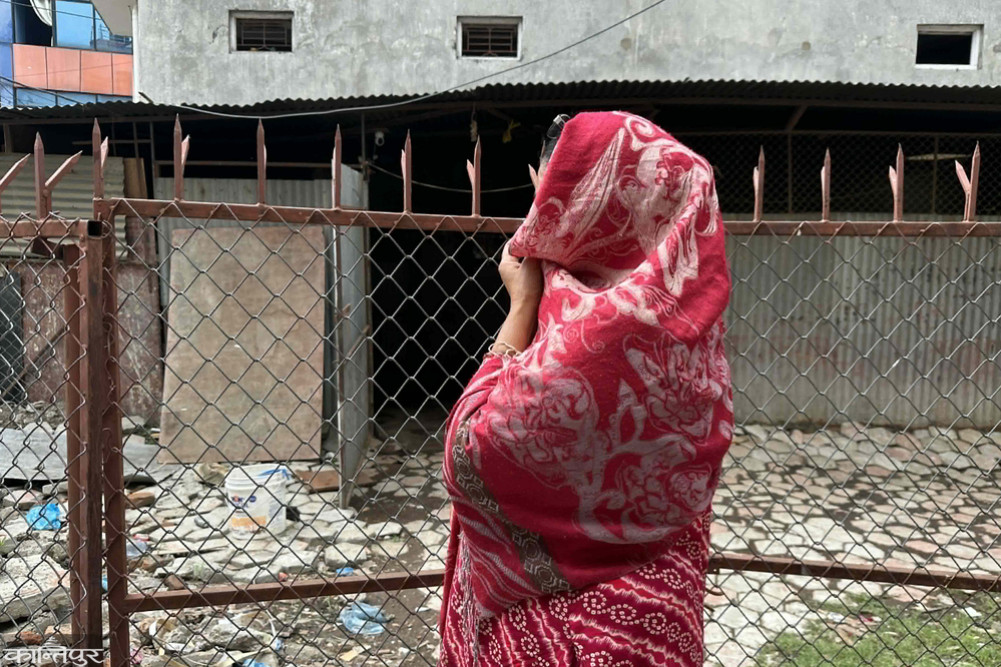
The government is demolishing squatter settlements in Kathmandu, claiming to clear encroached land. Those displaced from the settlements are worried about losing their jobs, and some have already been forced to quit their jobs.
We use Google Cloud Translation Services. Google requires we provide the following disclaimer relating to use of this service:
This service may contain translations powered by Google. Google disclaims all warranties related to the translations, expressed or implied, including any warranties of accuracy, reliability, and any implied warranties of merchantability, fitness for a particular purpose, and noninfringement.
Shanta, 56, had been living in a slum in Gairigaun (Shantinagar) of Kathmandu for two and a half decades. For the past 10 years, she had been working as a cleaner at a clinic in Shantinagar. She worked in two shifts, from 8 am to 12 pm in the morning and from 3 pm to 8 pm in the evening. On April 12, when a government bulldozer entered her settlement, her job was taken away along with her home. Since then, she has been living in a hotel in Machhapokhari, designated by the government as a holding shelter.
‘When I was here, it would have been easy for me to go to the office twice.’ But now, if I go back and forth four times from a distance, the rent alone costs 200 rupees. While my income is 9,000 rupees,’ she said. She is confused about where to go now. The salary she received from working in the clinic used to help her with household expenses. ‘Mummy’s medicine was also bought with that money. Now she has to quit her job. This is also worrying her,’ her daughter said.
Even now, Shanta remembers the work she used to do. ‘It is so difficult for a person who works and eats to sit in this room all day. I can’t live with the same thoughts in my mind,’ she says.
The government is demolishing squatter settlements to clear encroached land. Those displaced from the settlements are worried about losing their jobs, while some have been forced to leave. One example is 46-year-old Sabina Magar. She had been living in the squatter settlement of Thapathali for 20 years. From Thapathali, she would regularly go to work at a house in Dhobighat, Lalitpur. She would work from 9 am to 3 pm. Her monthly salary was 16 thousand. She used to support her family with that income. However, after the bulldozer demolished her house, her family was displaced.
She is currently living with her family in a guest house in Balaju. She has also lost her job after being displaced. ‘My job there was not only cooking, cleaning and tending the flower garden, but I also had to take care of my elderly father.’ She said that after the house collapsed and she came to a temporary shelter, she was forced to quit her job. Dhobighat is far from there. On one hand, the road is long. On the other hand, her 67-year-old mother is a heart patient. After the collapse of the settlement, her mother’s condition has worsened.
‘When I go to work, there is no one to look after my mother at home, and even at work, I would have been the one to cook and take care of my elderly father.’ It was difficult to leave my sick mother behind,' she says. She said that she quit her job after being advised to hire someone else because she could not afford it. She said that she was worried about what to do and where to go as she had no money. 'I will make my parents happy, but my heart is crying because there is no place for them to retire,' she laments.
Rita Khadka, who has been living in the Balkhu slum for 15 years, is not only homeless but also unemployed. From the displaced slum, she has taken a temporary shelter at the Nepal Electricity Authority Engineering Services Directorate Training Management Department in Kharipati, Bhaktapur. She is currently 46 kilometers away from Bansighat. She thinks, 'Where have I come?'
She used to work in two houses in Balkhu. She used to reach one house at 6 in the morning. She used to do everything from washing dishes, cleaning to washing clothes. For which she earned 4 thousand rupees per month. She used to go to another house 3 days a week from where she used to earn 25 hundred per month. Her monthly income was 6 thousand 500. Rita, who lives in a hut in the settlement, did not have to pay rent. Her two children are also domestic workers. She lost her job after coming to Kharipati in Bhaktapur. 'I used to work all day. I had money in my hand. Now I have no work, no money,' she says. Her housemate calls her and asks, 'Are you coming or not?' If you go, you can work. However, she is not in a position to go because she is far away. Rita does not even remember how she reached Kharipati on the day she was displaced. ‘I brought the stadium from home in a car. I only found out where it was taken from there,’ she says.
Sumitra Karki, who was displaced from Bansighat in Teku, also used to do household work. She used to earn 3,000 rupees a month by working in a house in the morning. The house, which was close to her settlement, is now far from her. Living 46 kilometers away, she cannot return to work even if she wants to. ‘He loved me very much. He would say that the work is good. He would give me more than money,’ she recalled, ‘I did not want to leave the work I was doing. But, even if I go now, the rent will be more expensive than the income.’
Rajkumar, who was displaced from Bansighat, was working in the BK department. He is always busy with work at other times, but it is difficult for him to spend a day there. Rajkumar's family, who used to work and support a family of 4, is currently in the department. He used to work as a laborer. He is now unemployed after being displaced. He has not been able to return since he came far from the place where he used to work.
'I feel like I came a long way when I came by car. The car fare is now expensive. How can someone who earns a little pay for that fare?' he says. He used to earn 500,000 to 2,000 daily from street work. Now he seems restless due to lack of income.
Sharmila Nepali and Sujata Nepali are sisters living in the holding center at the Radhaswamy Satsang Center in Kathmandu. They had a house in the Sinamangal Sukumbasi settlement. They had a family of four with their brother and mother. Their mother used to sew and weave. ‘We also used to clean the house because the money our mother earned did not cover our expenses. With the money we earned, it was easy to educate my brother and meet other expenses. But now we have to leave that job too,’ said Sharmila.
Now Sharmila’s sisters do not want to stay in Nepal. ‘We have also lost our jobs. What will we do now?’ they said. Where will they be if they are not at home? They do not even know. ‘It is far to go to work from here. The rent is expensive. There is no money left. That is why we were forced to leave,’ said Sujata.