The President is currently in a dilemma as the bill with similar provisions, which was passed by both houses, was returned to the parliament and a similar ordinance recommended by the Sushila Karki-led government was not issued.
We use Google Cloud Translation Services. Google requires we provide the following disclaimer relating to use of this service:
This service may contain translations powered by Google. Google disclaims all warranties related to the translations, expressed or implied, including any warranties of accuracy, reliability, and any implied warranties of merchantability, fitness for a particular purpose, and noninfringement.
President Ram Chandra Poudel, who has been issuing ordinances recommended by the Council of Ministers, has been caught in a quandary over the ordinance amending the Constitutional Council Act. The President is in a dilemma as to whether to issue another ordinance because it contains provisions similar to the provisions of the previously 'held' ordinance.
The Council of Ministers recommended two ordinances on the Constitutional Council and cooperatives on Monday, and the President has already issued the ordinance on cooperatives on Thursday. The ordinance on public procurement recommended on Wednesday has also been issued. President Poudel is consulting constitutional scholars/legal experts on the issue of the ordinance on the Constitutional Council.
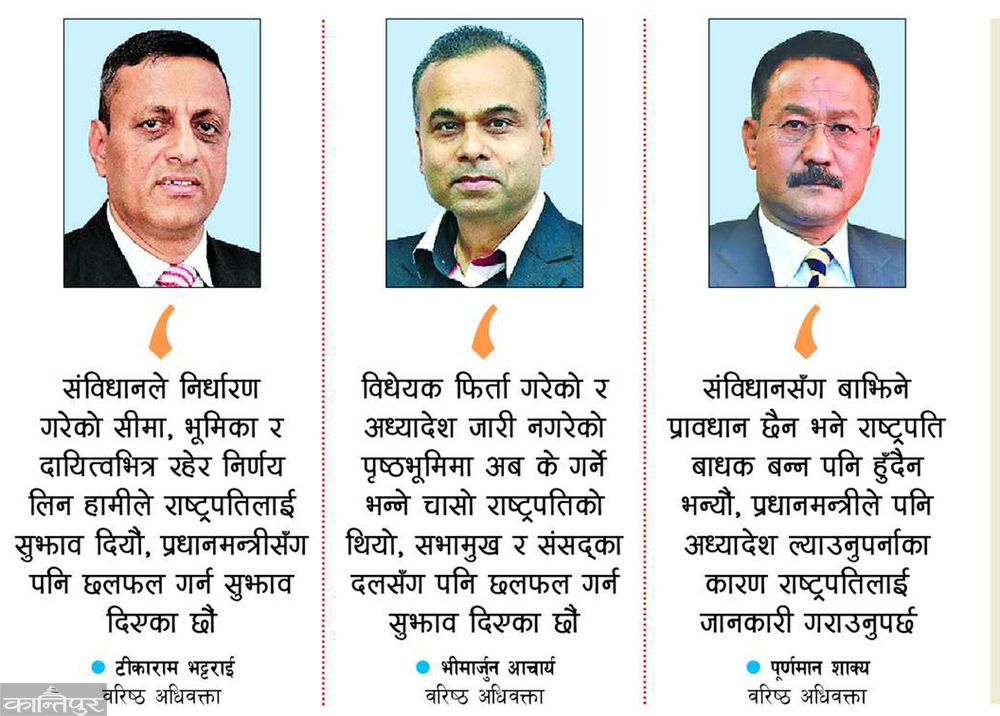
President Poudel has held constitutional consultations with the Attorney General and six senior advocates on the ordinance on Thursday. The President's Office is preparing to hold discussions with the officials of the Nepal Bar Association on Friday. Homework is also being done to discuss the issue of the Constitutional Council ordinance with Prime Minister Balendra Shah. Senior advocates Bhimarjun Acharya, Tikaram Bhattarai, Badri Bahadur Karki, Mahadev Yadav, Raman Shrestha and Purnaman Shakya had reached Sheetal Niwas for consultation on Thursday.
The President is now in a dilemma as the bill with the same provision, which was passed by both houses and sent, was returned to the parliament itself and the similar ordinance recommended by the Sushila Karki-led government was not issued. The President's advisor Baburam Kunwar also participated in the discussion. Before consulting with the constitutional experts/legal experts, President Poudel had consulted Attorney General Narayan Dutt Kandel separately.
President Poudel had sought suggestions from constitutional experts on what could be the basis for accepting the ordinance of the same nature that was returned twice before from the same organization. In such a situation, the President was also concerned about how to maintain a balance between his constitutional obligations, privileges, and established precedents.
Constitutional scholars had opined that since the President is the 'guardian of the Constitution', he should consider not only the legal provisions but also the long-term impact and the impact on the balance of separation of powers when making a decision. They suggested that it would be appropriate to discuss the ordinance with the Speaker and other political parties represented in the House of Representatives after the government makes its recommendation.
Senior advocate Bhattarai told Kantipur that they had suggested the President to take a decision within the limits, roles, and responsibilities set by the constitution. Despite the differences in wording and presentation, he said that everyone's suggestions on the ordinance related to the Constitutional Council were the same. 'We also suggested discussing it with the Prime Minister. We also urged him not to forget his responsibility as the guardian and upholder of the constitution,' Bhattarai said.
An ordinance amending the Constitutional Council (Works, Duties, Powers and Procedures) Act, 2066, was sent to the President's Office on Monday, providing for a provision that allows the six-member Constitutional Council, chaired by the Prime Minister, to make decisions from three members, including the chairperson. The government claims that the proposed provision will facilitate the decision-making process of the council.
President Poudel had earlier returned the Constitutional Council bill, which was passed by both houses of the federal parliament and sent on 31 Ashad 2082, nine days later without verifying it, saying that 'decisions should be made by at least a majority of the total number of members'. President Poudel had not even issued an ordinance of the same nature that was put forward by the Sushila Karki-led government. The ordinance sent earlier by the government had a provision that the presence of four people would constitute a quorum and that a decision could be made by a majority of three members including the chairman.
According to an official at Sheetal Niwas, President Poudel is concerned about whether the question of adopting 'double standards' will arise in issuing a similar ordinance now. 'We will consult with the Prime Minister once in this regard and reach a decision,' the official said.
Another senior advocate Shakya said that they had suggested that a decision should be taken after considering whether the ordinance is in line with the spirit of the constitution or not. 'We discussed the role of the constitution. Our president is not like in other countries. We cannot make decisions blindly. We need to see whether the constitution is compatible or not. If there is no provision that conflicts with the constitution, the president should not become an obstacle in the matter of running the government,' he said, 'Since the president is the guardian of the constitution, he should play his role accordingly. We had a similar suggestion. The prime minister should also inform the president about why such an ordinance had to be brought.' According to senior advocate Acharya, the President's main concern was what to do now in the context of the bill that was previously passed by both houses of the federal parliament and sent for verification being withdrawn and the ordinance of a similar nature not being issued even after that. 'We have suggested that a conclusion should be reached after discussing it with the Speaker and other parties in the House of Representatives,' he said.
In a separate discussion, the government's legal advisor Attorney General Narayan Dutt Kandel reminded that the constitution does not give the president the right to stop the ordinance and suggested that it be issued immediately.
President Poudel held a constitutional consultation with the attorney general and six senior advocates on Thursday, discussed with the bar association officials on Friday, and will also discuss with Prime Minister Shah.
The president had summoned Kandel to Sheetal Niwas and sought his opinion. Kandel told Kantipur that he had given his opinion that the ordinance recommended by the council of ministers should be issued without going into the subject matter of the ordinance on Thursday.
‘The President sought the government’s opinion on the ordinance related to the Constitutional Council. Without going into the content, I opined that it is the President’s responsibility to issue an ordinance as recommended by the government,’ he said, ‘There is a constitutional provision that the President must issue whatever the government recommends as it is.’
Seven ordinances amending 57 laws were sent to the President as per the decision of the Council of Ministers on Monday. ‘The ordinance related to cooperatives and public procurement has already been issued. The President himself, his legal advisors and employees are studying the other ordinances,’ said an official at Sheetal Niwas, ‘There is no major problem with the others, the main difficulty for the President is the ordinance related to the Constitutional Council.’

The ordinance provides for the immediate cancellation of all appointments made before 12 Chaitra 2082 under the ministries of Culture, Tourism and Civil Aviation, Education, Science and Technology, Health and Population, Energy, Water Resources and Irrigation, Agriculture and Livestock Development, Industry, Commerce and Supplies, Forest and Environment. 'It has been arranged that the tenure of those who have received political appointments will end from the date of issuance of the ordinance, and the number of such institutions is 110,' said an official of Sheetal Niwas.
000
Acts to be amended through the Ordinance to amend some Nepal Acts
1 Employees Provident Fund Act, 2019
2 Land Survey Act, 2019
3 Land Act, 2021
4 Education Act, 2028
5 Land Revenue Act, 2034
6 Technical Education and Vocational Training Council Act, 2045
7 Foreign Employment Act, 2064
8 Federal Parliament Secretariat Act, 2064
9 Contribution-based Social Security Act, 2074
10 National Medical Act, 2075
11 Land Use Act, 2076
12 Forest Act, 2076
13 Insurance Act, 2079
14 Design Act, 2081
15 Citizen Investment Fund Act, 2047
16 Nepal Academy of Science and Technology Act, 2048
17 Academy Act, 2048
18 Civil Service Act, 2049