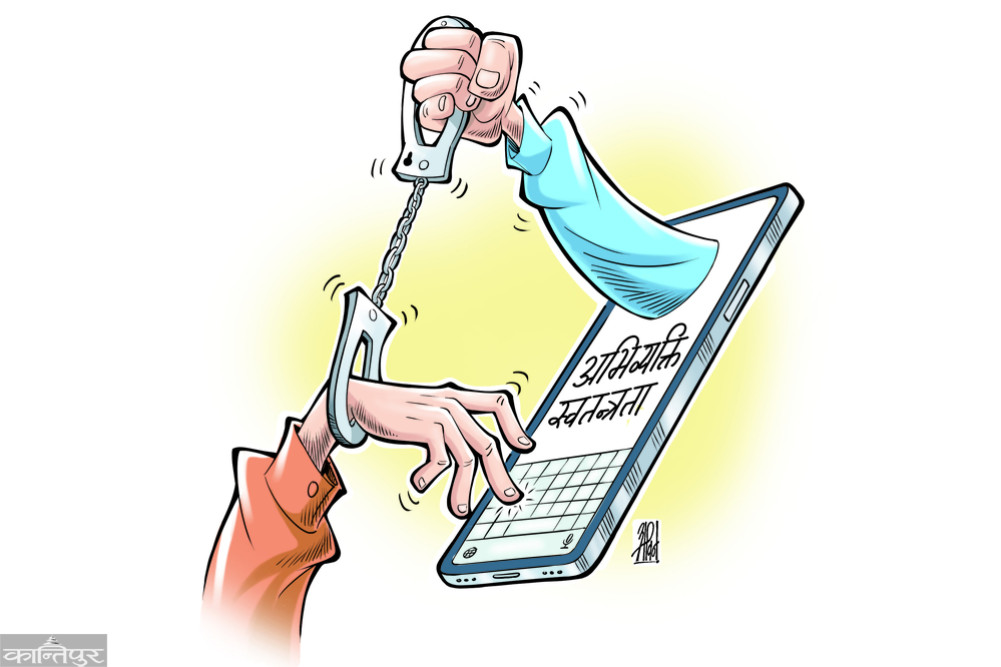
An analysis of the Kathmandu District Court's verdicts in cybercrime cases related to freedom of expression over the past decade shows that 45 percent of the accused have spent more time in prison than the prescribed sentence.
We use Google Cloud Translation Services. Google requires we provide the following disclaimer relating to use of this service:
This service may contain translations powered by Google. Google disclaims all warranties related to the translations, expressed or implied, including any warranties of accuracy, reliability, and any implied warranties of merchantability, fitness for a particular purpose, and noninfringement.
The Ministry of Information and Communications issued a notice last week saying that media outlets publishing ‘content not verified by official bodies’ could be prosecuted under the cybercrime law. The Nepali Army immediately issued another statement with a similar warning, without mentioning the name of the law, saying that it was ‘regularly monitoring unverified information and expressions’ targeting the military leadership and that those who do so would be ‘brought to justice’.
Information technology expert Dobhan Rai interprets the army’s statement as a ‘threat to citizens’. ‘Such threats attack the very essence of the democratic movement and freedom of speech,’ she said.
Kantipur's analysis of the Kathmandu District Court's judgments over the past decade shows that 45 percent of the accused spent more than the prescribed sentence in prison Rai’s comments are not unusual when analyzing the implementation of the cybercrime law (Electronic Transactions Act) in Nepal. Dozens of journalists and social media users have been victims of such warnings and subsequent prosecutions. An examination of the Kathmandu District Court records shows how the Electronic Transactions Act, enacted in 2006, was used to curtail freedom of expression over the past decade.
Until 2080, the Kathmandu District Court was the only court in the country to hear cybercrime cases. Of the more than 700 cases decided by the court in the decade after 2070, 70 were related to freedom of expression and journalism. Kantipur's analysis of those judgments shows that this law has also been used to suppress the voices of journalists, satirists and ordinary citizens.
The main subject of most of these cases was not a separate crime involving technology such as computers, mobile phones or the internet, but related to ideas and news expressed through the internet. These facts show how widely this law was misused in the past decade.
What was seen in a decade
The main facts revealed by Kantipur's analysis are as follows:
- In 64 percent of the cases related to freedom of expression, the accused was initially arrested. The accused spent an average of 38 days in custody.
– At least two people were detained for a year for political speech. The one-year sentence was the maximum sentence handed down in cases of this nature in the past decade, and neither of them was even given bail. By the time the final verdict was reached, one of them had already spent five months in detention longer than his sentence. In total, the accused in 32 cases had spent more time in detention than their sentence had been.
– In 97 percent (70) of the cases prosecuted, it was claimed that the alleged victims had suffered harm to the leaders or police organizations, while in less than 10 percent of those, the courts found that the alleged victims had actually suffered harm.
– 80 percent of the cases were filed over political comments directed at public figures and bodies, and a similar number of cases were filed at the initiative of government offices or leaders, such as the police, the Ministry of Home Affairs, and the Office of the President. In other words, the state had initiated the case itself, not on the basis of complaints from victims, but to silence its critics.
Let's look at some examples of the types of people against whom such cases were filed.
A 16-year-old boy from Itahari-1, Sunsari, was arrested by the police on charges of imitating the voices of the then President Bidya Devi Bhandari and the then Prime Minister Sher Bahadur Deuba and making a video using 'derogatory words'.
He was detained for investigation, and his phone and computer CPU were confiscated. The boy said that he did not make the video himself, but only posted it on the 'Troll Sunsari' page after meeting him elsewhere. However, the court sentenced him to imprisonment for the number of days he was detained for investigation (the decision did not specify how many days), a fine of Rs 5,000, and confiscation of his mobile phone.
A 22-year-old Sakar Adhikari, who had gone to Australia for study and was undergoing treatment for mental illness, was also charged with a similar political expression.
He was brought to court while he was undergoing treatment at the Lagankhel Mental Hospital in Nepal. A bail of Rs 50,000 was sought for the facility to fight the case outside the prison. In the end, Judge Krishna Prasad Poudel acquitted him, saying that no punishment could be imposed for the Facebook post made while he was mentally ill.
According to Kantipur's analysis, the court found guilty in 60 percent of the 70 cases related to freedom of expression. In some of the acquittals, the court reminded the police to respect freedom of expression. During this period, many people were prosecuted for posting cropped photos of the then President Bhandari and the then Prime Minister KP Sharma Oli.
One of them is Saroj Niraula, 29, of Triyuga-12, Phulchowk, Udayapur. He was arrested by the police on the basis of a letter from Bhandari's personal secretariat and charged with posting an 'indecent photo that offends humanity' of the President. Looking at the charge sheet and verdict filed in the court, it does not seem to reveal even a simple detail about what the photo that Niraula posted was like, what was written in the caption, and how it became a cyber crime.
In court, Niraula said that he did not edit the photo himself, downloaded it from another page, and deleted it within an hour after he felt the post was inappropriate. He then apologized to the president by writing a status on Facebook. However, the court did not even agree to release him on bail, sending him to pretrial detention. That is, he had to stay in prison until the final verdict in the case.
In his ruling three months and 26 days after his arrest, Judge Medini Prasad Poudel sentenced Niraula to exactly the same term of imprisonment and a fine of Rs 1,000, matching his detention. When Bhandari was president, his secretariat had ordered the police to arrest Niraula and take action under cyber laws more than a dozen times.
Thus, the court has decided to convict the accused in most of the cases. According to Kantipur's analysis, the court found the accused guilty in 60 percent of the 70 cases related to freedom of expression. In some of the acquittals, the court has reminded the police to respect freedom of expression.
Example – Tara Nachhiring of Khotang, residing in Budhanilkantha-13, had posted a photo of Oli, Dahal and the then ministers Ishwor Pokharel, Gokul Baskota, Bhanubhakta Dhakal and Yogesh Bhattarai with the status, ‘Look at the faces of the famous national robbers who have misled 30 million people and emptied the national treasury, spit.’ None of these leaders had complained that they were hurt by such a post. Police Inspector Pradin Tamrakar filed a report against Nachhiring for cybercrime. Nachhiring was arrested and charged. The court sought a bail of Rs 25,000.
When the final verdict was made, District Judge Binod Kumar Pokharel held that Nachhiring had not committed any crime but had exercised his freedom of expression. While acquitting Nachhiring, the judge made a comprehensive constitutional interpretation. One, the leaders shown in the photo themselves accuse each other in a public forum in even stronger language than that post every day, and if that is called freedom of expression, then the public's assessment of them cannot be called a crime.
Two, many other people are also posting photos of those leaders on Facebook along with such posts, holding only one person guilty goes against the principle of equality. Three, none of the leaders who were said to have spread hatred came to file a complaint as a victim or give a statement in court, who is the purpose of the charge of compensation in a case where there is no victim? And, finally, Judge Pokharel said that Nachhiring's post was not of criminal intent, but rather it 'represented public sentiment', it cannot be called cybercrime.
Similarly, in 2079, Deepak Raj Joshi wrote on Facebook, ‘Two policemen who had just come on patrol in the Kalanki Mitranagar area were seen walking around drunk, who is monitoring this?’
The police had ordered him to close the cafe immediately while he was eating, and Joshi had asked for some more time. After the police forcibly closed it, Joshi had posted such a post without including the names and photos of the policemen, assuming that they might have been drunk. However, the police arrested Joshi and filed a cybercrime case.
The court finally said, ‘Since the situation has even been brought to the attention of the state machinery, it cannot be called cybercrime.’ However, by then, Joshi had been detained by the police for 23 days.
There are many such cases where a citizen’s question to a public body has been filed as ‘against public morality’. Like Joshi, they have been sentenced to prison despite being innocent. Of the cases prosecuted, 45 percent (32) of the accused have spent additional time in custody. Some of them have been found innocent, like Joshi. Some, even though they were found guilty, have served more time than the court had prescribed.
The interesting aspect of this analysis is that different decisions have been made for the same type of expression. A person who posted a TikTok saying ‘Yamraj has sent a message of death’ on a photo of Jhalanath Khanal has been acquitted, while some have been found guilty for calling Oli ‘corrupt’. Some have been acquitted and some have been found guilty for calling Dahal a murderer of 17,000 people. Bhandari has been convicted and sent to jail for driving a car more expensive than the Queen’s.
In all these cases, the judge has used Section 47 of the Electronic Transactions Act to decide who is guilty and who is innocent, not on the basis of the content of the expression, but on the basis of the judge’s interpretation.
The Root of Article 47: Royal Ordinance
After King Gyanendra took power and dissolved parliament on 19 Magh 2061, he began ruling through ordinances. In that unstable political environment, on 27 Bhadra 2062, the Electronic Transactions Ordinance was promulgated. Its Article 47 prohibited the publication of material via the Internet or computer that was ‘against public morality and decency,’ ‘spreading hatred and enmity,’ or ‘disturbing relations between castes and communities.’
The Act does not define these terms. Their interpretation may differ from person to person. Amidst such confusion, a provision has been made for imprisonment of up to five years and a fine of up to one lakh rupees for the guilty, and that provision is still in force.
As mentioned in Martin Chautari's policy paper 'Background and process of drafting the Electronic Transactions Act, 2063', this ordinance had to be passed within six months of the parliament's inauguration to prevent it from becoming inactive, and the legislature quickly passed the bill without much debate, and Section 47 was kept exactly the same.
The initiative to draft a law to regulate electronic transactions had been in place since 2058. Chautari-affiliated scholar Harshaman Maharjan wrote in Himal Khabar under the title 'The Danger of Section 47', 'In the said ordinance, the definition of the scope of the crime, the amount of the fine, and the period of imprisonment were increased compared to 2058.'
चौतारी आबद्ध अध्येता हर्षमान महर्जनले हिमालखबरमा ‘दफा ४७ को खतरा’ शीर्षकमा लेखेका छन्, ‘उक्त अध्यादेशमा २०५८ मा भन्दा अपराधको दायरासम्बन्धी व्याख्या, जरिवाना रकम र कैद अवधि बढाइएको थियो ।’ The section, which was introduced with the aim of controlling the digital expression of citizens in the political situation in which the king took power, was passed by the re-established House of Representatives after the success of the People's Movement without changing even a full stop or comma. ‘शाही अध्यादेशमा रहेको दफा ४७ लाई जस्ताको त्यस्तै ऐनमा राखिसकेपछि पनि कहिल्यै संशोधन गरिएन,’ चौतारीका अनुसन्धानकर्ता महर्जन भन्छन् ।
प्रतिनिधिसभाले चाहेको भए उक्त दफा हटाउन सक्थ्यो वा उक्त दफाको प्रयोग नागरिकको अभिव्यक्ति स्वतन्त्रताविरुद्ध हुन नसक्ने गरी त्यसयताका कुनै पनि संसद्ले संशोधन गर्न सक्थे । महर्जनले हिमालखबरमा लेखेका छन्, ‘पत्रकार र मानवअधिकार क्षेत्रबाट दफा ४७ को आलोचना भएको सन्दर्भमा विद्युतीय कारोबारसँग असम्बद्ध अभिव्यक्ति स्वतन्त्रतालाई कुण्ठित गर्ने प्रावधान संशोधन गर्न वा हटाउन सकिन्थ्यो । यसको दुरुपयोग गर्नेलाई सजाय वा बदनियतपूर्वक चलाइएको कारबाहीका कारण पीडित भएकालाई क्षतिपूर्तिको व्यवस्था गर्ने विकल्प पनि थियो । तर, ...राजनीतिक आस्थाका आधारमा प्रतिशोध लिन र व्यक्तिगत रिसइबी साध्न आजसम्म दफा ४७ को दुरुपयोग भइरहेकै छ ।’
सर्वोच्च अदालतले एक फैसलामा दफा ४७ अन्तर्गतका मुद्दाको व्याख्या ऐनको प्रस्तावनाअनुरूप हुनुपर्ने आदेश दिएको छ, प्रस्तावनाले यो ऐन मूलतः डिजिटल कारोबारलाई ‘भरपर्दो र सुरक्षित बनाउन’ बनेको बताएको छ । अर्थात् व्यक्तिको अभिव्यक्ति नियन्त्रण गर्ने उद्देश्यले यो ऐन बनेकै थिएन ।
यो समस्यालाई महान्यायाधिवक्ताको कार्यालयको अनुसन्धानले पनि स्वीकार गरेको छ । ‘नेपालमा साइबर कसुरसम्बन्धी कानुनको प्रभाव मूल्यांकन, अनुसन्धानमूलक अध्ययन प्रतिवेदन, २०८१’ ले ‘दफा ४७ को प्रावधानमा ‘कम्प्युटरसम्बन्धी कसुर’ का तत्त्वहरू अस्पष्ट, अन्योलपूर्ण, विरोधाभाषी रहेको उल्लेख गरेको छ । भनिएको छ, ‘संविधानद्वारा प्रदत्त विचार र अभिव्यक्ति स्वतन्त्रताको अधिकारको सम्मान र संरक्षण हुने गरी कानुन परिमार्जन गर्नुपर्ने’ आवश्यकता छ ।
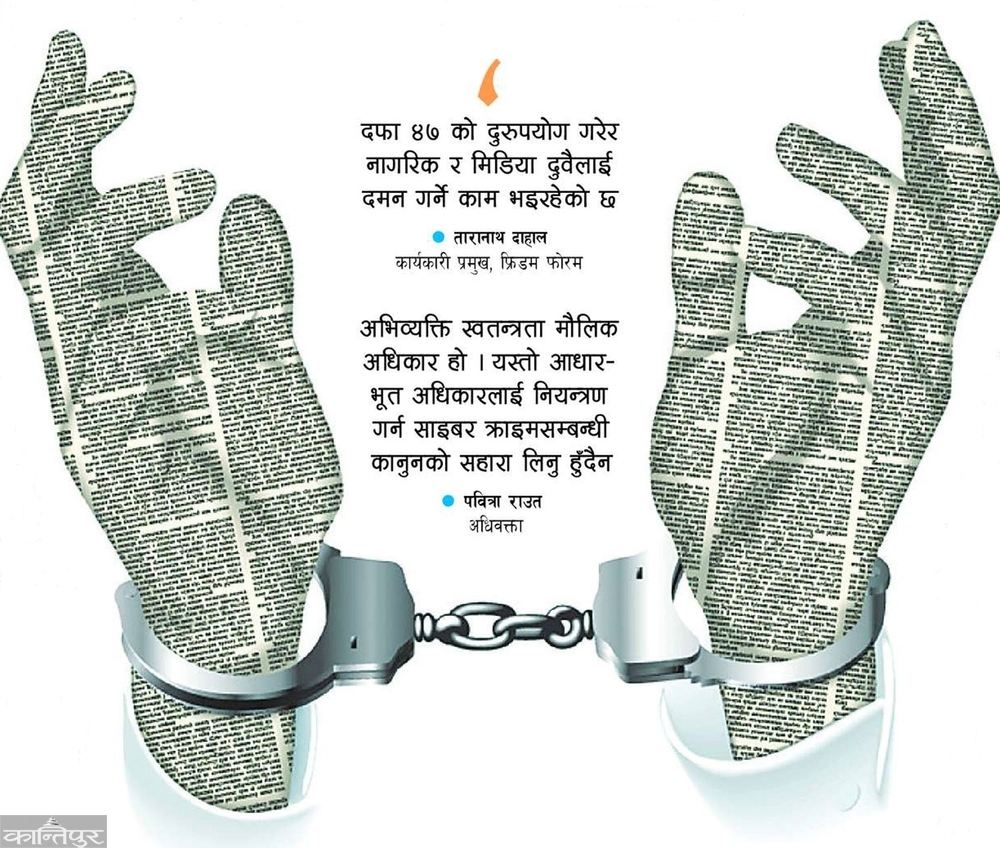
अधिवक्ता पवित्रा राउत सरकारले यो कानुनलाई अभिव्यक्ति स्वतन्त्रता कुण्ठित गर्ने ‘हतियार’ का रूपमा प्रयोग गरिरहेको बताउँछिन् । ‘अभिव्यक्ति स्वतन्त्रता मौलिक अधिकार हो । यस्तो आधारभूत अधिकारलाई नियन्त्रण गर्न साइबर क्राइमसम्बन्धी कानुनको सहारा लिनु हुँदैन,’ उनले भनिन् ।
‘नेपालमा साइबर क्राइमसम्बन्धी एक अध्ययन : चुनौती र सिफारिसहरू’ शीर्षकमा राष्ट्रिय न्यायिक प्रतिष्ठानले प्रकाशन गरेको प्रतिवेदनले पनि यो कानुन नेपालमा विद्युतीय हस्ताक्षर नियमन गर्ने उद्देश्यले बनाइएको तर साइबर क्राइमका लागि प्रयोग भइरहेको उल्लेख गरेको छ । ‘हाम्रो अध्ययनले अधिकांश मुद्दाहरू दफा ४७ अन्तर्गत गालीबेइज्जती र चरित्रहत्या जस्ता विषय नियमन गर्न प्रयोग भएको देखियो, तर, त्यसका लागि छुट्टै कानुन छँदै छ,’ प्रतिवेदनमा भनिएको छ ।
फ्रिडम फोरमका कार्यकारी प्रमुख तारानाथ दाहालले विद्युतीय कारोबार ऐनलाई पत्रकारितालाई नियमन गर्ने कानुनका रूपमा पनि प्रयोग हुँदै आएको बताए । ‘दफा ४७ को दुरुपयोग गरेर नागरिक र मिडिया दुवैलाई दमन गर्ने काम भइरहेको छ,’ उनले भने । अभिव्यक्ति स्वतन्त्रता नियन्त्रण गर्न साइबर कानुनको प्रयोग आजसम्म जसरी हुँदै आएको थियो, त्यो नयाँ सरकार गठनपछि पनि निरन्तर छ ।
नयाँ सरकार हिँडेको पुरानै बाटो
पाँचथरको फाल्गुनन्द–७ का रोशन पोखरेल गत २६ चैतमा पक्राउ परे । वालेन्द्र शाहको नेतृत्वमा नयाँ सरकार गठन भएको दुई साता मात्र भएको थियो, ‘हेड्स’ नामक युट्युब च्यानलमा प्रधानमन्त्री शाहको आलोचना गर्दा साइबर क्राइम गरेको आरोपमा उनलाई प्रहरीले पक्राउ गर्यो । पोखरेलले युट्युबमा प्रधानमन्त्री शाह र मन्त्रीहरूको कार्यशैली पुराना दलका नेताको भन्दा फरक नरहेको भन्दै आलोचनात्मक विचार राखेका थिए ।
नेपाल प्रहरीको साइबर ब्युरोले उक्त भिडियोका विषयमा ‘इन्क्वायरी’ (सोधपुछ) गर्न निर्देशन दिएपछि पाँचथर प्रहरीले भिडियोहरूको अध्ययन गरी उनलाई नियन्त्रणमा लिएको जिल्ला प्रहरी कार्यालय पाँचथरका प्रवक्ता, प्रहरी निरीक्षक रामचन्द्र शाहले बताए । ‘साइबर ब्युरोबाट उनीमाथि निगरानी गर्नु भनेपछि हामीले उनका भिडियोहरू हेर्यौं, विवादित देखिएपछि पक्राउ गरेका हौं,’ शाहले भने । पक्राउ परेका पोखरेलविरुद्ध विद्युतीय कारोबार ऐन–२०६३ को दफा ४७ अन्तर्गतको कसुरमा जिल्ला अदालत पाँचथरमा मुद्दा दायर गरिएको छ ।
नयाँ सरकार बनेको एक महिना नपुग्दै सञ्चार तथा सूचना मन्त्रालयले पत्रकार र सामाजिक सञ्जाल प्रयोगकर्तालाई त्यही दफा ४७ अन्तर्गत कारबाहीको चेतावनी दिएको छ । सेनाले समेत नागरिकका डिजिटल क्रियाकलाप निगरानी गरिरहेको चेतावनी दिएको छ । त्यस्तै गत साता कञ्चनपुरका पत्रकार बासुदेव धामीविरुद्ध जिल्ला प्रहरी कार्यालय कञ्चनपुरले साइबर अपराधमा अनुसन्धानका लागि पक्राउ पुर्जी जारी गरेको छ । पश्चिम समाचार दैनिकमा प्रकाशित समाचारका विषयमा बेलडाँडी गाउँपालिका उपाध्यक्ष शान्ति नाथले उजुरी दिएपछि साइबर ब्युरोको निर्देशनमा जिल्ला प्रहरी कार्यालयले विद्युतीय कारोबार कसुरअन्तर्गत मुद्दा चलाउन पक्राउ पुर्जी जारी गरेको हो ।
पत्रकार महासंघका महासचिव रामप्रसाद दाहालले विज्ञप्ति जारी गरी समाचारसँग सम्बन्धित विषय प्रेस काउन्सिलको क्षेत्राधिकारमा पर्ने स्मरण गराउँदै पत्रकारलाई फौजदारी अभियोग लगाएकोमा विरोध गरेका छन् ।
फ्रिडम फोरमका कार्यकारी प्रमुख दाहाल भन्छन्, ‘यसले त ओली शासनकै झल्को दियो, मिडियाको विषयवस्तु नियमन गर्न विद्युतीय कारोबार ऐन प्रयोग गर्नै पाइँदैन ।’ सञ्चार मन्त्रालयको हालैको विज्ञप्ति र पत्रकारमाथि साइबर कानुनअनुसार मुद्दा लगाउन खोजिएको विषयप्रति पत्रकार महासंघकी अध्यक्ष निर्मला शर्माले आपत्ति जनाइन् । ‘आचारसंहिता पालना नगर्ने सञ्चामाध्यमलाई हेर्ने निकाय प्रेस काउन्सिल हो, त्यसमा पनि चित्त नबुझे जाने न्यायिक निकाय छन्,’ शर्माले फेसबुकमा लेखेकी छन् ।
मन्त्रालयले भने दर्ता नभई अनर्गल प्रचार गर्नेहरूलाई लक्षित गरिएको दाबी गरेको छ । मन्त्रालयका उपसचिव रवीन्द्रप्रसाद पौड्यालले भने, ‘यो कुनै निरंकुश कदम होइन, विनम्रतापूर्वक गरिएको अनुरोध मात्र हो । अपुष्ट सूचना छ्यापछ्याप्ती हुँदा मन्त्रालय चुप लागेर बस्न मिल्दैन ।’
सूचना–प्रविधि विज्ञ दोभान राई डिजिटल इकोसिस्टममा अभिव्यक्ति स्वतन्त्रता र डिजिटल सुरक्षाबीच सन्तुलन हुनुपर्ने बताउँछिन् । ‘तर, स्वतन्त्रता हनन हुँदा डिजिटल स्पेस सुरक्षित हुनुको साटो झन् आतंकित बनिरहेको छ,’ उनले भनिन्, ‘सरकारको प्राथमिकता कमजोर मानिसहरूलाई डिजिटल हिंसाबाट जोगाउने हुनुपर्ने हो, तर व्यवहारमा शक्तिशाली व्यक्तिहरूको मानप्रतिष्ठा जोगाउन र आलोचना गर्नेहरूलाई समात्न यो कानुनको दुरुपयोग भइरहेको छ ।’
गतवर्ष भदौको जेन–जी आन्दोलन सामाजिक सञ्जाल प्रतिबन्धको विरोधमा सुरु भएको थियो । अभिव्यक्ति स्वतन्त्रता खोस्ने सरकारको कदमको विरोधमा भएको आन्दोलनले ओली सरकार ढाल्यो । निर्वाचनपछि शाहको नेतृत्वमा नयाँ सरकार बनेको एक महिना नपुग्दै सञ्चार तथा सूचना मन्त्रालयले पत्रकार र सामाजिक सञ्जाल प्रयोगकर्तालाई फेरि त्यही दफा ४७ अन्तर्गत कारबाहीको चेतावनी दिएको छ । नेपाली सेनाले समेत नागरिकका डिजिटल क्रियाकलाप निगरानी गरिरहेको चेतावनी दिएको छ ।
सेनाको यस्तो चेतावनीले सात वर्ष पुरानो एउटा यस्तो घटना सतहमा ल्याइदिएको छ । २०७६ मा नेपाली सेना साइबर सुरक्षा शाखा, युद्धकार्य महानिर्देशनालय, जंगीअड्डाले कतारमा कार्यरत दाङका २१ वर्षका रुद्र केसीलाई पक्राउ गरी कारबाही गर्न साइबर ब्युरोलाई पत्र लेख्यो । उनले फेसबुकमा तत्कालीन प्रधानसेनापति पूर्णचन्द्र थापालाई कायर भन्दै उनको तस्बिर राखेर स्टाटस लेखेका थिए ।
जंगीअड्डाको उक्त पत्रमा ‘मानहानि हुने गरी नेपाली सेनासम्बन्धी विभिन्न लाञ्छना लगाएको स्टाटस पोस्ट गरेको’ उल्लेख छ । जंगीअड्डाले ब्युरोलाई लेखेको पत्रमा केसी कतारबाट ११ पुस बिहान ११ बजे कतार एयरलाइन्सको उडानबाट काठमाडौं उत्रने विवरण राखेर विमानस्थलबाटै पक्राउ गर्न भनिएको थियो । केसी त्रिभुवन विमानस्थलमा उत्रनेबित्तिकै पक्राउ परे ।
यो घटनाले सेनाले वैदेशिक रोजगारीमा रहेका नेपाली नागरिकको सामाजिक सञ्जालका पोस्टहरू र उनीहरू कहिले, कुन समय र कुन उडानबाट यात्रा गर्छन् भन्ने जस्ता विवरण पनि निगरानी गरिरहेको देखाएको थियो । तर, त्यो सात वर्षअघिको कुरा थियो ।
अहिले सेनाले विज्ञप्ति नै निकालेर भनेको छ, ‘हामीले नियमित निगरानी गरिरहेका छौं ।’ यसले प्रश्न जन्माएको छ– नागरिकको डिजिटल क्रियाकलाप निगरानीको हद कहाँसम्म छ ?