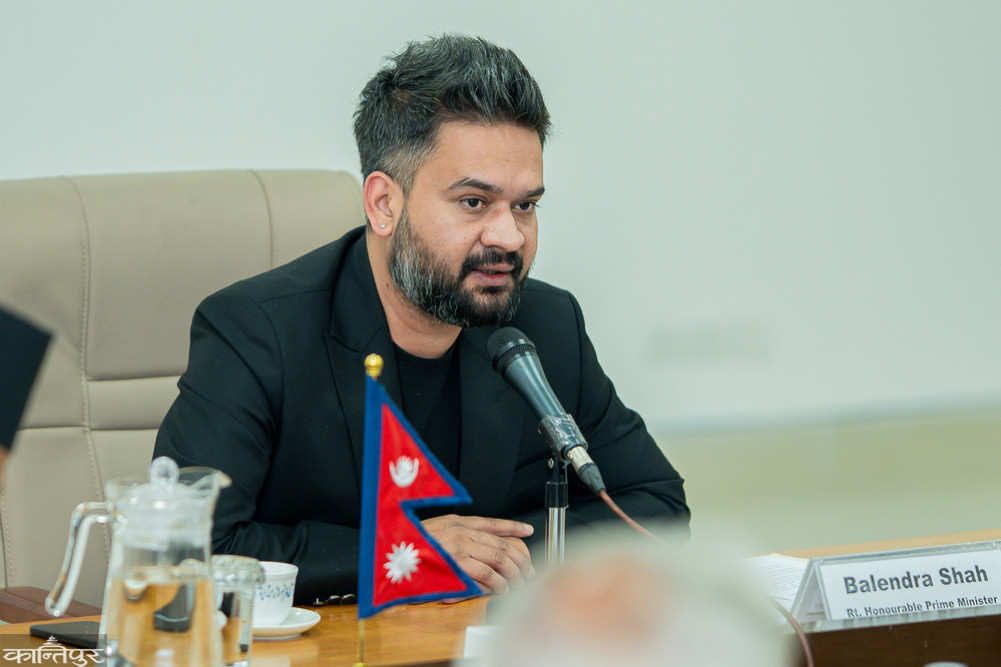
Four opposition parties have urged the President not to approve the laws recommended by bypassing Parliament, while the ruling Rashtriya Swayamsevak Sangh (RSS) claims that the government is trying to issue ordinances with the right intentions and objectives.
We use Google Cloud Translation Services. Google requires we provide the following disclaimer relating to use of this service:
This service may contain translations powered by Google. Google disclaims all warranties related to the translations, expressed or implied, including any warranties of accuracy, reliability, and any implied warranties of merchantability, fitness for a particular purpose, and noninfringement.
The government is moving forward with one ordinance after another to amend the law by bypassing the parliamentary process. The Council of Ministers, which sent two ordinances to the President's Office on Monday, recommended three more ordinances on Tuesday. The President has not yet issued the ordinances.
The Council of Ministers had recommended an ordinance on Monday to amend the Act on the Provisions of the Constitutional Council (Work, Duties, Rights and Procedures), 2066 BS, and the Cooperatives Act, 2075 BS. On Tuesday, ordinances amending the University Act, the Health Sciences Academy Act, and some Nepal Acts were recommended. According to an official from the President's Office, employees have been informed that some more ordinances will be issued.
According to Deepa Dahal, the Prime Minister's Press and Research Expert, an ordinance has been recommended to amend 20 acts under some Nepal Acts. According to Deepa Dahal, the Prime Minister's press and research expert, some ordinances have been recommended to amend 20 acts under Nepal Acts. These include Education, Civil Service, Land Revenue, Land (Survey), Technical Education and Vocational Training Council, Citizen Investment Fund, and Nepal Academy of Science and Technology Act. The ordinance is also going to amend the University Grants Commission, Health Services, Foreign Employment, Federal Parliament Secretariat, Land Use, Forest, Public Procurement, Insurance and other acts.
According to an official in the Prime Minister's Office, an ordinance to amend some university-related acts has also been recommended, including the acts of 16 universities. Similarly, the acts of 7 institutes are going to be amended through the ordinance to amend some acts related to the Health Sciences Academy.
The official said that the provisions related to the termination of the term of office of officials in universities and institutes are going to be amended through the ordinance. All universities and institutes have the provision of a vice-chancellor and registrar, and some even have the post of rector. There is a legal provision that the term of office of all of them is four years.
An official in the Prime Minister's Office said that the ordinance is going to amend the law by terminating the term of office of officials of universities and health sciences institutes and paving the way for new posts. ‘The ordinance does not provide for the term of office of the office bearers,’ he said.
The Supreme Court has issued interim orders many times stating that appointments with fixed terms cannot be dismissed before the end of the term, so the government may have adopted a clever approach, said a legal practitioner. Arrangements are also being made through the ordinance to dissolve student organizations of political parties in universities and health science institutes.
Dahal said that the government has brought forward the ordinance with the aim of making appointments in public bodies transparent and competitive, ending party politicization, accelerating public construction, returning the money of small savers of cooperatives, and making services including land, land revenue, and surveying more effective. Dahal, the Prime Minister’s press and research expert, informed that an ordinance has also been recommended to amend the act to make special provisions for the dismissal of public officials appointed and nominated in the past based on political influence and access. However, it has not been disclosed whether this ordinance has reached the President’s Office.
The four opposition parties urged the President not to approve the recommended acts bypassing Parliament, and the ruling Rashtriya Swayamsevak Sangh (RSS) claims that the government is trying to issue the ordinance with the right intention and purpose.
According to a source at Sheetal Niwas, the ordinance has amended the existing legal provision that requires the registration of land to be done at the Land Revenue Office and has given the authority to the local level. The Forest and Parks Act has been amended to include special provisions related to land use of national forests in the ordinance. Arrangements are being made to abolish trade unions with party affiliations by amending the Civil Service Act.
The Presidential Office has sent the ordinance on cooperatives recommended on Monday back to the government for correction and sending, saying that it has many linguistic errors. ‘The ordinance on cooperatives is timely, it is also necessary. But in the ordinance sent by the government, there were discrepancies in the clauses and the language, and the word ‘government’ was written where it should have been called cooperative,’ said an official from the President’s Office. ‘If we reconcile this, we may be accused of forgery. That is why we have asked the government representatives to reconcile and send it.’ The official said that there is no problem in issuing the ordinance on cooperatives as the President has already studied it. President Poudel himself, his legal advisor and staff are studying the other ordinances against the provisions of the act.

As recommended by the Cabinet decision of 8 Baisakh, President Ram Chandra Poudel had called the Federal Parliament session for 17 Baisakh. However, on 10 Baisakh, the Cabinet had recommended the postponement of the Parliament session, and accordingly, a notice of the postponement of the session was issued.
Opposition party leaders have drawn the attention of President Poudel not to issue the ordinances recommended by the government. A joint meeting of the Congress, UML, NCP and RPP was held at Singha Durbar on Wednesday to discuss this matter. 'We sincerely request the President not to approve the ordinances as they were recommended with the intention of deceiving Parliament,' the joint statement issued by the four parties states.
The most complicated issue for President Poudel has been the ordinance related to the Constitutional Council. According to an official at Sheetal Niwas, the President plans to discuss it with constitutional experts on Thursday or Friday to understand the legal opinion in this regard.
[Related_News_Section_3]
‘There is a problem of whether the President will maintain double standards in the ordinance related to the Constitutional Council. Earlier, the bill passed by both houses of parliament and brought for verification was returned by the President, saying that it was against the spirit of the constitution. The ordinance recommended by the Sushila Karki-led government last November with the exact provisions of the same bill passed by parliament was put on hold,’ the official said. ‘The President plans to discuss it with constitutional experts once on what to do this time.’
The most complicated issue for President Poudel is the ordinance related to the Constitutional Council. According to an official at Sheetal Niwas, the President plans to hold discussions with constitutional experts on Thursday or Friday to understand the legal opinion in this regard.