The government has taken the displaced people to the Dasharath Stadium in Tripureshwor. Some have gone to find shelter on their own. So far, 68 families from Thapathali have been contacted, and residents of other areas are also continuing to come in contact.
We use Google Cloud Translation Services. Google requires we provide the following disclaimer relating to use of this service:
This service may contain translations powered by Google. Google disclaims all warranties related to the translations, expressed or implied, including any warranties of accuracy, reliability, and any implied warranties of merchantability, fitness for a particular purpose, and noninfringement.
‘Who are you going to Kirtipur? Don’t bring anything except your clothes and bedding. Leave it where it is,’ a city policeman was saying inside the Dasharath Stadium on Saturday.
58-year-old Hira Hari Dusadh, who was leaning against the wall and shaking, started asking the police, ‘What will happen to the belongings you took out of your house?’
‘Are you also going to Kirtipur? I will give the belongings to the Kawadi later,’ the city policeman replied.
Hira was speechless. A vehicle going to Kirtipur for temporary accommodation was waiting outside the gate. ‘How can I leave my belongings and go?’ he said in a somber voice.
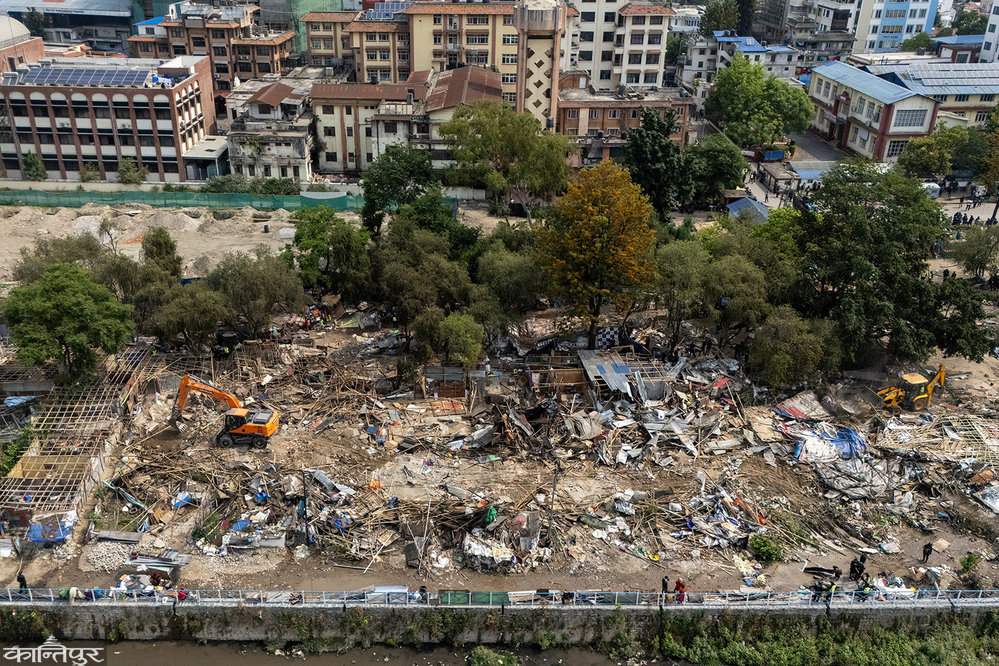
The displaced people including Hira had reached the stadium after the house they had built on the banks of a river in Thapathali with years of sweat and tears turned into mud on Saturday.
Hira had been living in the slums of Thapathali with his family of 9 since 2061. He had made the hut, which he had put together piece by piece with his hands, habitable. But on Saturday, a dozer demolished the hut before his eyes. ‘I feel very sad,’ he said tearfully.
There was no house and land in Bara. He had come to Kathmandu struggling and was still struggling with the problem of housing. At that time, he had built a bamboo hut in the slums. ‘Now everything has been uprooted. We are homeless again,’ he sounded even more sad, ‘Now we are the government’s refuge. We should have been given a place to live.’
The story of the ruined house like Hira’s had begun on Saturday morning. Before 6 am, the pleading of the locals was mixed with the strange sounds of the Sukumvasi settlement in Thapathali. The Nepal Police, Armed Police Force and Metropolitan Police Force were deployed outside the settlement.
The people on the riverbank were thinning out, the number of security personnel was increasing.
By 6:19 am, not only the security personnel but also the number of media personnel had increased. But no one was allowed to enter the settlement. A ‘media zone’ was posted on the wall outside the settlement. The media personnel were sitting in that zone and recording the scene.
After hearing the pain-filled voices inside the settlement, the Kantipur team bypassed the security personnel and entered. There was silence inside. As per the government order, some had already left the settlement on Friday. Those who remained had nowhere to go. Since morning, some were removing the roof tiles, some were carrying blankets and bedding. Some were removing their belongings, while others were sitting there unable to remove them. Their only question was, ‘Where to go now?’
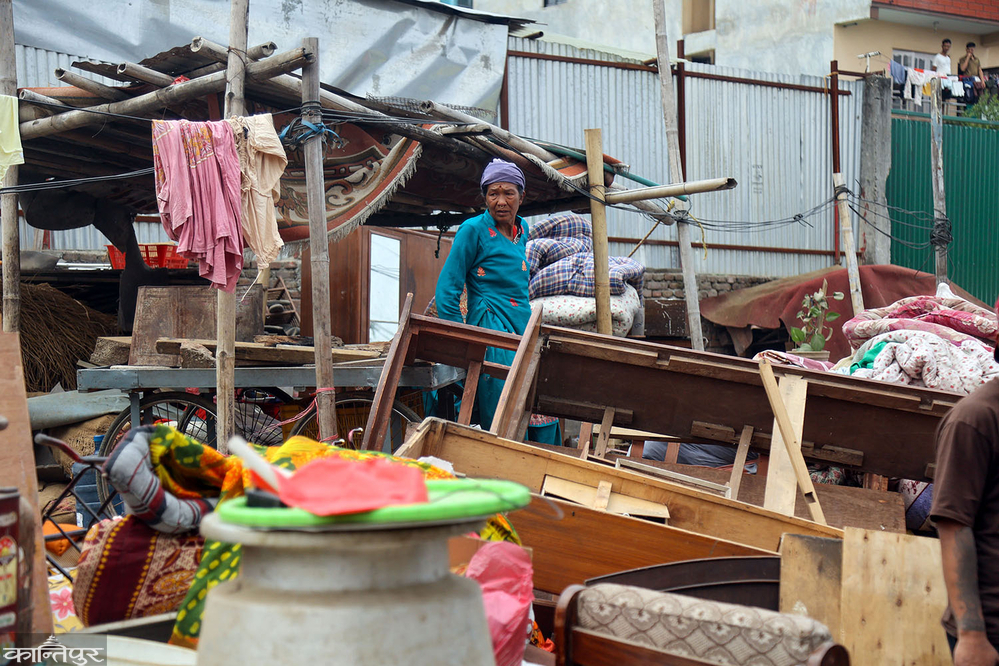
Even in the bright rays of the morning, their faces were dark. 43-year-old Kumari Tamang was among those who felt that darkness. She had been in this slum for 24 years. There were worn-out sheets of tiles and broken belongings around her. There was no decision on where to take those belongings. ‘What will I do if this too is destroyed,’ Kumari said in a frightened voice.
Her father had passed away just 6 days ago. On top of that, Sanima’s back is broken. She needs care. But the government’s harsh measures have left them helpless. ‘We have small children, where are we going to take them!’ She was crying.
While Kumari was speaking, a team of Nepal Police arrived. They asked, ‘Have you moved the belongings? The dozer is about to arrive.’
Kumari angrily replied, ‘We have removed them, what else can you say?’
Her eyes were filled with complaints that the state had destroyed the house without proper management. ‘We have raised our children here by sitting here and suffering. Now what will we do if they suddenly tell us to leave,’ she cried.
52-year-old Pakcha Tarim Kasai was next to Kumari. He is disabled. Even after 8 o’clock, he had not been able to move his belongings out. ‘I have been living here for 20 years. Now they are telling me to leave. My legs don’t work. Where to go in such a situation?' he complained.
Some police arrived to take out the butcher's goods. It was easy to take out the goods, but there was a problem of where to put them. A team of Metropolitan Police came miking. 'Quick, quick, now the dozer has arrived,' the miking spread fear among children and the elderly. The team of Metropolitan Police and Nepal Police who were miking forcibly took out the journalists who were reporting inside.
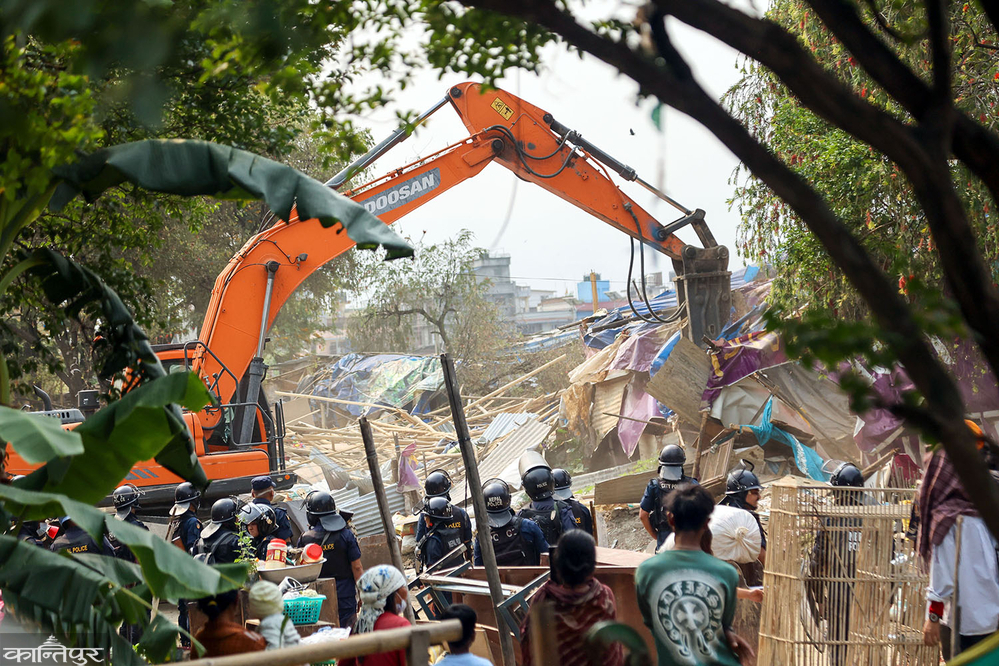
At 8:15 in the morning, two large red dozers appeared on the road in front of the settlement. Security personnel were gathered around the dozers. Within a few minutes, the dozers started demolishing the huts. Kumari could not hold back her tears when the dozer bucket hit the settlement that was visible from the road.
The dozer entered the settlement full of dreams, hopes and aspirations and it was destroyed in a flash. People's cries were continuously heard from inside the destroyed settlement.
After the settlement was destroyed, the police posted a photo of the locals helping them on their official Facebook page. But they neither took pictures of the locals' cries themselves nor allowed the media to take pictures.
After demolishing the squatter settlement in Thapathali, the Kathmandu Metropolitan City's bulldozers reached Gairigaun in Shantinagar. 70-year-old Bishnumaya Gurung, who was watching the bulldozer demolish her own house, was in tears. Kantipur asked Bishnumaya, who was sitting outside on her scattered belongings, "Where are you going now?" "Where will the destroyers take them?" was her answer.
Bishnumaya's family had not yet managed to remove all the belongings. Nepal Police helped remove the remaining belongings. They removed the belongings, but where will they be kept? They were in a state of shock. ‘We came here from Samakhusi in the year the king died (058). We had nothing,’ Bishnumaya recalled the time she first entered the settlement, ‘I, the old man and my son are all disabled. We were living here because we could not work or pay the rent.’
The ground was shaking with the sound of the dozer demolishing the house. Some pleas were mixed in with that sound. ‘Grandma, the house was demolished. We are looking for a room. Will you put it somewhere!’ A man was telling his daughter on the phone about his grief. His wife, who was with him, was sobbing and crying. Her little daughter was also packing her belongings and shedding tears. As they entered the settlement, everyone’s eyes were filled with fear, haste and tears.
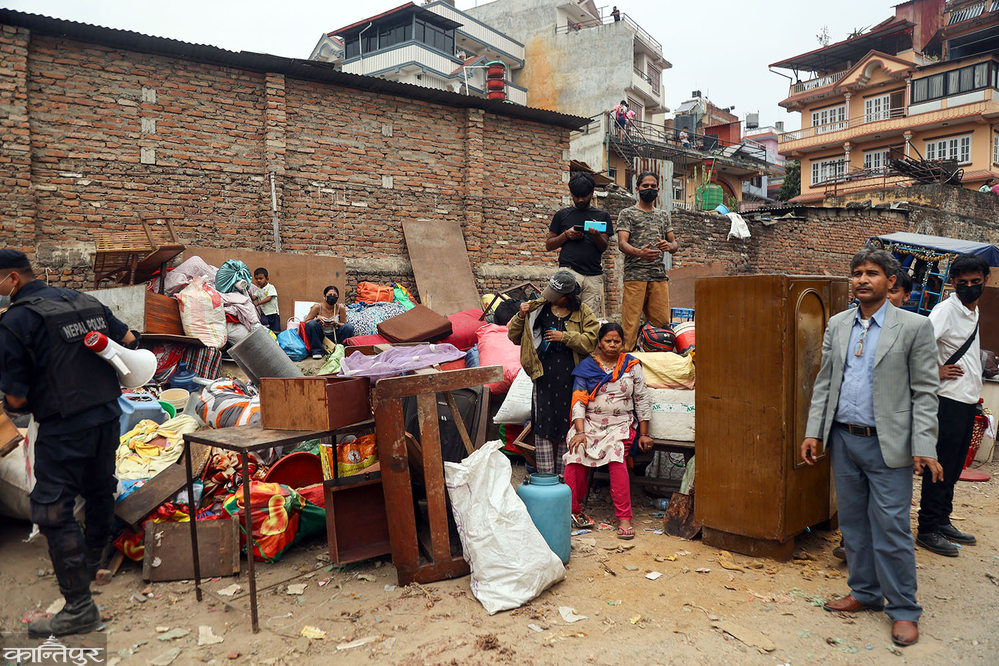
A 10-year-old girl was asking her father inside the empty room of the house, ‘Dad, where should we go now?’ She and her 13-year-old sister were helping her father move the belongings from inside. The father did not have an answer to her daughter’s question. ‘Let me take these belongings, the way is not clear. Where should I put them,’ he kept saying incessantly while looking around.
The girl was pointing to an empty space to her neighbor, asking, ‘Auntie, are you going to keep the belongings here?’ When she got the answer, ‘We are also keeping them there,’ she ran away. ‘Dad, can you keep them there?’ She suggested to her father, who was sitting there helplessly, ‘Dad, call your aunt and uncle. Let’s take these belongings there for a few days, shall we?’ She herself took out her mobile from her father’s pocket and called her relative. She went to the corner of the house and told her father, ‘Auntie, please speak.’
The girl’s father was telling her sister about the problem. The girl waved to her neighbor who was packing her things in the car and was ready to walk on the road and said with a smile, ‘Where are you going, sister? Go well.’ They had loaded their things and left after finding a room somewhere.
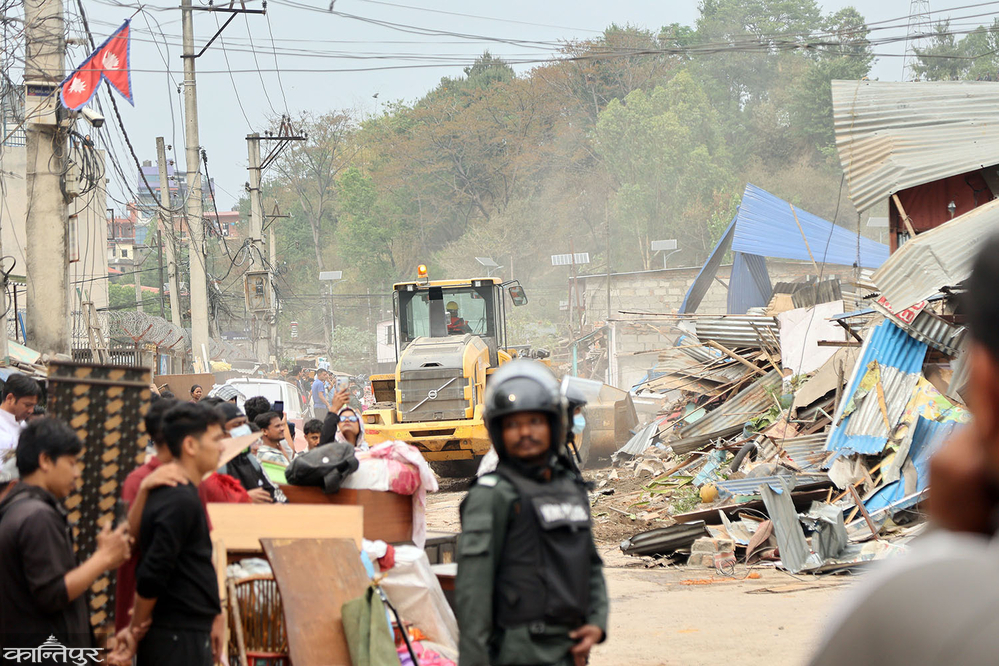
Some of the children were in their own world. Some were taking out bags and books. Some were playing.
When we reached Gairigaun in the morning, there were more than 10 goats outside the house of 70-year-old Krishnamaya Tamang. Krishnamaya was looking at the goats and grumbling, ‘These people raised us. Now they are going to be in trouble. And, ours too.'
Krishnamaya's family had arrived in this settlement from Hokse in Kavre in 046 BS. They had started raising goats in a small hut. Krishnamaya's family supported themselves by selling the increasing number of goats and their manure. There was also a dog inside the hut. 'Earlier, there was a fear that gas cylinders and cooking utensils would be stolen here. That's why I brought the dog. Now where will I take it too!' Krishnamaya looked worried. She had stopped liking food since the day she heard the news that the dozer was running.
When she reached the settlement in the afternoon after the dozer arrived, Krishnamaya was not seen. There were no goats either. The dog was sitting in the courtyard.
In the morning, the women around were talking face to face from their houses. They were saying, 'We have lived together for so many years.' Where are you now? Where are we? We should be talking.’ Dogs were also kept in other huts. The neighbors were lovingly telling the dog sleeping inside the empty house, ‘Now we don’t know where to go, where should we take you?’
In the morning, Krishnamaya Damai had expressed her pain to Kantipur, ‘My husband is sick. We haven’t found a room yet. We are in a lot of pain.’ Her heart, which had been pounding repeatedly to see if the bulldozer had arrived, finally broke down when the bulldozer finally arrived. ‘Now everything is over. We are homeless,’ she said crying.
Dhadkan Yadav, who has lived in this place for 22 years, had only one worry. ‘Where will we go now? Where will we educate our children? The government has made us suffer.’ Can it give you happiness?’ He stood there with many questions.
50-year-old Sukumayya Pariyar urged the government to convey her grief to Kantipur. ‘They don’t listen to our voices. Will they listen to yours?’ Sukumayya said, ‘I have a heart condition. I’m going to get sicker.’ She was talking to her son-in-law about the room. ‘Look for a room yourself, my daughter-in-law said there is a room available. The rent is 14-15 thousand rupees. How can you pay that much money?’ Sukumayya said, ‘Still, I have to stay, maybe I will get some support later!’
Sukumayya, who hails from Sindhuli, had earned a living by earning land rights from others for a long time. The earthquake destroyed her house. Poverty added to poverty. Then she left her place and fled. ‘Life was meant to be a fugitive, sir,’ she said emotionally.
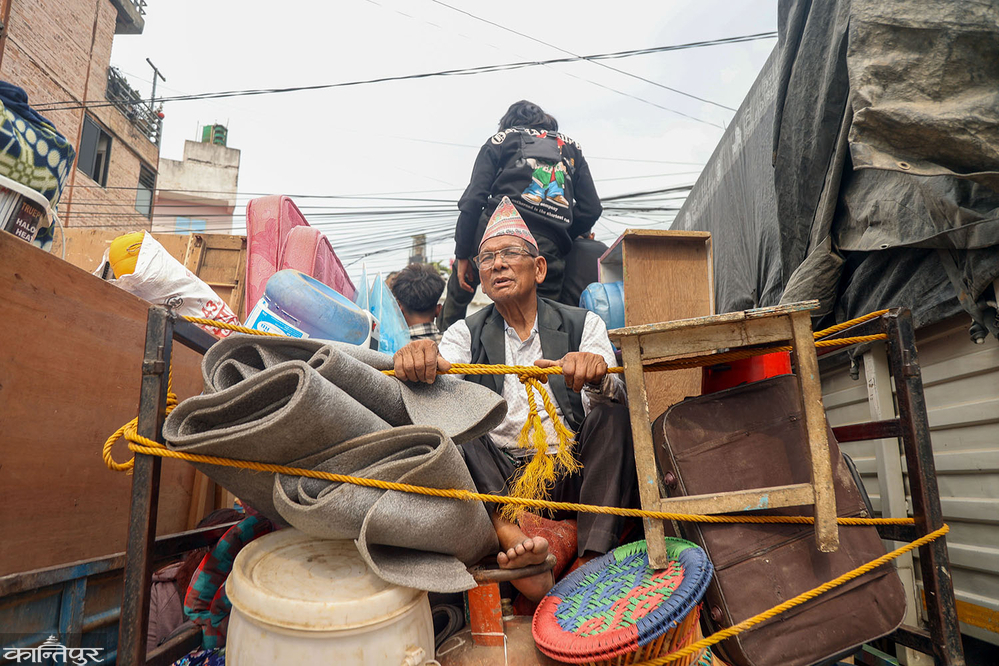
In the morning, Tirtha Shrestha took Kantipur to his house after walking along the banks. He had a grocery shop. ‘We had done our duty without harming anyone. The government was going to take everything away,’ she complained, ‘We have no land, no branches to hold it. Who would have become a squatter out of greed!’
He had come to Kathmandu in 042 BS after not being able to find food and shelter in Ramechhap. ‘Our village had 5 ropanis of paddy fields, but that paddy field was of no use to a family of 9. There are still no roads and electricity facilities there,’ Tirtha explained the reason for staying here.
Shrestha's family had been living in Gairigaun since 2008. 'This place was not so good before, water would freeze. It was a place where dead people were swept away. We made it habitable with hard work. All the money I had earned and saved so far was spent on building this house,' said Tirtha.
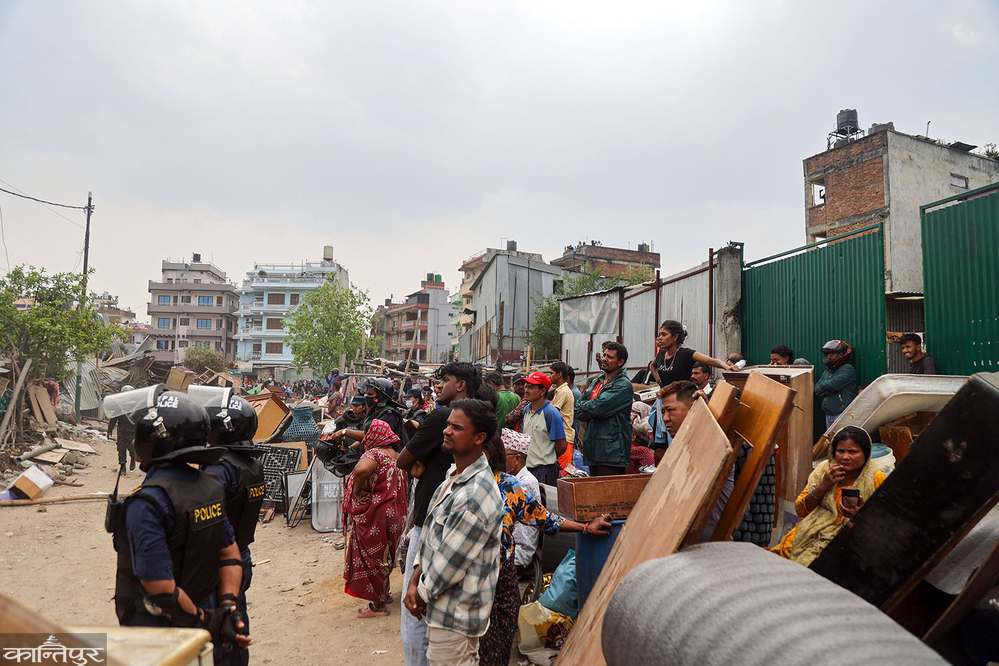
The government had demolished the house three or four times before. But they had put up with it. After not having to pay the rent and their children studying in government schools, they were barely making ends meet. 'We ordinary people cannot fight the government, but where will they take us if we leave this place where we have worked hard and earned our lives?' He feels sad thinking about the uncertain future.
The scenes of Thapathali and Gairigaun were repeated in Manohara. The government is also preparing to evacuate the settlements of Gothatar Buddha Chowk and Manohara Tole. According to the Kathmandu Valley Development Authority, there are 476 families living in Shantinagar, 162 in Gairigaun, 143 in Thapathali, 77 in Gothatar and 13 in Manohara Tole. A total of 871 families are affected by all these areas.
The government has taken the displaced people to Dasharath Stadium in Tripureshwor. Some have gone to find shelter on their own. So far, 68 families from Thapathali have been contacted, while residents of other areas are also continuing to come in contact. The families who have come in contact will be brought to Dasharath Stadium to collect their details and then temporarily housed in various hotels in Kathmandu. Their household belongings have been kept safely at the Radhaswamy Satsang Vyas Nepal premises in Sundarighat, Kirtipur, according to the Prime Minister's Office.
The government has said that the identification process to determine whether the families being kept in the hotel are genuine squatters or not will begin on Sunday. The families of those who have been identified as actual squatters are being prepared to be shifted to government apartments in Nagarjuna Municipality-1 and other safe places within two weeks. After that, their long-term rehabilitation and management will be taken forward, the Prime Minister's Office has stated.

