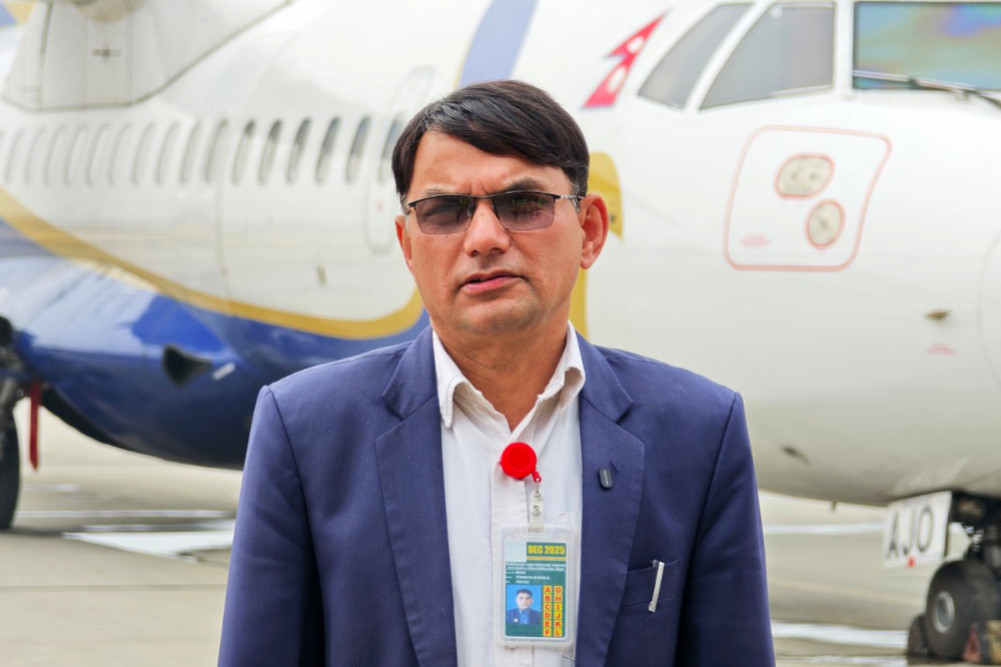
The photo pass used at Tribhuvan International Airport expired in December 2025. However, the new card did not arrive on time. As a result, nearly 14,000 people working at the airport have been forced to work with old, expired cards for four months.
We use Google Cloud Translation Services. Google requires we provide the following disclaimer relating to use of this service:
This service may contain translations powered by Google. Google disclaims all warranties related to the translations, expressed or implied, including any warranties of accuracy, reliability, and any implied warranties of merchantability, fitness for a particular purpose, and noninfringement.
There was a special scene on the eastern apron of Tribhuvan International Airport that day. Buddha Air was bidding farewell to its first ATR-72 aircraft, which it had purchased 16 years ago. It was an emotional moment in Nepal's private aviation history.
An aircraft that had spent its entire life flying. The aircraft, which carried the memories of mountains, Terai, weather, fog, and thousands of passengers, was being retired from service. What's more interesting is that not only in Nepal, but for the first time in the world, an ATR-72 aircraft was being retired after completing 70,000 cycles.
So the ceremony was not ordinary. Buddha Air employees, officials of the Civil Aviation Authority of Nepal, foreign guests, and representatives of the aviation sector were all there. Stefano Marazzani, Senior Vice President of ATR Company, himself attended the ceremony.

However, on that day of the historic departure of the plane, another scene was equally clear inside the airport - the passes hanging around the necks of most of the participants in the program had expired.
People were moving easily in the most sensitive area of Nepal with identity cards that had expired three months ago.
‘ID cards are not a big deal. But the airport is a sensitive place. And everyone who entered there had their passes that had expired for three months,’ said a person who participated in the ceremony, ‘We Nepalis are used to it. But how must the foreign guests have felt? Everyone was attending the program carrying fake, expired cards.’
Ironically, the official of the body responsible for the main responsibility of this pass system was also in the same situation. Teknath Sitaula, who is the head of the airport on behalf of the Civil Aviation Authority of Nepal, was seen attending the meeting with an expired pass. It was clear from afar that his card had expired (December 2025).
14 thousand people, one problem
The photo pass used at Tribhuvan International Airport expired in December 2025. However, the new card did not arrive on time. The result - nearly 14 thousand people working inside the airport have been forced to work with old, expired cards for four months.
Of these, 31 are employees of international airlines. 21 are employees of domestic fixed-wing and helicopter companies. Ground handling staff at Nepal Airlines Corporation, Nepal Police, Customs, Immigration, airport tea houses, coffee shops, sanitation staff, and designated employees of foreign embassies are moving around the airport every day carrying these old cards.
The number of people working inside the airport is large. According to the airport office, 170 agencies including government, private, security agencies, airlines, taxis are active here. About 5,000 employees work in three shifts in a 24-hour period.
However, despite such congestion and high sensitivity, the entry system has been stuck on expired papers for four months.
'Every day there is a hassle when going to the cockpit'
The biggest problem is faced by employees of foreign airlines. According to an employee of a foreign airline in Kathmandu on Sunday afternoon, they have to reach the cockpit of the plane every day. They have to submit load sheets, flight documents, and safety documents. However, the cabin crew has been 'stopping' after seeing the expired card.
'We have to enter the cockpit of the plane every day. We have to submit the documents. "But, the cabin crew stops it when they see that the card has expired," another airline employee said on Sunday evening. "Then it takes time to explain it to the cabin crew. Newly arrived foreign employees have even more problems. They need to be reminded why this is happening. It is an insult to the country."
Employees of foreign airline companies regularly go abroad for training, seminars and meetings. When they go there, they feel embarrassed when they have to show that the card issued by Nepal's airport is old and expired.
The Airlines Operators Community Nepal (AOCN), an organization of station managers of international airlines working in Kathmandu, has also raised this issue with the airport management repeatedly. According to an AOCN official, the card has been extended twice 'through the system' after its actual expiration date.
The first time the time was extended until February. Then the airport administration asked for another period of time till May 31, i.e. Jestha 17. However, the problem was not solved immediately. Because the date printed on the card is old.
So Kathmandu Airport wrote a separate letter to the foreign airline company - asking them to temporarily recognize the old card. The foreign airlines sent that letter to their headquarters. Their Kathmandu-based employees are moving around the cockpit, boarding area and apron of the aircraft by showing the same letter.
Even when Nepali workers cleaning the aircraft have to enter the foreign aircraft, the same letter has started becoming the basis. That is why the cabin crews of those aircraft are even suspicious of the cleaning staff.
Pass contract, delay and mutual quarrel
The responsibility of printing the photo pass of Kathmandu Airport is vested in Babarmahal-based Marsyangdi Enterprises Pvt. Ltd. According to the company's director Sandesh Thapa, this company has been the sole supplier of the pass printing contract for the past 10 years.
According to Thapa, the new card should have been distributed by January 2026. However, the process was stopped due to a dispute between employees within the airport.
'It's not because of us,' Thapa said, 'The delay was caused by a dispute between airport employees. We did not stop the work.' According to him, the company had already printed 13,000 passes to the airport by December 2025. Surprisingly, an order for 1,470 more passes has come by the same deadline. 'We have been asked to print more passes by December 2025. We are still printing the same,' Thapa said, 'What should we do?'
This pass is not an ordinary paper card. Marsyangdi has installed a printing machine inside the airport. The card uses a chip. The chip contains the employee's name, organization, photo, and details of which areas they can go to. According to Thapa, the chip and blank card required for the card are purchased from Barcode Inc. Nepal in Anamnagar.
Marsyangdi gets Rs 647 for making a photo pass. However, employees working at the airport have to pay a fee of about Rs 1,500 including tax.
42 doors can be opened with a single card
This card used at Tribhuvan Airport is not an ordinary entry pass. According to Kiran Gautam, Director of the Aviation Security Division, a single photo pass can open about 40 to 42 doors at the airport. This card is used at various doors, flap gates, service areas, aprons, and restricted areas of the domestic and international terminals.
In this sense, an expired card is not just an old piece of plastic. It is access to sensitive areas of the airport. The organizations that take the most passes at Kathmandu Airport are Nepal Airlines Corporation, Buddha Air and Nepal Police. These agencies alone have made cards with at least 1,000 photos.
Lessons from 26 years ago, current neglect
The issue of airport security is not new to Nepal. After the hijacking of an Indian Airlines plane 26 years ago, the government formed a high-level investigation committee. The committee, led by retired Inspector General of Police Hem Bahadur Singh, made detailed suggestions about the security, structure and entry system of Tribhuvan Airport.
At that time, the committee also made it clear about passes - only those with tickets and entry permits should be allowed to enter the check-in counter. Security personnel should be stationed at all entrances to the airport. They should have walkie-talkies. And, all entry systems should be strictly regulated.
At that time, handwritten passes were used at the airport. Now, technology has changed. Radio Frequency Identification-RFID-cards with photos are used . Currently, there are 8,400 digital cards active at the airport .
However, even though technology has changed, the problem has not changed . Earlier, handwritten passes were a weakness . Now, the lack of a new system even after the expiration of the digital card has become a big problem .
'Now we print passes ourselves'
According to the acting general manager of the airport, Teknath Sitaula, the process of printing new cards has now been moved forward rapidly . 'There was already a delay before I was transferred to the airport,' he said, 'I have already moved forward the tender process .'
According to a high-ranking official of the airport, the problem of delays in printing cards through private companies, problems in the tender and the process being stuck due to commissions is recurring . So now the Civil Aviation Authority of Nepal has planned to print the passes itself.
‘Every year, the country is humiliated when there is a delay,’ the official said, ‘Now we are preparing to print the cards ourselves.’ Preparations are also being made to inform Tourism Minister Khadak Raj Poudel about this.’ Meanwhile, the police at the airport are also pressuring to issue new passes in every security meeting. According to a security official, the airport management is reminded of this issue in every meeting. Because the validity of the pass issued at the airport is two years. If an employee is transferred, leaves his job or changes agency, his access should be removed from the system immediately.
However, when an expired card continues to be used for months, the question arises as to whose access to the system is actually still available and whose should have been removed. On March 9, Buddha Air’s ATR-72 said goodbye with the memory of its last flight. The plane, which had completed 70,000 cycles, had reached the end of its life. However, on the same day, another system at Tribhuvan International Airport was also seen operating artificially despite its lifespan - the airport's identity card system. An aircraft used up its entire life and received a respectful farewell. However, the security system at Nepal's international airport is still stuck with the old card even after its expiration date.