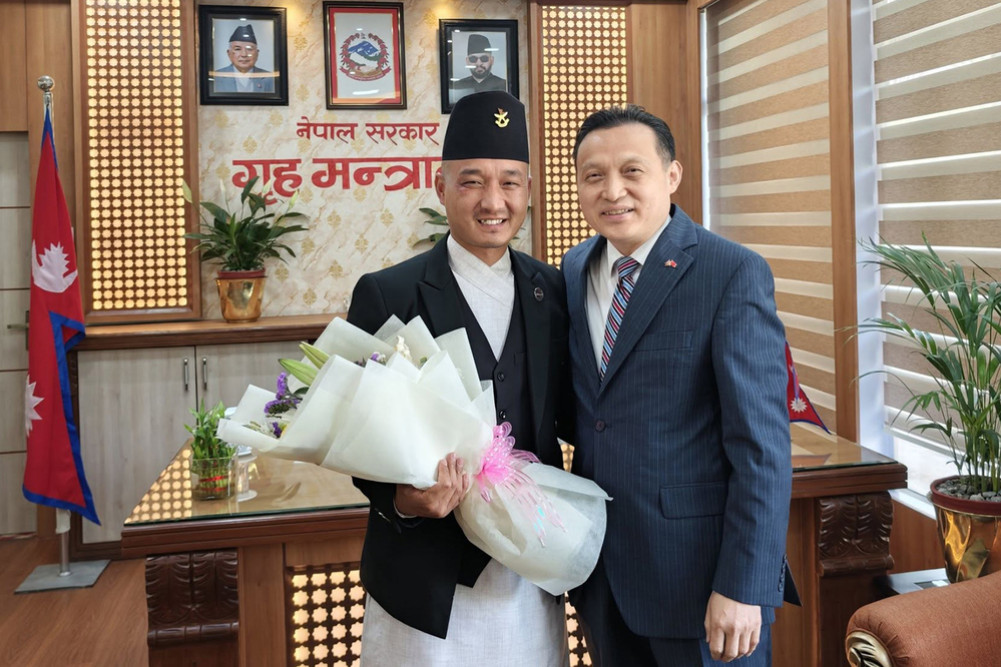
During the meeting with the Home Minister, the Chinese ambassador expressed interest in the government's participation in the oath-taking ceremony of the Tibetan leadership and expressed concern over Taiwan-related activities in Kathmandu.
We use Google Cloud Translation Services. Google requires we provide the following disclaimer relating to use of this service:
This service may contain translations powered by Google. Google disclaims all warranties related to the translations, expressed or implied, including any warranties of accuracy, reliability, and any implied warranties of merchantability, fitness for a particular purpose, and noninfringement.
Chinese Ambassador to Nepal Chang Maoming held an 'informal but frank' conversation with Home Minister Sudhan Gurung on Monday. In which he raised various concerns regarding Tibet and Taiwan activities in Nepal and sought assurances that Kathmandu would not become a platform for foreign interests against Beijing. According to two officials present at the meeting, the Chinese ambassador raised issues including the registration status of Tibetan refugees in Nepal and the ongoing 'separatist' activities of Tibetans living on Nepali soil. An official present at the meeting said, 'He also drew the Home Minister's attention to reports about Taiwan-related activities in Kathmandu. In particular, he mentioned the issue of someone briefly displaying the Taiwanese flag at a cultural program organized in the capital last month.' An official from the Home Ministry and the Foreign Ministry gave this account of the meeting to Kantipur on condition of anonymity. Representatives from 11 countries and regions, including Taiwan, Germany, South Africa and Estonia, participated in the 13th International Folk Festival organized by the Everest Nepal Cultural Group on March 28. The Taiwanese flag was hoisted for a while at the event, which was removed after protests. Home Minister Gurung, who has been accused of supporting the 'TOB'-backed youths who were seen on the streets during last year's Gen-G movement, who are accused of being linked to Tibetan refugees, was congratulated by the ambassador at the beginning of this meeting on his new responsibility.
In October, Gurung had strongly objected to attempts to discredit his political campaign by linking it to the 'Free Tibet' movement and foreign powers.
The Chinese ambassador's main concern during the meeting was the swearing-in ceremony of Penpa Tshering, the head of the Central Tibetan Administration (Shikyong), to be held in Dharamsala, India, for his second five-year term. He drew attention to the fact that no level of the Nepalese government should participate in the ceremony.
According to an official, the ambassador had said, 'They can invite the Nepalese government to the swearing-in ceremony, so I would like to draw your attention to this matter.' Anand Kafle, spokesperson for the Ministry of Home Affairs, who attended the meeting, also confirmed the background to the conversation. 'In the conversation, the Home Minister clearly stated that Nepal will maintain its long-standing policy on Tibet and will not allow Nepal's territory to be used against China,' Kafle said. 'He has also assured that the government is ready to control such activities.' Home Minister Gurung also reiterated Nepal's commitment to the 'one China policy' and said that there will be no change in its position on Tibet and Taiwan. According to an official present at the meeting, the Home Minister told the ambassador, "We are committed to the sovereignty and territorial integrity of the country and will not become a foreign puppet." The meeting is seen as a sign of growing concern in China about Nepal's diplomatic practices, which have evolved since last year's Gen-G movement. After a video of the movement's youth wearing jackets with the words "TOB" written on them went viral on social media, police arrested some people associated with the group. One of them was seen arguing over citizenship. The Chinese embassy had previously expressed dissatisfaction with the frequent visits of some Rinpoches to Kathmandu. The Sushila Karki-led government had tried to limit such visits. According to officials, Beijing's interest seems to be a continuation of their previous understanding. Because after the successful election, Prime Minister Sushila Karki and Balendra Shah were congratulated separately by the Dalai Lama
and Penpa Tshering
after becoming Prime Minister. Chinese strategic affairs experts seem to understand the new power structure in Nepal and their inclination towards the 'West'.
According to former Nepali Ambassador to China Bishnu Pukar Shrestha, China is deeply interested in the congratulatory message given by Tibetan leaders to the Nepali Prime Minister. He said, 'The visit of the Dalai Lama's representative and the honor given in Kathmandu have irritated China.' They believe that a pattern of anti-China activities has been seen in Nepal in recent months.
Ambassador Chang also raised the issue of security concerns related to third countries, hinting that it could put China under siege. But he did not clarify which country.
Kathmandu Post did not receive a response when it repeatedly contacted the Chinese Embassy on Tuesday for a comment on the matter. *This has been corrected for a factual error. -Editor