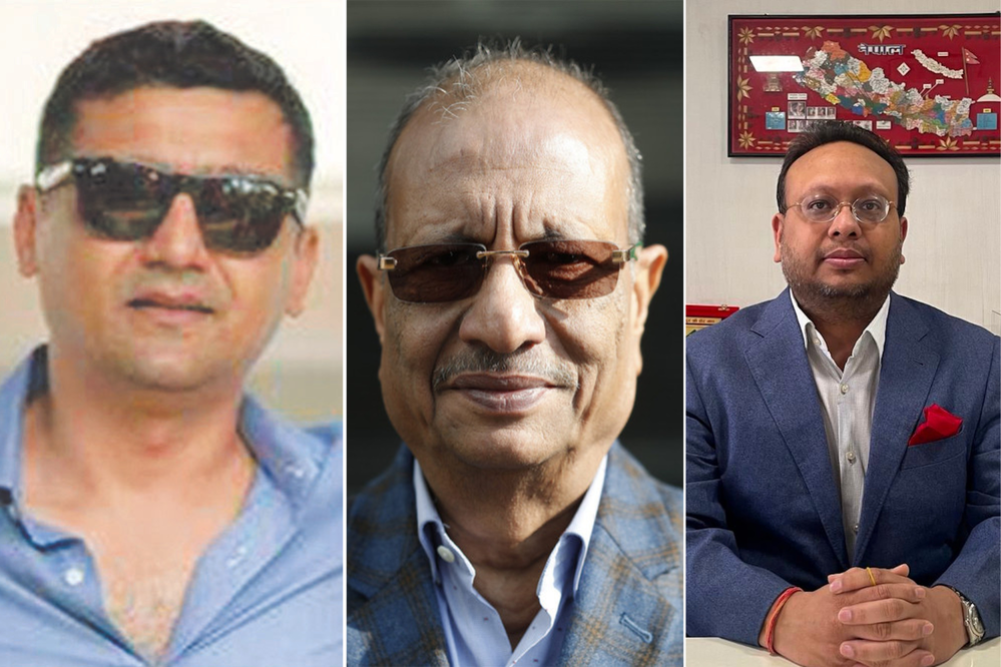
Dozens of industries, thousands of jobs, and huge debts are at risk as the Shankar Group, which has a nine-decade history, is dragged into a money laundering investigation following its partnership with Bhatta.
We use Google Cloud Translation Services. Google requires we provide the following disclaimer relating to use of this service:
This service may contain translations powered by Google. Google disclaims all warranties related to the translations, expressed or implied, including any warranties of accuracy, reliability, and any implied warranties of merchantability, fitness for a particular purpose, and noninfringement.
The nine-decade-old business family Shankar Group is in trouble after it was caught in the company of controversial businessman Deepak Bhatt. With Bhatt arrested for money laundering, the Shankar Group, which was in league with him, has also been brought under investigation. The chairman of this group, Shankarlal Agrawal, has been arrested, and the police are also searching for his sons.
As the investigation intensifies, more than 40 industries and businesses operated by the Shankar Group across the country will be directly affected. The annual turnover of the Shankar Group is Rs. 1.25 trillion. The industries and businesses under the group provide direct employment to more than 15,000 people. It is estimated that around Rs. 200 billion has been loaned to various industries and companies of the Shankar Group by banks and financial institutions.
Shankar founded the Jagdamba Group in 1979. Later, his two sons Sulabh Agarwal and Sahil Agarwal also joined the business. Sahil Agarwal is the chairman of the Jagdamba Group, while Sulabh is the chairman of ‘Jagdamba Holdings’ under the Jagdamba Group. The Shankar Group has been in business continuously for 91 years. The group was born in 1935 when Rawatlal Agrawal brought and sold clothes from abroad on Kathmandu New Road. His son Shankarlal Agrawal expanded that business into a business family and took it to new heights.
The main companies under the Shankar Group are Jagdamba Steels, Jagdamba Motors, Saurya Cement, Riddhisiddhi Cement, Union Life Insurance, Himalayan Reinsurance, Jagdamba Enterprises, Jagdamba Floor and Agro, Jagdamba Mobiles, Jagdamba Alcobev, Jagdamba Overseas, Modikhola Hydropower, Balefi Hydropower and Jagdamba Hire Purchase. These industries and businesses are located from Kathmandu Valley to Jitpur, Simara, Bhairahawa, Lumbini, Parwanipur. The company’s website states that the companies under the Shankar Group had a total turnover of more than 1 billion US dollars (about 11 thousand crore rupees) in 2020/21.
Shankar founded the Jagdamba Group in 1979. Later, his two sons Sulabh Agarwal and Sahil Agarwal also joined the business. Sahil Agarwal is the chairman of the Jagdamba Group, while Sulabh is the chairman of ‘Jagdamba Holdings’ under the Jagdamba Group.
Jagdamba Steel Industry opened in Simara, Bara in 1994 under the Shankar Group. Currently, there are more than two dozen iron (steel) industries in the market. Industrialists say that Jagdamba’s share in the total iron rod turnover is more than 20 percent.
When the controversial Bhatt took refuge...
Sulabh has been dragged into the scope of the money laundering investigation, while no formal details have been made public about Sahil.
Home Minister Sudhan Gurung has made public a list of 10 people on social media, saying that they have been arrested so far. In which the name of former Prime Minister KP Sharma Oli is at number one and the name of Sulabh is at number 10. However, the Money Laundering Investigation Department, the Central Investigation Bureau of the Police and the Nepal Police have not confirmed the arrest. “There is information that Agarwal has been arrested in India and is being brought to Nepal via land,” said an official of the department. “The police will provide official information about Agarwal’s arrest after he is brought to Nepal.”
The Jagdamba group alone has taken loans of more than Rs 30 billion from banks and financial institutions. Banking sources have informed that the total loan is around Rs 100 billion when the loans taken by the businesses operated in partnership with Deepak Bhatt and Shankar Group are added.
This group was doing business in its own way before becoming friends with the controversial businessman Bhatt. They were earning good money from business, but they did not have political access. Bhatt filled that gap. The friendship between Bhatt and Shankar group that started in this way complemented each other. This friendship facilitated Bhatt’s ‘cash flow’ while Shankar group was able to increase political contacts.
000
The Jagdamba group alone has taken loans of more than 30 billion from banks and financial institutions. When the loans taken by the businesses operated in partnership with Deepak Bhatt and Shankar Group are added, the total loan is around 100 billion, according to banking sources. The story of the meeting between Bhatt and this group is very interesting. It was the time of the Corona pandemic. There was an extreme shortage of ‘thermal guns’ to measure fever. On 25 Chaitra 2076, Shankar’s son Sulabh was arrested on charges of black marketing the same ‘thermal gun’. The police alleged that he had sold a ‘thermal gun’ worth five thousand rupees for 15 thousand rupees. At that time, the police had recovered 67 ‘thermal guns’ from him. Agarwal was also the honorary consul general of Kyrgyzstan.
At that time, the government had imposed a ‘lockdown’ to prevent the spread of Corona infection. There was a ban on the use of public and private vehicles. Agarwal, on the other hand, had misused his position and privileges and used a vehicle with the blue number plate of the diplomatic mission. The police concluded that he may have used a diplomatic mission vehicle since there were no restrictions or checks on his movement. However, Agrawal was caught before he could deliver the goods.
After Sulabh was arrested, this group finally realized the importance and lack of political access. Because Sulabh's arrest on that charge did not have a major impact on the business. However, the professional reputation earned through decades of hard work was dealt a major blow. Bhatta used his political access to free Sulabh. This was a great achievement for the Shankar group. After that, a business partnership began between Bhatta and the Shankar group. But this partnership was not formal or written. Bhatta used to arrange political access and settings, this group used to invest money.
The collaboration between them, especially to maintain dominance in the insurance sector, seems to be very 'successful'. Before 2071, there was no reinsurance company in Nepal. A lot of money used to be spent on reinsurance. On 21 Kartik 2071, Nepal Reinsurance Company was established with the joint investment of the government and insurance companies. The Emergency Insurance Fund established in 2060 was converted into a reinsurance company. Initially, the company was established with 43 percent of the government's share capital and 57 percent of the insurance companies' share capital.
The Shankar Group had already been eyeing the business of this company. At Bhatta's initiative, former Secretary Surya Prasad Silwal was brought in as the chairman of the previous Insurance Committee. The source claims that the main purpose of bringing him in was to provide the group with a reinsurance and insurance company license. 'During his tenure, Silwal fulfilled both conditions,' the source said, 'as a result, this group obtained the license of a reinsurance company and more than half a dozen microinsurance companies.' Thus, in Jestha 2078, Himalayan Reinsurance Company was established with a capital of 10 billion, in which the largest share investment is by Shankar Group and Bhatta.
The collaboration between Shankar Group and Bhatta did not stop there. Policies were started to be made in a way that was favorable to Shankar Group by interfering in the government's budget. In the fiscal year 2078/79, during the reign of the then Prime Minister Sher Bahadur Deuba, Finance Minister Janardan Sharma brought a supplementary budget, in which tax exemptions were given to Jagdamba Steels to the exclusion of other industries. At that time, some industrialists and businessmen protested, saying that the policy arrangements were made to benefit a particular business family.
Similarly, on 14 Jestha 2079, the night before the announcement of the annual budget for 2079/80, an incident came to light in Singha Durbar where middlemen were introduced to benefit vested interests by manipulating tax rates. Bhatta and Shankar groups were also involved in this manipulation. It was also alleged that industries and businesses under the Shankar group, with the help of Bhatta, took 'illegitimate profits' in these incidents. To confirm this allegation, suspicious transactions were made from bank accounts in the names of the directors of Bhatta and Shankar groups at that time.
Questions were also raised about their investment in Himalayan Reinsurance. Now, as the source and ultimate beneficiary of the same investment could not be identified, the Rastra Bank had sent a letter to the Money Laundering Investigation Department in 2078 to investigate the business transactions of both groups. Earlier, it was also alleged that both these groups had influenced the decision to revoke the reinsurance license by using 'power'. Questions were also raised about their investment in Himalayan Reinsurance. Now, as the source and ultimate beneficiary of the same investment could not be identified, the Rastra Bank had sent a letter to the Money Laundering Investigation Department in 2078 to investigate the business transactions of both groups. The investigation that was underway on the basis of that letter has now gained momentum. During the initial investigation into the suspicious transactions between Infinity Holdings and the Shankar Group during the period 2077 to 2079, the Financial Intelligence Unit (FIU) of Nepal Rastra Bank had sent a letter to the department to investigate after finding a complaint. In the letter, it was found that Bhatta's account in Siddhartha Bank had 'transferred' Rs 450 million from his account in Nepal Investment Bank to the name of Jagadamba Steel Pvt. Ltd. in June 2021.
Meanwhile, the audit report of Jagdamba Steel for 2077/78 also found that there was a transaction of Rs 450 million with Bhatta and his company. Similarly, it was found that Rs 300 million 1587 thousand was ‘transferred’ to an overdraft (OD) account in Bhatta’s name in June and July 2021 and Rs 450 million 445 thousand was withdrawn from this account. The Rastra Bank has mentioned in the letter sent to the Money Laundering Investigation Department that Bhatta invested this Rs 450 million in Himalayan Reinsurance.
However, there is no mention of the transaction of Rs 450 million in Jagdamba Steel’s financial report for 2077/78. On this basis, the Rastra Bank has considered Bhatta’s investment in Himalayan Reinsurance as ‘suspicious’. ‘The amount deposited in Deepak Bhatt’s account from Jagadamba Steels was deposited in the account of Infinity Holdings Pvt. Ltd., in which he is the sole shareholder, and the amount appears to have been deposited in the account of Himalaya Reinsurance through three checks on July 1, 2021,’ the letter sent by the FIU to the department states.
After that letter, the department had started an investigation and also recorded a statement from Bhatt. However, under pressure/influence from the power center, the department had stopped the investigation without concluding it. In Baisakh 2082, the department itself had decided not to proceed with the investigation file and sent it back to the Rastra Bank without conducting a detailed investigation. However, after the formation of the government on Chaitra 13 under the leadership of Balendra Shah, the department opened the file that it had previously closed, and the directors of two large business groups have come under investigation for money laundering. According to department sources, all suspicious financial transactions made by Shankar Group and Infinity Holdings have been brought under the scope of investigation. It is not yet clear whether this investigation will be limited to the partnership between Bhatt and Shankar Group or will extend to other industries and businesses of Shankar Group.