The issue of whether the 'urgent arrest warrant' to be issued in the case of escape or destruction of evidence was necessary for Oli and the writer is in dispute. The selective decision of the Council of Ministers to not immediately implement the recommendations of the Commission of Inquiry for those related to the security apparatus but to implement them only for leaders is an accusation of retaliation.
We use Google Cloud Translation Services. Google requires we provide the following disclaimer relating to use of this service:
This service may contain translations powered by Google. Google disclaims all warranties related to the translations, expressed or implied, including any warranties of accuracy, reliability, and any implied warranties of merchantability, fitness for a particular purpose, and noninfringement.
Former Prime Minister KP Sharma Oli and former Home Minister Ramesh Lekhak were arrested by the police from Gundu in Bhaktapur and Katunje in Bhaktapur on Saturday morning without a court-approved arrest warrant. According to Oli's legal practitioner, senior advocate Tikaram Bhattarai, the police issued an 'urgent arrest warrant' and took them into custody. According to the provisions of the Criminal Procedure Code, if there is a risk of escape or destruction of evidence if the arrest is not made immediately, the police can issue a warrant and arrest them, but no investigation can be carried out until such a warrant is approved by the court.
With such a legal provision, the question of what risk Oli and Lekhak faced if they were not arrested on Saturday morning has sparked debate in legal circles. Constitutional scholars and legal practitioners have raised the question of whether the urgent arrest warrant, which should be issued in the case of escape or destruction of evidence, was necessary in the case of Oli and Lekhak. When the court opens on Sunday morning, the police will first have to 'convince' the Kathmandu District Court why the urgent arrest warrant was needed.
Former Attorney General Khamma Bahadur Khati objected to the government's attempt to prosecute based only on the report, saying that it is not legally permissible to do so. 'The report is only a recommendation, it is not evidence,' he says, 'until the investigation establishes what negligence and negligence they committed, they cannot be arrested and a case registered.' Similarly, constitutional expert Purnaman Shakya says that the report of the inquiry commission led by former judge Gauri Bahadur Karki, formed to find out the truth about the incidents of Bhadau 23 and 24, is only an opinion and consultation for the government. 'The commission's report is only a recommendation, not evidence,' he says, 'the report is only an opinion and consultation for the government.' Senior advocate Bhattarai says that the police can investigate, but they do not have to prosecute for it. ‘They (Oli and Lekhak) cannot be arrested until the minimum facts are established that show their involvement in the incident,’ he says.
Senior advocate Bhattarai has questioned the validity of the warrant. ‘The arrest warrant is only issued if the person concerned can escape and cannot be arrested again,’ he says, ‘Where would they have gone? They would not have left the country. The investigation could have been carried out by specifying the location.’
Legal experts and security agency experts have questioned why the government decided not to immediately implement the decision in the case of people related to the security apparatus among those recommended by the commission, but to implement it only in the case of leaders.’
Former Additional Inspector General of Nepal Police Uttam Raj Subedi says that the government's strategic move to arrest only the political leadership, leaving security officers alone, is a mistake. Former Attorney General Khati says that the decision by the Council of Ministers not to touch security personnel seems to have 'focused' only on politicians. 'The question has arisen as to why the government did that,' he said.
The commission has recommended an investigation into negligent homicide under Sections 181 and 182 of the Criminal Code against Oli and Lekhak. The commission has recommended an investigation and prosecution against the then Prime Minister Oli, Home Minister Lekhak and the then Inspector General of Nepal Police Chandrakuber Khapung in its report, saying that people died during the protests due to negligence and negligence. Similarly, it has recommended that a criminal investigation be conducted against the then Home Secretary Gokarna Mani Duwadi, Armed Police Inspector General Raju Aryal, the then National Investigation Department Chief Hutraj Thapa and Kathmandu CDO Chhabilal Rijal for negligence.
Prime Minister Balendra Shah had reached Singha Durbar on Friday after taking oath and took office. During that, Prime Minister Shah and Army Chief Ashok Raj Sigdel had a conversation at Singha Durbar. The cabinet meeting held immediately after the inquiry commission's report decided to implement the recommendations except those related to security personnel.
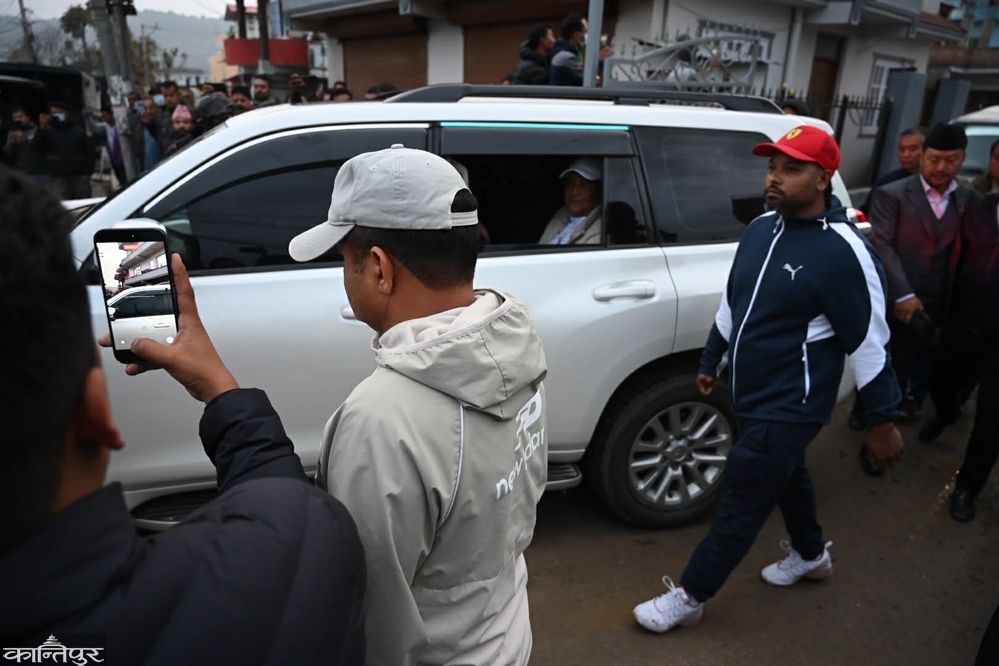 After that, Home Minister Sudhan Gurung had discussed the arrest of Oli and the writer with Inspector General of Police Dan Bahadur Karki, Inspector General of Armed Police Raju Aryal, Home Secretary Rajkumar Shrestha and Law Secretary Parashwar Dhungana until midnight. During the discussion, police officials had suggested that it would be appropriate to proceed with the investigation only after receiving a complaint. After hours of discussion, the police had reached the conclusion that Oli and the writer should be arrested for investigation based on the decision of the Council of Ministers and the complaint filed by the Home Ministry as the complainant. In the same process, Oli and the writer were arrested on Saturday morning.
Oli, 74, who has undergone two kidney transplants, has been at the helm of the UML for the past 11 years. He became the Prime Minister for the first time after the constitution was promulgated in Asoj 2072 and has since been the Prime Minister three more times.
According to the legal process, the police and the government prosecutor must first get the urgent arrest warrant approved by the court. Deputy Attorney General of the Attorney General's Office Sanjeev Raj Regmi said that the process of seeking permission to extend the time limit for investigation against Oli and the writer will proceed only after the court approves it.
When asked why the arrest was made on a holiday without the court's permission when it was impossible to conduct an investigation without the court's approval, Kathmandu Valley Police Office Chief AIG Ishwar Karki replied, "There is a situation where the accused should be arrested immediately and investigated." "The law provides for immediate arrest by handing over an urgent warrant if there is a situation where an arrest should be made immediately and obtaining permission after the court opens," he said. "We have adopted the same path, and in the case of some other accused, we have been arresting them using urgent warrants."
District Attorney's Office Kathmandu Chief Ramhari Kafle said that they will first get the urgent warrant approved by the court on Sunday and only then proceed with other processes.
Khamma Bahadur Khati, who became Attorney General when Sher Bahadur Deuba was the Prime Minister under the leadership of the Nepali Congress, has said that he will challenge the police's urgent arrest warrant. Khati was in legal consultation with the writer before he was arrested on Saturday morning.
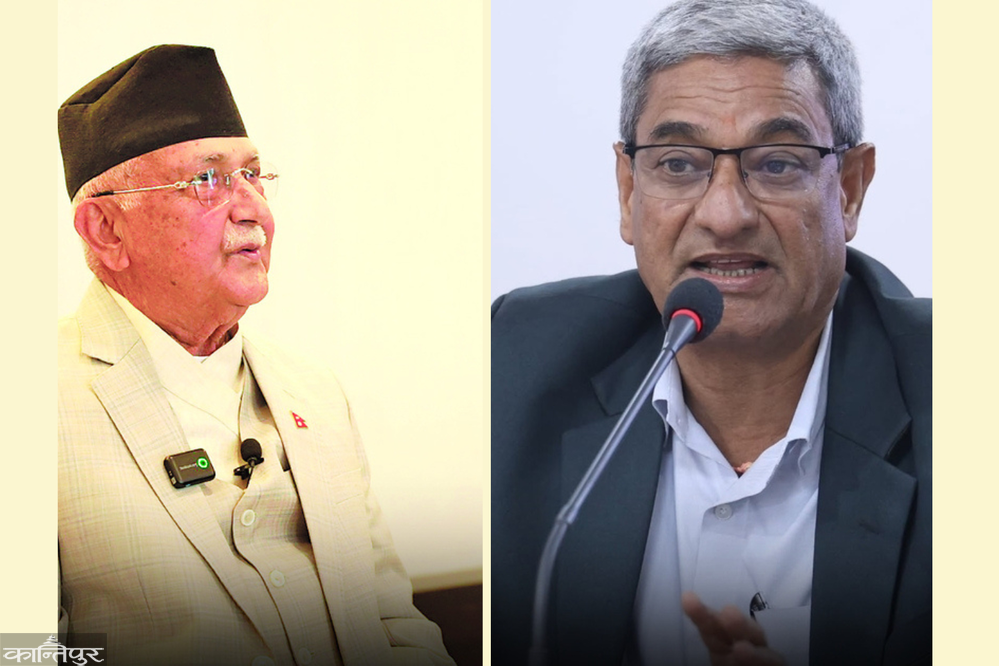 On Saturday morning, a police team led by SSP Santosh Khadka of the Kathmandu Valley Crime Investigation Office arrested both leaders for investigation in a murder case, and Oli was admitted to the Tribhuvan University Teaching Hospital after undergoing a medical examination. The writer was taken into custody at the Kantipur Hospital in Tinkune and placed under the custody of Police Battalion No. 2 in Maharajgunj.
DIG Om Adhikari of the Kathmandu Valley Police Office said that the police are working according to the law. He said, "We used to work like this in the past, and the same thing has happened now too."
According to the law, the police cannot detain anyone for more than 24 hours without a court order. Therefore, the police will have to produce Oli and the writer in the Kathmandu District Court tomorrow morning. Initially, the court will decide whether to uphold the urgent arrest warrant issued by the police on Saturday. If the court does not uphold it, both Oli and the writer will be released immediately. Even if they are released, the investigation against them will not stop. If the court approves the warrant, the public prosecutor will then seek a remand period to keep Oli and the writer in custody for further investigation. Kafle, the head of the Kathmandu District Public Prosecutor's Office, told Kantipur, "Both Oli and the writer will be detained for further investigation."
The prevailing law allows for a maximum of 25 days of detention for investigation in such cases. After the court grants permission, the police will detain Oli and the writer for questioning and recording statements. Generally, the court does not allow detention for a maximum period at a time. It is customary to grant a remand period of four, five or seven days and if it is not completed by that time, the public prosecutor will seek another remand period. The law provides that the court may not grant any additional remand period at any of these stages or that the police may decide to release them on bail on any day in consultation with the public prosecutor.
Both sides will try to convince the court why Oli and the writer should be detained or released to continue the investigation.
According to another deputy attorney general of the Attorney General's Office, the government prosecutor will present an argument that they should be detained for investigation since the evidence collected includes the report of the inquiry commission, the decision of the Council of Ministers to implement it, the complaint filed by the Ministry of Home Affairs itself, the postmortem report of the deceased, the incident report, CCTV footage, etc. .
Oli and the writer's lawyers will argue that there is no reason to keep them in detention and that the investigation can continue even if they are released on bail, arguing that the deadline should not be extended. They may argue that the report of the inquiry commission itself is not evidence, that Oli and the writer did not appear to have reached the scene of the incident or given instructions, and that no decision was made by the Council of Ministers meeting or otherwise ordered the shooting.
Whether the police keep them in custody for the entire period or release them early, after completing the investigation, they will submit a report with their opinion to the District Attorney's Office, giving them the basis for prosecuting them. After receiving such a report or during the investigation, the Office of the Public Prosecutor may give the police further instructions regarding the investigation and collection of evidence. The police must comply with such instructions.
After receiving such a report with an opinion, the Office of the Public Prosecutor decides whether or not to prosecute, and if so, for what offense, and how much punishment to demand. If the decision not to prosecute is made, it must be sent to the Attorney General's Office through the High Public Prosecutor for confirmation. Either of these two bodies can also return the file with instructions to prosecute without confirming. In that case, the Office of the District Attorney must prosecute the case in the district court. If the decision not to prosecute is confirmed, the case ends there.
When deciding to prosecute, the District Attorney's Office is free to decide what punishment to seek for which offense. However, the Commission of Inquiry has recommended an investigation under Sections 181 and 182 of the Criminal Code. The said sections provide for imprisonment for 3 to 10 years and a fine of Rs 30,000 to 100,000 if found guilty of negligent homicide.
After the case is registered, a custodial hearing is held in the district court. This will determine how Oli and the writer will defend the case until the final decision is made. The court will decide whether to keep them in custody, release them on bail or postpone their trial.
Oli's legal practitioners are preparing to file a writ of custodial interrogation in the Supreme Court against their arrest on Sunday. Senior advocate Bhattarai said, "He (Oli) has said that he will fight a legal battle, so prepare." We will go to the Supreme Court tomorrow (Sunday) with the habeas corpus case if possible. If the writ of habeas corpus is filed in this way, the legal process of this case will be continued in the Supreme Court along with the district court.
Law Minister Sobita Gautam said that efforts are being made to implement the report of the investigation commission formed by the previous government. 'Since this matter falls under the jurisdiction of the Home Ministry, why was an urgent arrest warrant issued, he (the Home Minister) will say tomorrow,' she said, 'I think whatever should be done should be done according to the law.'
After the arrest of Oli and the writer, Home Minister Sudhan Gurung wrote on Facebook that the arrest was 'not revenge against anyone, but only the beginning of justice.' 'I believe that now the country will take a new direction,' he wrote.
Gurung, the founder of an organization called Hami Nepal, had previously been putting heavy pressure on the then Home Minister Om Prakash Aryal to arrest Oli and the writer. He had launched the 'Arrest Oli-Writer' hashtag campaign on social media and had also demanded the resignation of the then Home Minister Aryal for not arresting him.
Gurung, who has been running the arrest campaign since before becoming the Home Minister, had himself been taken to court by the inquiry commission regarding his involvement in the Bhadra 23-24 incident. Even though the report of the inquiry commission was made public by the media, the question of why the government has not made it public has also become a matter of public interest.
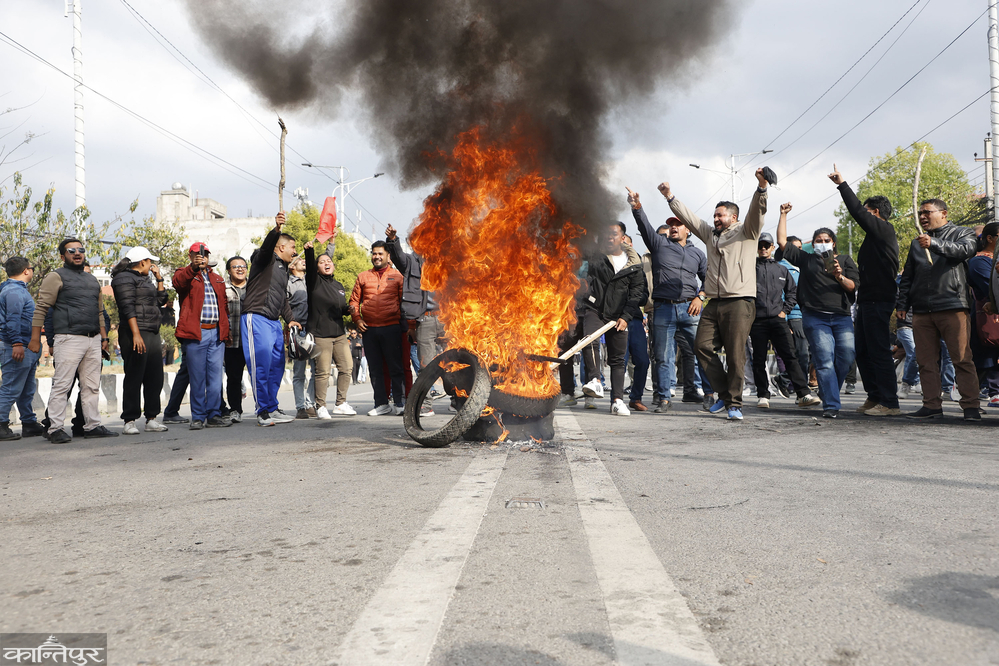 Commissions had been formed earlier to investigate violent incidents and abuse of power. The report of the commission, formed under the chairmanship of retired Supreme Court judge Girish Chandra Lal after more than 40 people died during the Madhesh movement in 2072, has not been made public to this day and has not been implemented.
२०६२/६३ को जनआन्दोलनमा २२ जनाको मृत्यु र पाँच हजारभन्दा बढी नागरिक घाइते भएको घटनाको छानबिन गर्न गठित रायमाझी आयोगले जिम्मेवार ठहर्याएका व्यक्तिहरूमाथि अहिलेसम्म अनुसन्धान र अभियोजन भएको छैन । २०४६ को जनआन्दोलनपछि मल्लिक आयोग गठन भएको थियो । आन्दोलनमा हिंसात्मक दमन गर्नेहरूलाई जिम्मेवार ठहर्याएको आयोगको त्यो प्रतिवेदनसमेत दबाइएको थियो ।
छानबिन आयोगले दिएको प्रतिवेदन ललिता निवासको जग्गा घोटाला काण्डमा भने कार्यान्वयन गरिएको थियो । मन्त्रिपरिषद् निर्णयका आधारमा यस पटक झैं गृह मन्त्रालयकै किटानी जाहेरबाट सुरु गरिएको उक्त मुद्दामा विशेष अदालतमा मुद्दा चलाइएको थियो ।
यो पटक भने सरकारले जाँचबुझ आयोगको प्रतिवेदनमाथि सम्बद्ध निकायबाट औपचारिक अध्ययनसमेत नगराई, संविधानअनुसार सरकारको कानुनी सल्लाहकार, महान्यायाधिवक्ता नियुक्तसमेत नगर्दै र आयोग प्रतिवेदन सार्वजनिक नगरी सरकार गठन भएको अर्को दिनमै ओली र लेखकलाई पक्राउ गरेको छ ।

