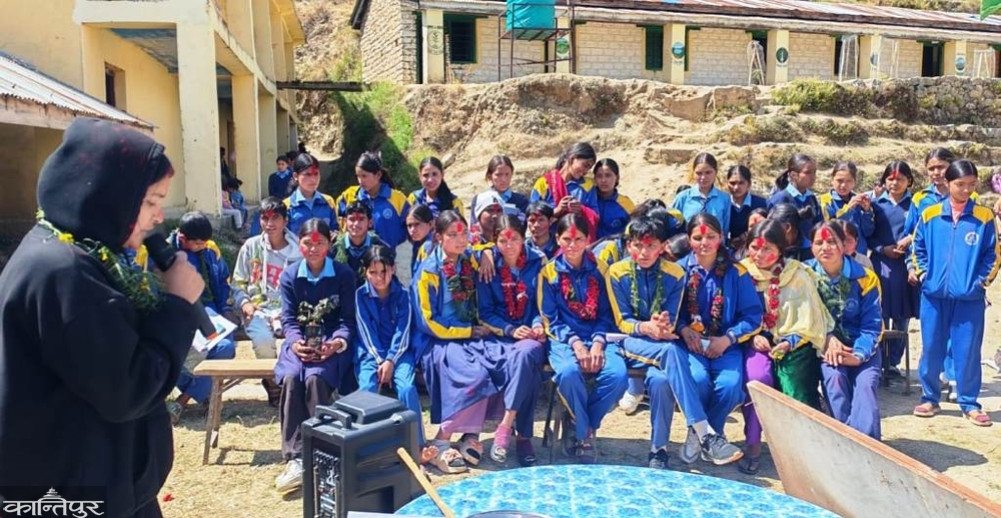
Due to the lack of permanent teachers and problems with regular teaching in community schools in Karnali, students are forced to participate in the SEE by relying on tuition and external sources.
We use Google Cloud Translation Services. Google requires we provide the following disclaimer relating to use of this service:
This service may contain translations powered by Google. Google disclaims all warranties related to the translations, expressed or implied, including any warranties of accuracy, reliability, and any implied warranties of merchantability, fitness for a particular purpose, and noninfringement.
Jamuna Rokka, a class 10 student of Janata Secondary School in Shubhakalika-1 Chhati, Kalikot, is appearing for the SEE exam this year without completing most of the subjects. ‘I had studied only up to 7 units of English, 13 units of Science, and 10 units of Mathematics, and then it was winter break,’ she said. ‘Since then, many of my friends went to Surkhet and the district headquarters, Manma, to study tuition, so the school did not conduct regular classes. The school provided coaching, and even then, I could not complete all the courses.’
Since the number of permanent teachers in classes 9 and 10 in the school is zero, two teachers of English and Mathematics have been appointed at the secondary level through municipal and federal grants. Primary level teacher Dipendra Adhikari has been teaching science subjects. ‘The annual vacation was in Asar-Shrawan, immediately after the Genji movement, the classes were stopped for 2 weeks,’ he said, ‘The Dashain-Tihar vacation in Asoj and the winter vacation in Pus-Magh also had an impact.’
A team led by Navraj Acharya, the head of the education branch of Shubhakalika Rural Municipality, monitored the school on Tuesday. During the monitoring, only 16 out of 28 students studying in class 10 were present at the school, the branch head Acharya said. According to him, the other students had gone to Manma and Surkhet to study tuition. He said that there are zero vacancies in classes 9 and 10 in 5 of the 7 secondary schools in the municipality. Due to this, most primary level teachers are forced to teach students who are appearing for the SEE exam.
It has been almost 5 months since 13 students, including Navina Bohara, who is studying in class 10 at Durga Secondary School in Tilagufa-2 Sada, Kalikot, came to Surkhet for tuition. This year, 28 students from the school are appearing for the SEE exam. "We went to school until the Dashain-Tihar holidays, but the course was not ready to be completed, so we came here from Kartik to study tuition," she said. "We return to the village in 1/2 days and give SEE."
According to her, the geometry unit of mathematics had not started until Kartik, while grammar of English and chemistry of science had not started. She informed that she took tuition for three subjects at the rate of 3 thousand rupees per month and spent up to 10 thousand rupees per month on food and accommodation.
Durga Shahi, a social studies teacher at the school, said that there was a problem in teaching and learning as students left before completing half of the courses in subjects such as social, Nepali, and health-physical education. ‘Going out to study tuition has become a fashion here,’ she said, ‘Since it is very cold, we give winter vacation in winter, but students go out to study tuition before that, how can we teach without them?’ The school has 7 permanent teachers from primary and lower secondary levels, while the municipality has kept 2 of them to bear the expenses.
Man Bahadur Shahi, a parent of Tilagufa-2, said that parents are also suffering due to the lack of completion of courses in remote community schools. His son Prakash is also appearing for SEE this year. ‘Sending children to Surkhet costs at least 20,000 rupees a month, including room and board,’ he said, ‘Even if we have to take out loans, we are forced to send children out to prepare for SEE.’
According to a study conducted in 110 schools by the Directorate of Education Development of Karnali Province in 2080 BS, it was concluded that barely 60 percent of the courses were completed by the end of the academic session. Acting Education Director Deepa Hamal said that the quality of education in Karnali is deteriorating due to lack of teachers and physical infrastructure, non-arrival of textbooks on time, and students and teachers not attending classes regularly.
Out of 35,061 candidates who participated in the SEE last year from Karnali, 20,384 passed. According to the directorate's data, out of 730 community and GG schools across the province, not a single student from 46 schools failed to pass. Last year, only 402 students scored 3.61 to 4.
SEE results in Karnali are on a downward trend. Last year, 58.13 percent passed from Karnali, while 64 percent passed in the SEE in 2080 BS and 64.8 percent before that. Balbir Sunar, head of the Education Division of the Ministry of Social Development, said that the shortage of 654 teachers in English, Mathematics and Science alone in Karnali is affecting SEE results every year.
According to him, out of 3,034 community schools, 3,109 teachers have been appointed at the secondary level. However, there is a shortage of 1,749 teachers at the secondary level. So far, only 1,360 teachers are working on permanent, temporary and relief basis.
There is a problem in remote schools that applications are not received despite repeated advertisements. Since last Bhadra, Saraswati Secondary School in Jairgaun, Sarkegad Rural Municipality-1, Humla has not received teachers for science and mathematics even after Chait has begun.
The school, which first published a one-week notice on Bhadra 5, has invited applications again for the ninth time on Chait 3, said the school's principal Jaya Bahadur Bam. ‘We could not find a secondary school teacher for science and mathematics,’ he said. ‘Students taking the SEE have prepared for the exam on their own since they did not get a teacher.’
Similarly, Rupadevi Secondary School in Narharinath-7, Kalikot, got a teacher only after the 19th advertisement for a mathematics teacher on Kartik 30. Min Bahadur Budha is currently working at the school on a federal secondary school grant. ‘More than half of the academic session was spent searching for a teacher,’ said Dan Bahadur Budha, the school’s principal. ‘Since November, it has been difficult to complete the course, students have been forced to take the SEE on tuition.’
Established in 2035, the school has 375 students studying, while the school is running on the basis of 3 permanent posts. Due to problems in teaching, 13 teachers have been hired at the school on rural municipality grants and private sources. This year, 35 students are taking the SEE from the school.
Due to heavy snowfall in Humla, Dolpa, Mugu and Kalikot, locals from the upper settlements migrate to the valley from the first week of Kartik to the end of Falgun every year. Education is also suspended as students go out with their parents for about 5 months. Mugamkarmarong Rural Municipality Chairman Tshiringkapne Lama said that the level of learning is deteriorating as teachers in remote areas refuse to come to schools and even if they do come, they do not attend school regularly.
‘How will students learn, how will the course be completed if there are no teachers?’ He said, ‘The academic session from Baisakh is impractical for us.’ According to him, before the Corona pandemic, the academic session was conducted from Falgun to Kartik in Mugu due to heavy snowfall and extreme cold from Kartik to Magh.
He said that the Yarsagumba season, various festivals, and teachers from outside the district not coming to school regularly due to extended leave are also making it difficult to complete the course. "During the Yarsa season, students go to Patan with their parents for 2 months, and agricultural work and various festivals also disturb students from going to school for 1/2 week," he said. "Our education is deteriorating due to the negligence of teachers, students, and the management committee."
This year, 38,379 students are appearing in the SEE exam in Karnali. Khim Prasad Dhakal, the head of the Examination Branch of the Education Development Directorate, said that 32,255 students will participate in the regular SEE exam from 161 examination centers across the province and 6,124 students will participate in the grade increase exam. According to him, the maximum number of students, 9,770, are from Surkhet and the minimum, 674, are from Dolpa. For this, the maximum number of exam centers has been set up in Surkhet and the minimum number of exam centers has been set up in Dolpa.