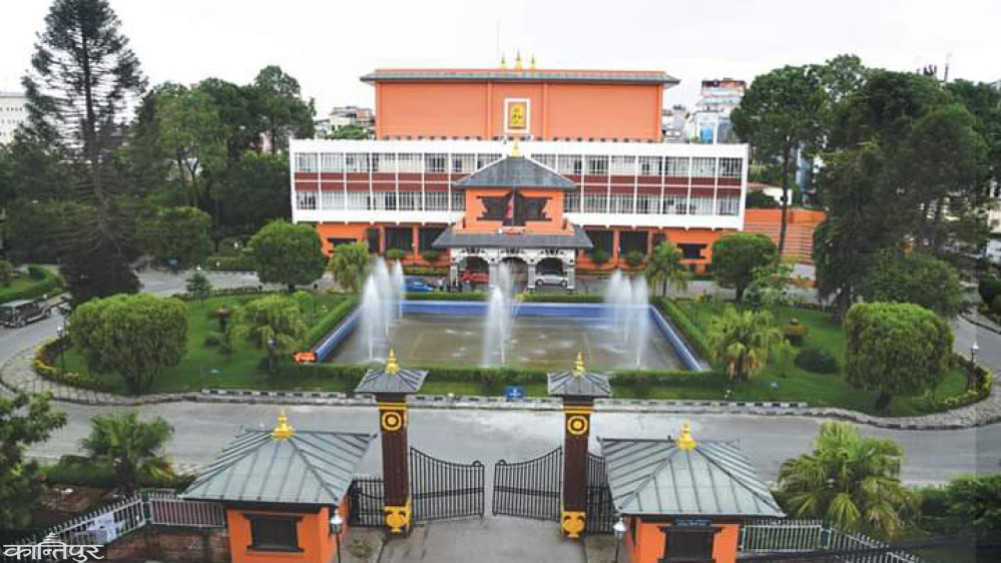
The Pragya Pratishthan has been providing around Rs 1 million per month to its 19 current life members, some of whom were found to be receiving double government benefits, and the Pratishthan had decided to stop such benefits three years ago. 11 academicians approached the court with a writ petition against it. Although the Supreme Court dismissed the writ petition, they have since received more than Rs 20 million in allowances at the rate of Rs 51,474 per month.
We use Google Cloud Translation Services. Google requires we provide the following disclaimer relating to use of this service:
This service may contain translations powered by Google. Google disclaims all warranties related to the translations, expressed or implied, including any warranties of accuracy, reliability, and any implied warranties of merchantability, fitness for a particular purpose, and noninfringement.
Life members of the Nepal Academy of Sciences, who were receiving dual government benefits, will no longer receive such benefits. Most of the members nominated by academic institutions were receiving monthly allowances from the academy along with their government pension.
On 1 Chaitra, the bench of Justices Manoj Kumar Sharma and Nripadhwaj Niraula of the Supreme Court dismissed the writ petition filed by 11 people including Prof. Dr. Vasudev Tripathi, and the academy has decided to stop the monthly allowances being given to them.
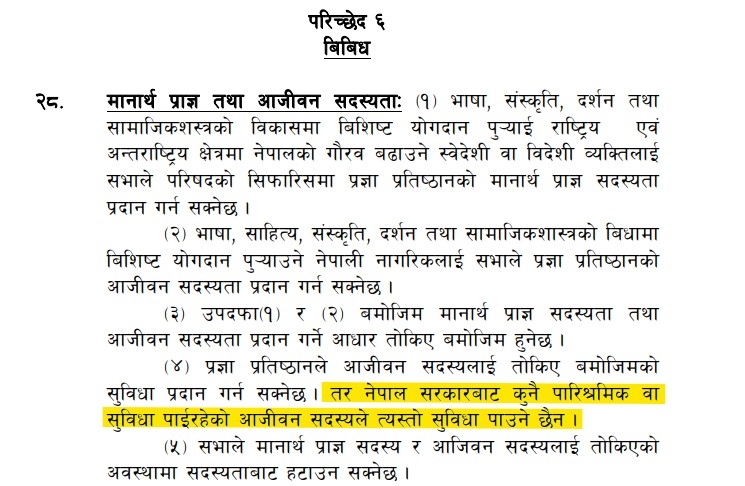
Section 28 (4) of the Nepal Academy of Sciences Act, 2064 BS clearly states that ‘a person receiving any remuneration or benefit from the Government of Nepal shall not be entitled to receive such benefits from the academy.’ However, ignoring the academy’s request to ‘self-declare and inform if they are receiving dual benefits’, they approached the Supreme Court against it on 24 Chaitra 2079 BS with a writ petition.
What was the dispute?
Seeking a second benefit is a moral failing, and people idealized by society should be freed from such cravings. -Bhupin Chancellor Bhupal Rai, appointed on 3 Falgun 2079, made an important decision on 11 Falgun within a week of assuming office – cutting the double benefits of life members. ‘As per the restrictive clause of Sub-section 4 of Section 28 of the Nepal Pragya Pratishthan Act 2064, double remuneration benefits cannot be provided, life members receiving pensions from the Government of Nepal, universities and other bodies will not be provided with the remuneration/benefits of life members from this institution from Falgun 2079,’ the decision states. Chancellor Rai says that they took the decision after receiving complaints that most of the life members receiving government ‘pension’ were also receiving government benefits from the institution.
‘A bold decision has come to improve the financial condition of the institution and end the unrest,’ he said. When the foundation made the decision, there were 20 life members (there are currently 19 after the death of Gyanmani Nepal). However, within a few days of the decision, 11 people led by Prof. Vasudev Tripathi approached the Supreme Court with a writ against the decision. ‘Immediately after the decision to reduce the benefits, we wrote to everyone asking them to reveal who is receiving double benefits,’ says Chancellor Rai, ‘but they have reached the Supreme Court without giving us an answer.’
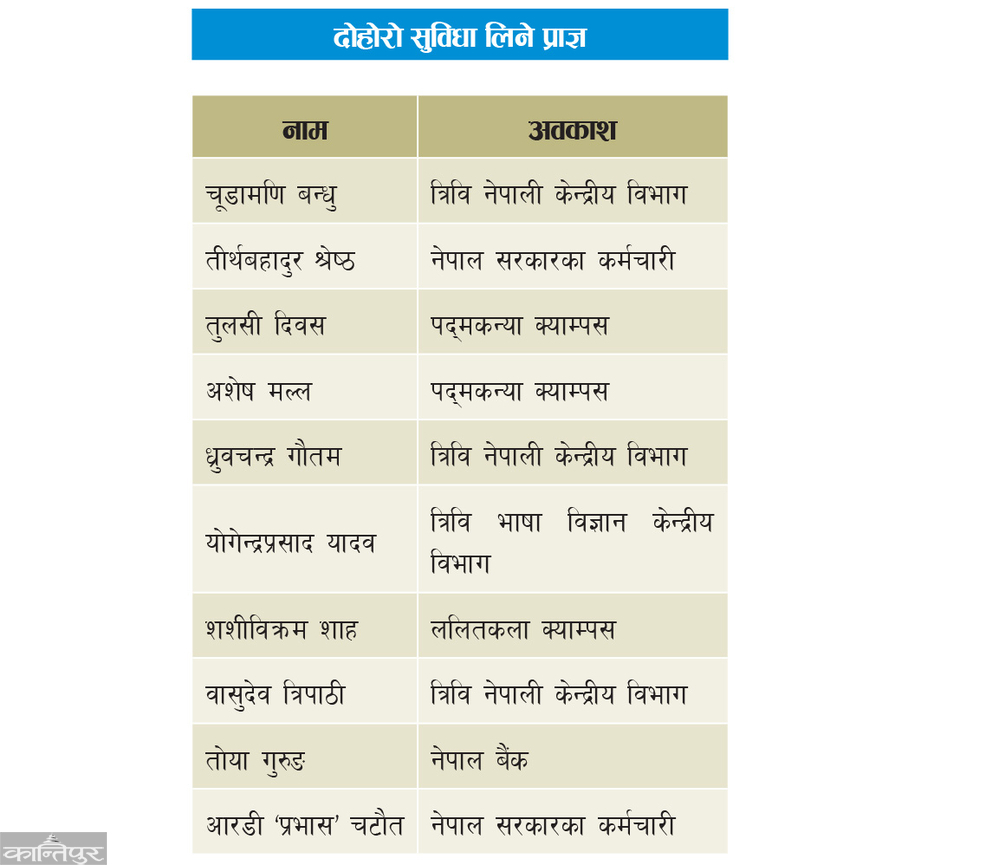
The writ argued that ‘since they have made an incomparable contribution to the field of literature and the foundation has decided to provide an allowance in recognition of that, they can receive both the pension provided by the government and the allowance received from the foundation.’ Along with Tripathi, those filing the writ against the foundation’s decision include Tulsi Prasad Joshi (Tulsi Divas), Dhruva Chandra Gautam, Toya Gurung, Rajeshworidatta Chataut (RD Prabhas), Ganga Prasad Upreti and others. Gurung is retired from the bank and Chataut is a civil servant, while all the others are pensioners from Tribhuvan University.
They were taking the facilities after a bench of Justices Sushmalata Mathema and Hari Prasad Phuyal issued an interim order on their writ petition on 5 Baisakh 2080. On 1 Chaitra, the Supreme Court ruled to dismiss their writ petition. The Supreme Court has also dismissed the writ petition filed by Ghanendra Ojha, seeking to quash the provision related to lifetime membership and the provision providing monthly salary and allowance to lifetime members.
The dispute has now been resolved after the Supreme Court upheld the decision of the institute. ‘This is a historic decision regarding double facilities,’ says Chancellor Rai, ‘following the Supreme Court’s order, the institute will stop their facilities from this month.’ He also said that further decisions will be taken accordingly after the full text of the decision is released.
Question of ethics in academic institutions
Section 28 of the Nepal Academy Act 2064 BS contains provisions related to honorary academics and lifetime membership. It is stated that ‘the Assembly may grant life membership of the Academy to Nepali citizens who have made outstanding contributions in the fields of language, literature, culture, philosophy and social sciences’. Section (4) of the same section states that the Academy shall provide facilities as prescribed to life members, but life members who are receiving any remuneration or facilities from the Government of Nepal shall not receive such facilities.
The government had also decided on 8 Magh 2072 that persons holding public office shall not be able to avail of dual facilities. If a person holding a public office retires and is reappointed to receive government service facilities, the provision that he/she must choose between pension or the facilities to be provided after new appointment was implemented at that time. According to the records of the Academy, Siddhicharan Shrestha was nominated as a life member for the first time in 2022. Then in 2024, Yagya Prasad Sharma, Bal Krishna Sam, Bhavani Bhikshu and Madhav Prasad Ghimire were nominated.
Since then, life members have been nominated in 2036, 2046, 2047, 2051, 2052, 2060, 2069, 2077, 2078 and 2079. Of the 54 life members nominated since 2022, 35 have passed away. Apart from those who filed the writ, the foundation has life members Bairagi Kainla, Tulsi Prasad Bhattarai, Ninu Chapagain, Manju Kanchuli, Modnath Prasrit, Naresh Shakya, Bund Rana and Purnaviram (Balram Bhattarai). The foundation has been giving about one million rupees a month to the current 19 life members.
‘Life members also have to be paid allowances from the budget provided by the government,’ said Dhan Prasad Subedi, member secretary of the foundation. ‘When the budget ceiling is not enough, we have to manage the resources ourselves.’ He said that according to the Supreme Court’s decision, the allowances of the concerned life members should now be stopped. ‘After coming to the academic arena to question others on ethics and good governance, ethics are the main thing,’ he said, ‘Their expertise and contribution are appreciated, but after being bound by the rules, we decided to reduce the benefits.’
From 2067/68 to 2071/72, life members received a monthly allowance of Rs 17,200. Madhav Prasad Ghimire was provided with Rs 29,200 along with the Rashtrakavi allowance. In 2072/073, the allowance rate was increased to Rs 29,113. After increasing it from time to time, life members now receive Rs 51,474 per month. This amount has been implemented since 2079/80. The writer/literary writer has commented that those who take double benefits by reaching academic institutions are exploiting the state treasury.
Poet/writer Bhupin says that people idealized by society should be free from such cravings. ‘They belong to the conscious academic class who teach morality. "Looking for a second facility when you are already receiving government facilities is a moral blunder," he said. He said that whatever the court decides, it will be acceptable in a state of law.
Since the academy's decision to stop double facilities in February 2079, 11 people have 'exploited' more than 20 million. 'If the court had given its conclusion at the time we made the first decision, the misuse of public taxes would have been avoided,' says Chancellor Bhupal Rai, 'Even after three years, the respected court has upheld the academy's decision. This has saved us from a huge financial burden.'
Member Secretary Subedi also said that the 11 academicians who went to the Supreme Court with a writ also admitted to receiving pensions, adding, 'We have no way of knowing where they got jobs. As for others, there is no information yet about them receiving double government facilities. If there is a basis to confirm it, the academy will take a decision accordingly.'
‘Let’s start the first operation of good governance from academia’
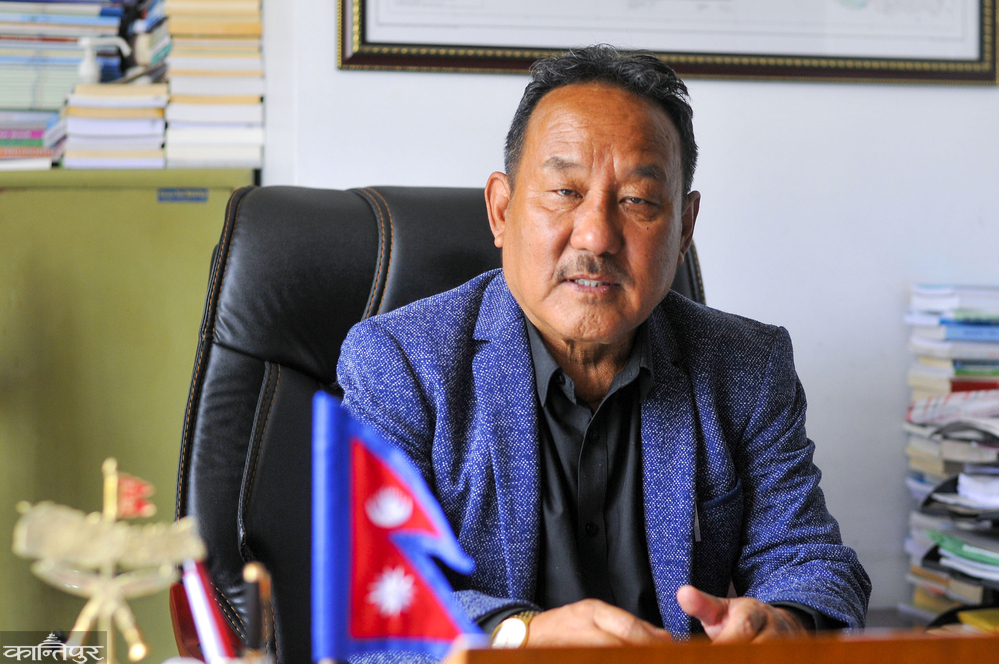
After becoming the Chancellor, you made your first ‘bold decision’ – to stop the double benefits being enjoyed by life members, why?
Before being appointed as the Chancellor, some journalists had asked me – what will be the first decision you will make if you become the Chancellor? I had said, I will stop the double benefits of life members. Accordingly, I made that decision within seven days of my appointment. Our entire academic body unanimously passed that decision.
The Academy is not only a body for debate, discussion, discussion and evaluation of knowledge, but also a place to demonstrate high ethics and clean conduct. It is a cultural center that creates an advanced culture and guides the country in the light of that culture. And, academics are the cultural heroes standing in the first wave. Such heroes should be of clean image, moral, who should not play with the people’s taxes. Double taxation is not allowed. Pragya Pratisthan, which no one thought before, is not just a place to glorify the knowledge acquired so far and to indulge in intellectual pursuits about it, but an academic factory for the excavation of new knowledge and the creation of a new culture.
Corruption in Nepal is not just a purely economic issue, but rather a manifestation of a cultural chain. To reduce this, it is necessary to create a new culture. Now let's think, what happens if a pile of financial garbage is piled up in a place where good manners and culture are taught? The first condition of the word 'good governance' that we keep repeating now is economic purification. And, my intention is to start the first operation of economic purification and good governance from Pragya Pratisthan.
Did you come under any pressure from the life members after this decision?
The writ petition of 11 life members was an unexpected pressure. The interim order of the Supreme Court that came on top of that was another pressure. Both these incidents were beyond my expectations. Initially, we had sent a letter to all our life members requesting that ‘those who are enjoying dual benefits should declare themselves and choose one of the two institutions from which they are receiving allowances and demonstrate ethics’. However, instead of responding to our letter, 11 members have gone so far as to file a writ petition. The court also gave high priority to the writ petition and immediately issued an interim order and stayed our decision. Thus, like throwing a stone at the first bite, my first step in my journey was met with disappointment. My campaign to cleanse the academic sector with the water of economic purification, which was my fight for morality, was stopped.
This definitely had a negative impact on the institution or the state treasury. The decision that the court has just made is definitely a decision in favor of the people. I thank the honorable court for this. I express my gratitude to the honorable judges. However, what happened came too late. If we had been able to stop it from the date of the decision, the misuse of public taxes worth about 25 million rupees would have been avoided.
Your predecessor, Ganga Prasad Upreti, decided to make himself a lifetime member and receive double allowance while leaving the institute and he did. What is your comment on that decision?
Personally, I have no prejudice or animosity towards him. Neither do the other 10 members. My point is towards the trend. At a time when corruption and misuse of state funds are also developing as a core culture, my point is towards that culture. There are still people in Nepal who ‘eat what you eat now’, that is, ‘eat when you eat’. Let us at least be a little ashamed of the facilities that allow us to continue being academics by exploiting the taxes paid by such people in a double way. In other words, let us now learn to question the opportunities provided by structural facilities by sitting within the structure.
How does the institute now use the budget being given to those 11 lifetime members?
Oh! That much saved money is like a lifeline for us. Where can one use all that money for an academic institution that does not receive a single penny of government funding for study, research, debate, discussion and knowledge creation, and has to run its 11 departments with its own internal resources? There are so many plans, all of which are stalled due to lack of budget! The Raithane Gyan Utsav, which I started as soon as I started the academy, is stuck there. The revision work of ‘Pragya Nepali Brihat Shashoki’ is the same. The writing of ‘Regional Guidance’ is in the same condition! The mother tongue related programs are the same.
Doesn’t your academic council increase its own allowance?
In such a situation, I can’t even imagine increasing the allowance of my own council. This is beyond my ethics. Because I am a person who even cancels the facilities I am getting. Don’t think of it as an exaggeration! Or even think of it. I was the general manager of a cultural institute for a short time around 2065 BS. There was an old practice there where the general manager would take an additional allowance for monitoring the morning music class. I deliberately held a board meeting there to remove that practice and cut off the benefits I received. As soon as I came to the Academy, I made many unsuccessful attempts to abolish the lunch arrangement for the council meeting. Even now, many times when I go from the Academy to a program in a foreign district, I have gone without a daily travel allowance. Now think about it, with what hand would a person who cuts his own allowance sign someone else's allowance!
The court has said that allowance should not be given only to those who are enjoying double benefits. But the lifetime allowance remains. Why should the state give lifetime allowance to poets and writers?
The issue that we decided and the court decided is 'abolition of double benefit allowance'. That is, it is only in relation to those who were enjoying double allowance. It is not the abolition of allowance for all lifetime members. The arrangement of lifetime members was not a system established by the Nepal Academy with such a far-sighted thinking and perspective. It was also like the management of the same structural beneficiary class. It has been distorted by making its own rules and regulations from time to time. That is why it has become controversial now.
However, this does not mean that it is unnecessary or unreasonable. If it is reorganized by creating meaningful, inclusive and fair standards, it will do a great job in supporting the livelihood of poor artists.