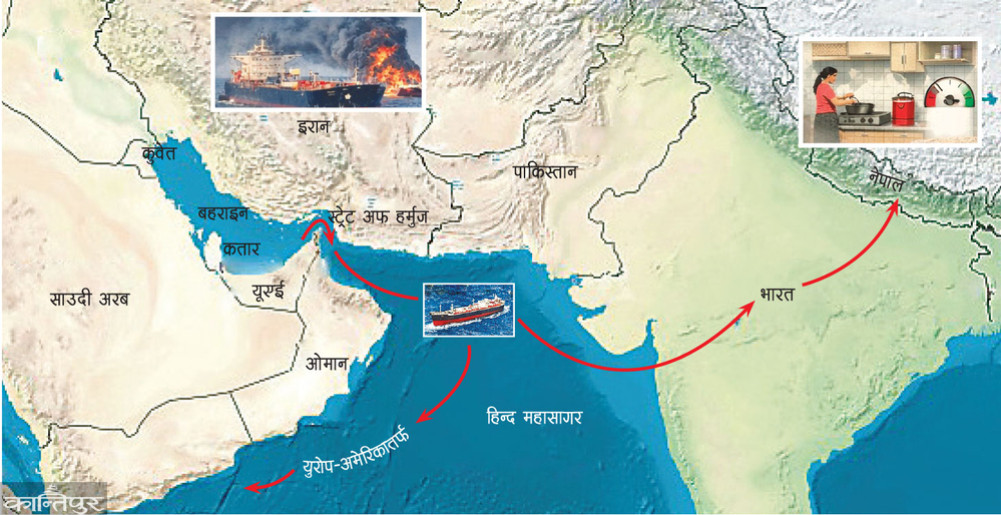
Nepal imports petroleum products by purchasing them from the Indian Oil Corporation, while India imports 90 percent of its crude oil and 60 percent of its LPG from various countries. Of the imported LPG, 90 percent comes through the Strait of Hormuz.
We use Google Cloud Translation Services. Google requires we provide the following disclaimer relating to use of this service:
This service may contain translations powered by Google. Google disclaims all warranties related to the translations, expressed or implied, including any warranties of accuracy, reliability, and any implied warranties of merchantability, fitness for a particular purpose, and noninfringement.
The war in the Gulf, about 3,000 kilometers away, is having a direct impact on the lives of Nepalese people. On the one hand, the security concerns of workers who have gone to work are increasing, while the travel of workers who are ready to fly for work has been disrupted. At the same time, the shortage of gas has added to the suffering of consumers.
Nepal Oil Corporation purchases petroleum products directly from Indian Oil Corporation (IOC). Private companies, on the other hand, bring gas from IOC's refining center after taking a PDO (Product Delivery Order) from the corporation. India itself is not a fuel-producing country. It also consumes it from elsewhere. After being refined in India, crude oil and gas are imported to Nepal.
Strait of Hormuz
It is a waterway between Iran and Oman, which is 167 kilometers long and 39 kilometers wide. However, ships ply only on a 3/3 kilometer route. Basically, oil from Saudi Arabia, Qatar, Kuwait, and the UAE is transported. Thus, about 22 percent of the world oil market is exported through this route. India is the world's third largest consumer of crude oil after China and the United States. According to the latest government data, India consumes about 5.5 million barrels of crude oil per day. There are large government and private oil companies like Naira Energy, Reliance Industries, Indian Oil Corporation (IOC), Bharat Petroleum Corporation (BPCL), Hindustan Petroleum Corporation. These companies operate 23 refineries in different cities. India bought oil from 40 countries in February.
About 22 percent of oil was imported from Russia, 20 percent from Saudi Arabia, 19 percent from Iraq, 10 percent from the UAE, 6 percent from Brazil, 4 percent from the US, 4 percent from Nigeria, and 3 percent from Kuwait. This shows that more than 50 percent of crude oil comes from West Asia. In the last 6 months, about 45 percent of crude oil came to India from West Asia. India is highly dependent on Qatar for cooking LPG. It buys about 30-35 percent of its gas from Qatar.
About 25 percent of LPG is imported from the UAE, 15 percent from Saudi Arabia and 10 percent from Kuwait. The US-Israeli attack on Iran on February 28 has disrupted the global fuel market. In particular, Iran has blocked the Strait of Hormuz in the Persian Gulf, preventing tankers carrying fuel from Middle Eastern countries from leaving. This has badly affected countries in South Asia like Sri Lanka, Pakistan and Bangladesh. The impact on India is comparatively less.
Because, since the start of the Russia-Ukraine war in 2022, India had started buying oil from Russia at concessional rates. India's dependence on Russian oil was high in 2025. According to Canadian oil analyst Kepler, in July 2025, about 40 percent of India's crude oil came from Russia. Iraq was in second place, Saudi Arabia in third, the UAE in fourth, and Kuwait in fifth. Small amounts of crude oil were also imported to India from the US, South Korea, Nigeria, Angola, and Mexico.
Transportation disruptions
After the US and Israeli attacks, Iran has used the Strait of Hormuz in its strategic defense. Since the war began, a dozen and a half ships have been targeted by Iran. And up to three ships have been attacked in a single day. This route, which carries more than a hundred ships a day, is now almost at a standstill. After becoming president for the second time in the US, Donald Trump began imposing economic sanctions on countries that "act against American interests." India was warned to reduce its dependence on Russian oil or choose to face steep tariffs. Trump threatened to increase tariffs on Indian goods entering the US by 50 percent. India has since reduced its dependence on Russian oil. On February 2, US President Trump and Indian Prime Minister Narendra Modi had a telephone conversation, in which they agreed to reduce tariffs on Indian goods entering the US market and in return, India would stop buying Russian oil.
Trump had expected the US oil market to grow in India. He expected that Venezuelan oil would be sold in particular in India. After invading Venezuela last January and capturing then-President Nicolas Maduro, Trump had urged American companies to invest in the oil fields there. Trump claims that the interim government of Venezuela is working very well with the US. India's imports of Russian oil, which were around 36 percent in November, fell to around 22 percent in February. The amount of oil imported into the Indian market from Saudi Arabia, Iraq and the UAE increased significantly.
The share of oil from countries including the US, Kuwait, Egypt, Nigeria, Libya, and Angola also increased slightly. The closure of the Strait of Hormuz in West Asia due to the war between the US, Israel and Iran has affected the supply of crude oil. Since the war began, more than 20 Indian fuel tankers have been stranded in ports near Hormuz. Not only for India, but also about 20 percent of the total share of the world market passes through Hormuz. 37.7 percent of the total oil consumed in China comes through Hormuz. Oil reaches South Korea, Japan, the US and European countries through Hormuz. The disruption of oil supply through the Strait of Hormuz has increased India's dependence on Russia.
On March 5, US President Trump said that India would be given an exemption to buy oil from Russia. But this exemption is said to be for only one month. This exemption will apply only to oil tankers that have been 'loaded' by Russia and sent to sea. 'Before this crisis, about 45 percent of crude oil used to come to India through the Strait of Hormuz. "Thanks to Prime Minister Modi's excellent diplomatic outreach, India has secured the same amount of crude oil that it needs to come from the Strait of Hormuz," Petroleum Minister Hardeep Puri had said in Parliament on Thursday.
Indian companies, which were not able to buy subsidized oil due to government policies earlier, are now buying crude oil from Russia at a premium price after Trump's announcement. That is why oil is coming to India from Russia in large quantities. Although there is no immediate crisis of crude oil in India, prices have increased. About 90 percent of oil in India is imported from abroad. The strategic oil reserves of the Indian government can last for 10 days and the reserves of private companies for 65 days, for a total of 75 days. That is, the reserves in India can last for 75 days in case of oil shortages. The Indian government issued a statement on March 11 stating that the supply of crude oil is secure.
"India's daily consumption is 5.5 million barrels. India is currently importing oil from 40 countries. More than 70 percent of the oil is coming from outside the Strait of Hormuz." Whereas earlier 55 percent of oil used to come through Hormuz,’ the statement said, ‘Indian oil refineries are working at high capacity. Some refineries are utilizing 100 percent capacity.’ Among the members of the Organization of the Petroleum Exporting Countries (OPEC), Saudi Arabia, Iraq, the UAE and Kuwait send a large portion of their oil through the Hormuz Strait.
Oil comes through this route, especially in the Asian region. Other South Asian countries that are highly dependent on West Asia are facing an acute oil crisis. Sri Lanka, which imports 80 percent of its crude oil from West Asia, has announced a public holiday on Wednesday to save fuel. The government expects that the consumption of petrol and diesel will decrease after the government shutdown. Pakistan has closed schools. A large number of government employees have been asked to work from home.
Universities are being run online. About 70 percent of Pakistan’s oil comes from West Asia. Bangladesh has also closed schools. About 90 percent of its oil comes through West Asia. In Thailand, the government has urged people to wear half-sleeved shirts to reduce the use of air conditioners. In Myanmar, it has been decided to operate private vehicles on a bi-weekly basis. India's 'liquefied' natural gas (LNG) consumption is 188 MMSCM (million metric standard cubic meters) per day. Of this, 97.5 MMSCM is produced domestically. The Indian government has said that alternative suppliers and routes have been used after the recent gas supply was affected. The Indian government says that gas companies are securing 'LNG' cargo from new sources.
The biggest problem in India right now is LP gas. 60 percent of the total gas consumption in India is imported from foreign markets. Out of that, about 90 percent comes through the Strait of Hormuz. 30-35 percent of LP gas is brought to India from Qatar, about 25 percent from the UAE, 15 percent from Saudi Arabia and 10 percent from Kuwait. India also imports gas from countries including the US. Due to its high dependence on West Asian sources, India is currently facing a shortage of cooking gas. Hotels and restaurants are issuing notices that they have stopped their services.
How does fuel reach Nepal from India? Nepal Oil Corporation has a monopoly on importing petroleum products. In Nepal, private sector companies have been allowed to import and sell gas directly from processing centers in Mathura in Uttar Pradesh, Barauni in Bihar, Haldia and Durgapur in West Bengal, and Paradip in Odisha. Private companies receive a 'PDO' (Product Delivery Order) after paying money to the corporation. After that, they bring gas from the processing centers of Indian Oil Corporation (IOC). Diesel, petrol, kerosene and aviation fuel have been imported only by the corporation.
Imports in Nepal
Nepal imports 2.5 million liters of petrol, about 5 million liters of diesel and 45,000 tons of cooking gas daily. Nepal imports 100 percent of its petroleum requirements from India, while India imports 85 percent of its petroleum requirements from abroad. India imports 50 percent of its petroleum from the Gulf, the main transportation route is the Strait of Hormuz. Diesel has been imported through the Motihari-Amlekhgunj pipeline since 2076. Petrol and kerosene have also been imported through the pipeline since 2081. The corporation has stated that 70 percent of the total consumption of petroleum products comes through the pipeline. The Amlekhgunj depot can store 43,000 kiloliters of fuel, including 25,500 kiloliters of diesel and 17,500 kiloliters of petrol. In addition to local sales, fuel is sent from Amlekhgunj to Thankot, Pokhara, Bhairahawa, Biratnagar and Janakpur depots.
Petrol pumps use the depot to receive fuel. The country consumes 2,000 to 2,500 kiloliters of petrol, 4,500 to 5,000 kiloliters of diesel and 600 kiloliters of aviation fuel daily. An agreement was signed in 1974 for the trade of petroleum products in Nepal, which is renewed every five years. The agreement has granted the Indian government-owned IOC the right to supply all petroleum products required by Nepal to India and on its behalf. The Nepal Oil Corporation has the right to import into Nepal.
IOC sends Nepal the prices of petrol, diesel and kerosene every 15-15 days and the prices of LP gas and aviation fuel every 30-30 days according to the price increase in the international market. The Corporation has been fixing the prices accordingly. Amidst the fuel crisis and price increase worldwide, the Corporation on Sunday increased petrol by Rs 15 per liter and diesel and kerosene by Rs 10 each. Currently, the price of petrol has reached Rs 172 per liter and diesel by Rs 152 per liter.
The selling price has been fixed by bearing some amount from the Price Stabilization Fund without maintaining the new rate sent by IOC. The Corporation has stated that this will result in a loss of Rs 3.93 billion in 15 days. As the price of petroleum products increases, the transportation cost also increases. The cost of production due to the increase in fuel prices has been affecting the kitchens of the common people. Experts say that due to the rising prices of petroleum products, vegetables and domestic food items will also become more expensive in the coming days. Economist Keshav Acharya has estimated that consumer prices could increase by at least 9 percent if the war in West Asia is not stopped immediately. In an interview with Kantipur on Monday, he said, "One-third of the total production in the world market is also produced in the Gulf. Therefore, the price of chemical fertilizers is also skyrocketing. This will affect inflation from Nepali kitchens to production." According to the International Monetary Fund, if the price of oil increases by $10 per barrel, the global economy will shrink by 0.15 percent and inflation will increase by 0.4 percentage points. If the price of oil increases by $100 per barrel, inflation will increase by 1.2 percentage points worldwide and the economy will shrink by 0.4 percent.