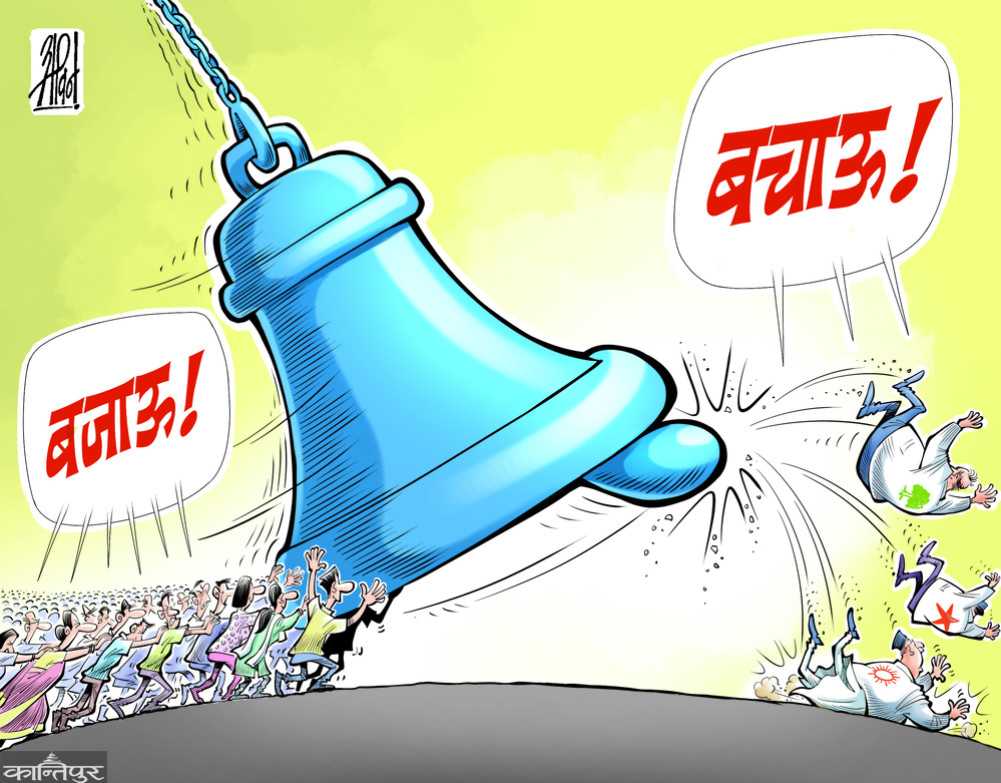
Top leaders of the ruling coalition during the Gen-G rebellion were defeated in the elections, and party leaders and activists themselves began to question the leadership.
We use Google Cloud Translation Services. Google requires we provide the following disclaimer relating to use of this service:
This service may contain translations powered by Google. Google disclaims all warranties related to the translations, expressed or implied, including any warranties of accuracy, reliability, and any implied warranties of merchantability, fitness for a particular purpose, and noninfringement.
The results of the House of Representatives elections have weakened the power of traditional political parties.
As the Rashtriya Swayamsevak Sangh (RSS) emerged as an alternative force, the Congress, UML and the Nepali Communist Party (NCP) have achieved their weakest results to date. There are signs that an internal power struggle will begin in the two old parties, Congress and UML, over the election results.
Top leaders of the ruling coalition parties, Congress and UML, during the Gen-G rebellion, have been defeated in the elections. The then Prime Minister and UML Chairman KP Sharma Oli has been defeated by senior RSSW leader Balendra Shah in Jhapa-5.
Most other office bearers, including General Secretary Shankar Pokharel, could not win the elections. Top leaders of the Congress, including President Gagan Thapa, General Secretaries Gururaj Ghimire and Pradeep Poudel, have also been defeated.
Leaders and activists in the UML have started questioning that Chairman Oli is responsible for the election results. Oli himself has not given any response on this.
He is more concerned about the report of the inquiry commission on the incidents of 23 and 24 Bhadra than about the election defeat and victory, say close leaders.
Oli doubts that the commission can find him guilty in the matter of the killing of 22 people in the Gen-G movement of 23 Bhadra. He also fears that he may be arrested if the commission finds him responsible.
'The RSVP won the election by a landslide, while the UML shrank to a small size. Chairman Oli is worried that he can take advantage of this and surround the UML,' said a member of his secretariat.
Congress President Thapa is at the most serious juncture in history. After the election results were not favorable despite the change in the Congress leadership through the special general convention, leaders from former President Sher Bahadur Deuba's faction have started questioning him. Chairman Thapa himself is facing defeat in Sarlahi-4.
Thapa, who became a member of the Constituent Assembly through the proportional system in 2064 and has since won three consecutive elections from Kathmandu-4, had reached Sarlahi with the goal of uniting the country and becoming a national leader.
With more than half of the votes counted, Thapa is trailing behind Amresh Kumar Singh of the Rashtriya Swayamsevak Sangh (RSS) by more than 7,000 votes. There has been no public response from President Thapa regarding the election results.
The Congress had entered the election with a message of changing its policy and leadership after the special general convention. But that failed to impress voters. With the final results yet to come, some leaders of former President Deuba's faction are expressing their views on social media that the legitimacy and legitimacy of the special general convention has ended.
The issue of the legitimacy of the special general convention, which was held amid disagreements between the Deuba faction, is pending in the Supreme Court. The Deuba faction has moved the Supreme Court against the Election Commission's decision to update the Central Working Committee elected from the special general convention held on 27-30 Poush.
The case regarding the validity of the special general convention is pending in court and there is speculation that Thapa may give the responsibility of acting president to Vice President Bishwaprakash Sharma, taking moral responsibility for the party's failure to participate in the elections.
A central member close to Thapa said that he has decided to discuss the issue with party leaders only after assessing his own and proportional vote results.
Vice President Sharma said that there has been no discussion on the leadership issue yet. He said that a meeting of the central working committee will be called after looking at the results till Monday and the shortcomings in the election will be reviewed.
Central member Subash Pokharel said that although the president would be justified in taking moral responsibility as the party's leader, there is no question of resignation.
'It is not possible to resign without discussing with party friends, it seems that no one else can lead the Congress than the current leadership. Resigning means running away from responsibility,' he said, 'If one is to resign, then all those who have been mainly responsible for bringing this situation into being since yesterday should do so.'
Pokharel said that the leadership should now analyze the situation and think about taking the Congress forward. 'It is about correcting the weaknesses and moving forward in a more responsible manner. When there is uncertainty about the path the country's politics will take, a trusted leader who can lead the country on the right 'track' should not run away from responsibility,' he added.
Leader NP Saud says that now is not the time to talk about the legitimacy and propriety of the special general convention. I do not want to talk about the legitimacy and propriety of the special general convention when the election process has not been completed, we will discuss it after the results are in,' he said, 'Radical reforms require collective leadership and unity, not individual leadership.'
He said that this time, when the Congress entered the election amid controversy, it faced a shock that was unprecedented in history. He himself was defeated by Rashtriya Swayamsevak Sangh (RSS) leader Deepak Raj Bohra in Kanchanpur-2. Saud pointed out three main reasons for the Congress's failure to win. "First, the alliance before the Gen-G movement was unnatural. The people were not satisfied with the coalition government's delivery. Second, the party should have immediately taken a policy decision after realizing the serious situation after the Gen-G movement. That could not happen," he said. Third, a serious dispute arose regarding the special general convention, in which only one side made the decision and participated. The other side went to the Election Commission and the Supreme Court. There should have been a consensus on the leadership and program after reviewing it. We have suffered this result when we went to the election in a divided mood." After the Gen-G rebellion, there was a demand for a leadership transfer in the old parties. To address that voice, the then Maoist Chairman Pushpa Kamal Dahal dissolved the Central Working Committee.
Then, the NCP was formed by uniting with various parties and groups. But Dahal himself became the coordinator, and the then Unified Socialist Party president Madhav Nepal became the co-coordinator.
The UML held a party convention, but Oli was approved as the leader. After the demand for leadership transfer was ignored, a special convention was held in the Congress amid disagreements between President Sher Bahadur Deuba and Acting President Purna Bahadur Khadka.
The then General Secretaries Gagan Thapa and Bishwaprakash Sharma had called a special convention. The special convention, which elected Thapa as the president and Sharma as the vice president, set the slogan 'Let's change the Congress, let's change the country'.
According to a Congress official, if the special convention had not been held, the position of the Congress would have fallen even lower than that of the UML and the NCP. ‘If we had not been able to hold a special general convention and give a new message, our situation would have been much weaker,’ he said, ‘at least we are ahead of the UML.’
According to the public vote results on Saturday night, the Congress has won 12 areas directly and is ahead in 7 areas. In the proportional representation, the Congress is getting around 16 percent of the vote.
Two general secretaries of the Congress, Gururaj Ghimire and Pradeep Poudel, have been defeated in the election. Congress’s joint general secretaries Farmullah Mansur and Prakash Rasaili ‘Snehi’, top leaders Shekhar Koirala, Bimalendra Nidhi and other leaders could not win the election.
Some leaders within the Congress, UML and the Maoists point to the prevalence of corruption, lack of good governance, the tendency to repeat leadership and factionalism within the party as the reasons behind such results. In particular, second-tier leaders in the UML understand that the party has shrunk due to the leadership.
According to Congress Vice President Sharma, the local level elections were a message of transformation for the big parties by allowing independent candidates to win in Kathmandu Metropolitan City, Dharan and Dhangadhi Sub-metropolitan Cities.
‘But those in the leadership were unable to transform the party and show effective work in the government,’ he said. ‘The Rashtriya Swayamsevak Sangh (RSS), which was established on the basis of growing disappointment, won a significant number of seats in the 2079 elections. Even after that, there was no change in the government and party operations, and citizens expressed great disappointment from the Gen-G rebellion to the elections.’
Vice President Sharma says that this election was not unexpected. ‘In the previous elections, the Congress became the largest party in the parliament, but it could not take the leadership of the government and the opposition. Even when the government did not work effectively, the disgrace fell on the Congress,’ he says. ‘After the Gen-G rebellion, there was confusion in the direction of moving forward. Voters expressed their disappointment at the ballot box.'
He also informed that the Congress will immediately convene a meeting of the Central Working Committee to seriously review the election results and engage in homework for the 15th General Convention. The Congress, which held a special general convention on 27-30 Poush, should hold a regular 15th general convention within a year.'
The election results have increased the pressure on the leadership for a regular general convention.'
Congress spokesperson Devraj Chalise says that despite spending a lot of energy on resolving disputes within the party, the message that the party has changed has not been conveyed to the voters. He says that the Congress, which has faced a long history of defeats and victories and struggles, should move forward with restraint without being scared by the current results.
'We have not been able to convey the reforms we tried to make to the people,' he said, 'The common people understood the Congress in its old state.'