The voter turnout was 58.62 percent in Koshi, 58.39 percent in Madhesh, 60.93 percent in Bagmati, and 54.92 percent in Gandaki. Similarly, 59.91 percent in Lumbini, 55.66 percent in Karnali, and 51.40 percent in Sudurpaschim.
We use Google Cloud Translation Services. Google requires we provide the following disclaimer relating to use of this service:
This service may contain translations powered by Google. Google disclaims all warranties related to the translations, expressed or implied, including any warranties of accuracy, reliability, and any implied warranties of merchantability, fitness for a particular purpose, and noninfringement.
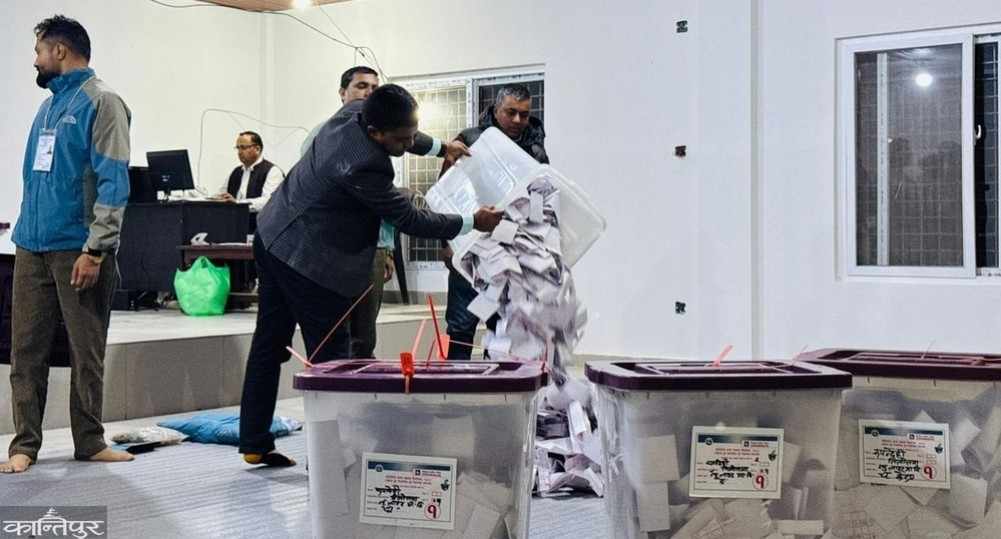
The preliminary results of the preliminary vote counting for the House of Representatives election have started coming in. The preliminary results of the vote counting for the House of Representatives election held on Thursday have started coming in since Friday morning. This time, the turnout has been the lowest since 2048.
According to the preliminary details of the voting released by the Election Commission on Thursday night, 58.07 percent of voters voted in the election. According to the preliminary data released by the Election Commission on Thursday night at 11 pm, it is seen that there was low voting. According to the data collected by the Commission, which has collected district-wise details, about 58 percent voted. 'This data has been prepared on the basis of verbal and written details received from the districts. If additional details are received from the offices of the Chief Electoral Officer and the Election Officer, it will be done accordingly,' the Commission has written in the 'note' of the data released.
The commission has said that it will make public the full details of the voting percentage by Friday evening. According to the preliminary details of the Election Commission, 19.77 million 711 people out of 18.9 million 3,689 voters have voted. This is 58.07 percent overall.
Although the election this time was held peacefully, the turnout was lower than in the elections since 2048. In 2048, 65.15 percent voted, in 2051 61.86 percent, in 2056 65.79 percent voted. In 2064 61.7 percent, in 2070 78.34 percent, in 2074 68.67 percent and in the elections held in 2079 61 percent voted.
Looking at the voting status of this election of the House of Representatives by province, 58.62 percent of the votes were cast in Koshi Province, 58.39 percent in Madhesh, 60.93 percent in Bagmati, and 54.92 percent in Gandaki. Similarly, 59.91 percent was cast in Lumbini, 55.66 percent in Karnali, and 51.40 percent in Sudurpaschim.
The lowest voter turnout was 39.39 percent in Achham. 40.41 percent in Dhanusha, 40.88 percent in Doti, and 42.85 percent in Khotang voted. The highest voter turnout was 71.46 percent in Bhaktapur. Other districts with the highest voter turnout are Parsa (68.43 percent), Lalitpur (68.22 percent), Nawalparasi Susta Paschim (67.80 percent), Kathmandu (67.01 percent), and Dolpa (66.17 percent). Voters have boycotted the election in 2-2 polling stations in Darchula and Dang and 1-1 in Dolakha and Okhaldhunga.
Speculations have also come to the fore as to why the turnout was low. The government, the Election Commission and election experts have given various arguments for the low turnout this time.
Acting Chief Election Commissioner Ram Prasad Bhandari said that there is no concrete reason for the low turnout this time. ‘This time the election was held amidst confusion. The voting may have decreased due to the uncomfortable situation,’ he argued.
Home Minister Om Prakash Aryal, however, argued that the low percentage was due to fair voting this time. ‘Earlier, booths were captured, votes were also cast in the names of dead people and people living abroad,’ Aryal said. ‘In some centers in Dolakha and Syangja, 98-99 percent of the votes were cast. Now, we have completely stopped unwanted activities. It is reported that 52 percent of the votes were cast in Syangja this time. This is the current reality, not the previous one.’
Former Chief Election Commissioner Bhojraj Pokharel says that there could be three main reasons for the low voter turnout this time. ‘The uncertainty and panic before the election, the inability of Nepalis living abroad to participate significantly, and the lack of willpower of citizens to go to the polling station may have reduced the voter turnout,’ he says. ‘Other small reasons may have also affected the voter turnout.’
Former Chief Election Commissioner Pokharel says that the high level of voter participation should be taken as enthusiasm. ‘Even from the announcement of the election to the registration of candidacies, there was uncertainty about whether the election would be held on the scheduled date,’ he said. Stating that democracy, adult suffrage and democracy were victorious in the election, he said that now he has gained confidence that the constitution will be ‘leaked’.
Pokharel said that voters should go elsewhere He believes that some groups have called for a boycott of the election, that there are those who say that the election is not necessary or right, and that there is a lack of voters due to infighting between parties. Similarly, Pokharel argues that the two major political parties, the then establishment faction of the CPN-UML and the Nepali Congress, filed a writ petition in the Supreme Court for the restoration of the parliament. He believes that the involvement of those celebrities who were waiting for the court to restore it has also had some impact.
Similarly, Pokharel estimates that the people may not have gone to the polling stations due to their reluctance to vote in two or three years.
Former Chief Election Commissioner and election observer Surya Prasad Shrestha said that the low voter turnout was due to the inability of Nepalis living abroad to come, fear of insecurity, and lack of trust in democracy and the electoral system.
‘There was an atmosphere of panic among the people until a few days before the election. Initially, there were rumors that the election would not take place. The parties did not speak openly and the talk of restoring the parliament also came in the form of rumors. Voters were never confident about the election,’ he said. ‘The election was held at a time when faith in democracy was weak. There was not much faith and enthusiasm for the electoral system.’